In-cell discovery and characterization of a non-canonical bacterial protein translocation-folding complex.
Cryo-electron tomography has emerged as a powerful technology for in-cell structural biology and, in combination with breakthroughs in protein structure prediction, offers a unique opportunity for illuminating functions of previously uncharacterized macromolecular complexes. Here, we used the genome-reduced bacterium Mycoplasma pneumoniae as a minimal cell model and determined in-cell maps of an unknown complex located at the cell surface. By combining proteomics, structure prediction, integrati
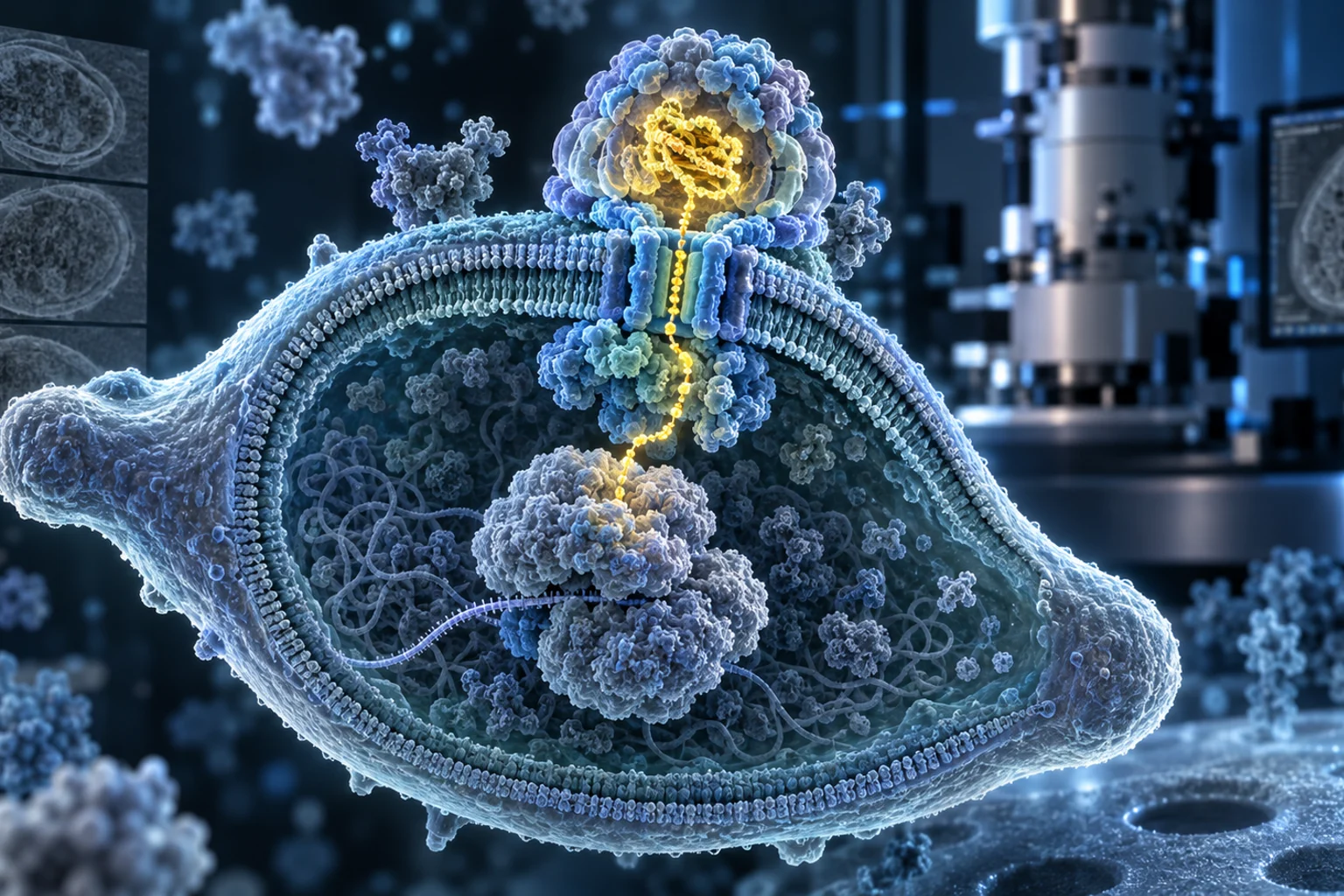
Cryo-electron tomography has emerged as a powerful technology for in-cell structural biology and, in combination with breakthroughs in protein structure prediction, offers a unique opportunity for illuminating functions of previously uncharacterized macromolecular complexes. Here, we used the genome-reduced bacterium Mycoplasma pneumoniae as a minimal cell model and determined in-cell maps of an unknown complex located at the cell surface. By combining proteomics, structure prediction, integrative modeling, and bioinformatics, we identified the complex to include the conserved Sec-translocon and an extracellular dome-like structure largely formed by three uncharacterized proteins (Mdps). The Mdps show structural homology to the periplasmic ATP-independent foldase PrsA, with Mdp444 retaining key catalytic residues and activity. Our study provides the first sub-nanometer-resolution maps of the complete bacterial Sec-translocation machinery, depicting its association in SecA-mediated co-translational translocation and its coordination with an extracellular protein-folding system.