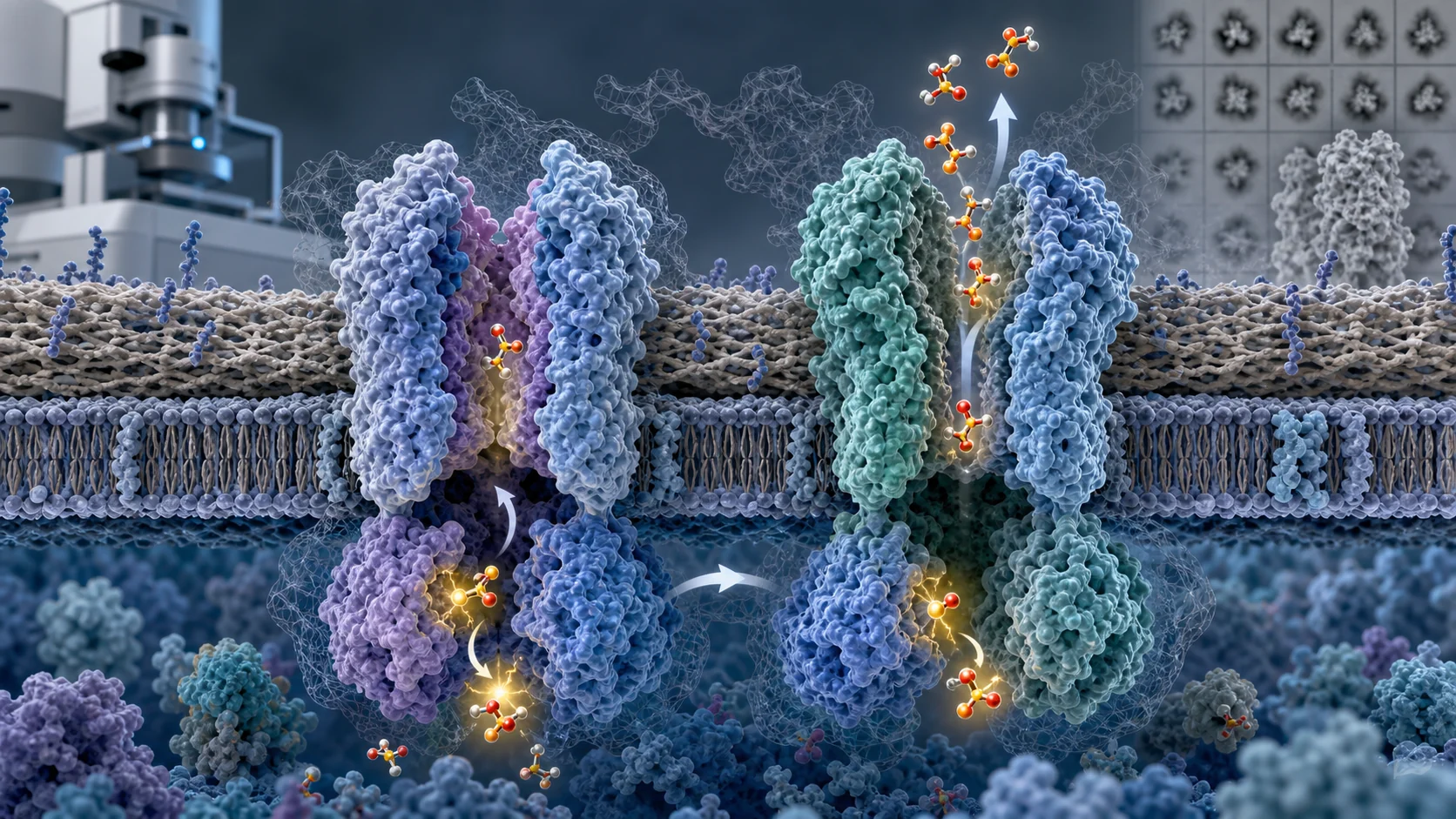
Sliding-before-breaking governs deformation in chitinous extracellular matrices reinforced by strong, fatigue-resistant chitin.
Many fibrous biological materials combine high strength with the ability to undergo permanent shape change, a balance that remains difficult to replicate synthetically. In twisted, plywood-like architectures, the origin of irreversible deformation remains unresolved: does strain arise from covalent bond scission or from coordinated interfacial processes across hierarchical scales? Here, we use the chitin-based protective tubes of vestimentiferan deep-sea tubeworms ( Siboglinidae: Vestimentifera
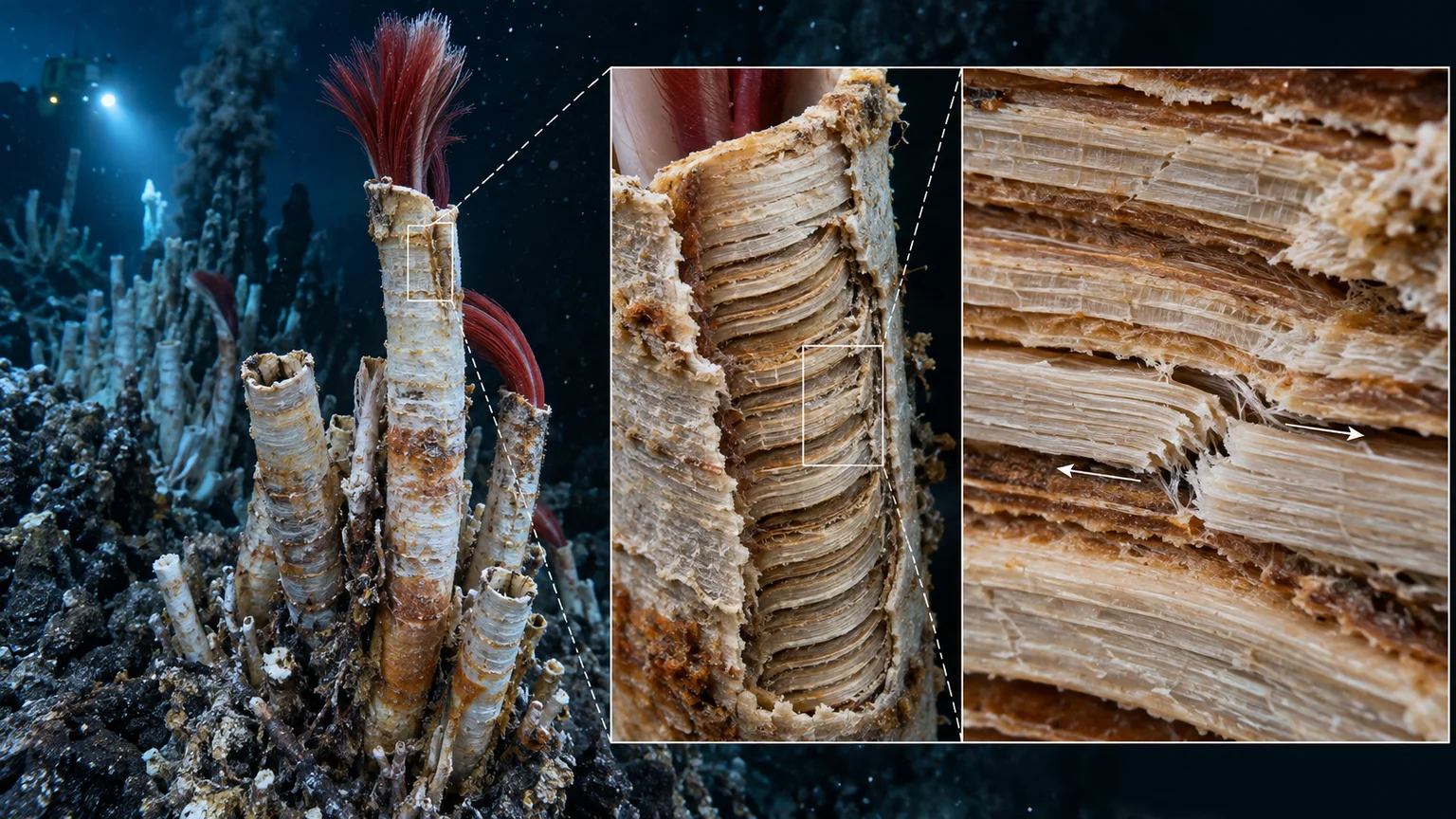
Many fibrous biological materials combine high strength with the ability to undergo permanent shape change, a balance that remains difficult to replicate synthetically. In twisted, plywood-like architectures, the origin of irreversible deformation remains unresolved: does strain arise from covalent bond scission or from coordinated interfacial processes across hierarchical scales? Here, we use the chitin-based protective tubes of vestimentiferan deep-sea tubeworms ( Siboglinidae: Vestimentifera ) as a model system to address this question. By integrating multiscale simulations with experimental measurements, we show that the chitin covalent backbone resists tensile rupture and exhibits negligible fatigue under physiologically relevant loading. Instead, mechanical stress is dissipated through controlled sliding within and between chitin nanostructures as well as across chitin-protein interfaces, leading to cumulative, irreversible deformation across length scales. Covalent bond rupture of chitin, the primary load-bearing component of the tube, becomes energetically accessible only when mechanical loading acts in concert with enzyme-mediated bond cleavage. These findings establish a sliding-before-breaking principle, in which backbone stability preserves structural integrity while regulated interfacial sliding governs energy dissipation and growth. This principle provides a general framework for the design of hierarchical materials that combine fatigue resistance with adaptive deformation.