Cellular remodeling during reversible life-stage transition in sessile ciliates: Genomic and transcriptomic insights.
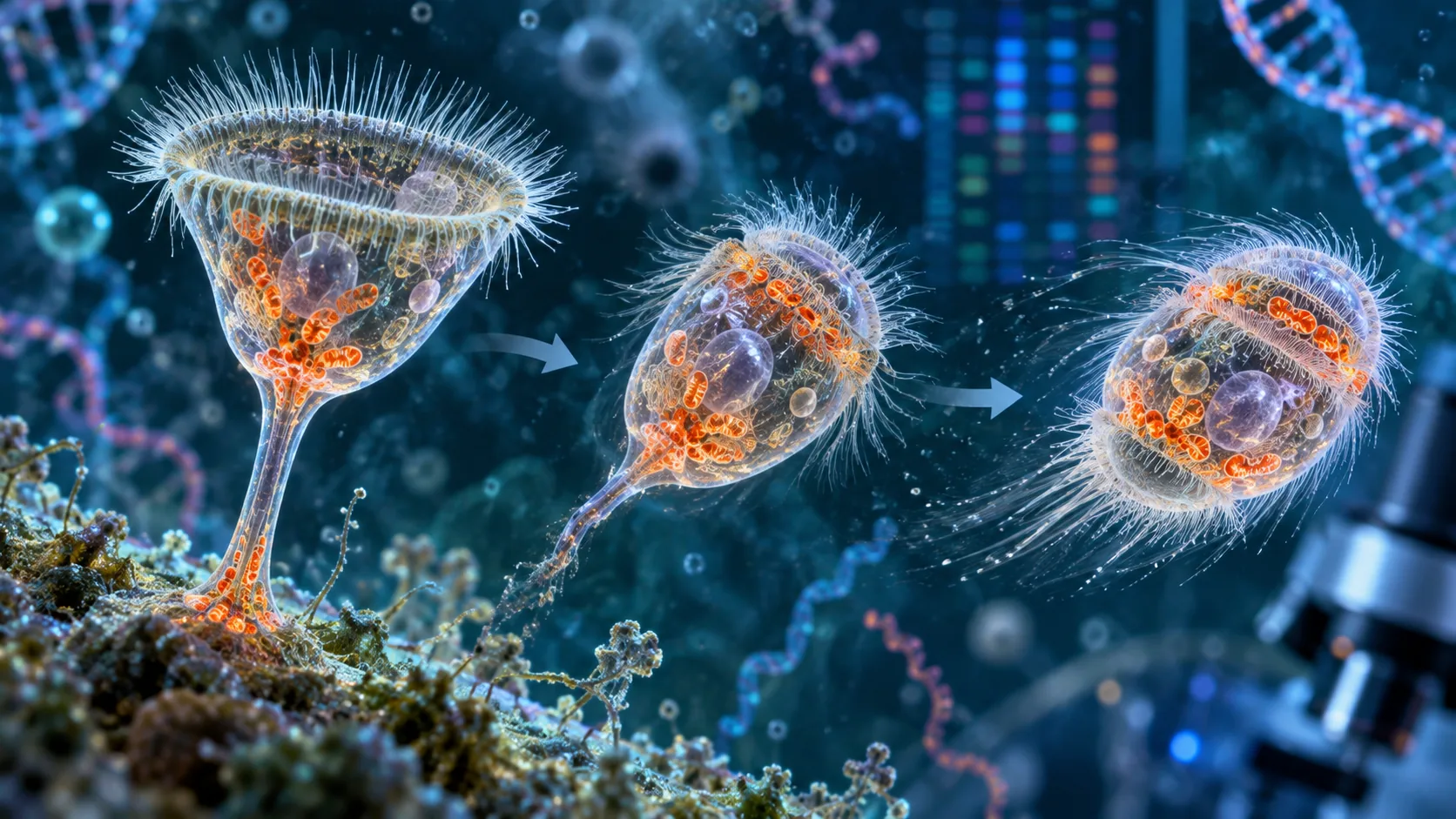
Unraveling mechanisms driving dramatic life-stage transitions in response to environmental stress is central to understanding cellular adaptation. We studied a distinctive group of sessile ciliates that undergo profound morphological and organellar remodeling when transitioning from sessile trophonts to motile telotrochs. We generated chromosome-level genomes for two colonial species ( Campanella sinica , Epistylis hentscheli ) and one solitary species ( Vorticella campanula ), revealing genome
Unraveling mechanisms driving dramatic life-stage transitions in response to environmental stress is central to understanding cellular adaptation. We studied a distinctive group of sessile ciliates that undergo profound morphological and organellar remodeling when transitioning from sessile trophonts to motile telotrochs. We generated chromosome-level genomes for two colonial species ( Campanella sinica , Epistylis hentscheli ) and one solitary species ( Vorticella campanula ), revealing genome sizes of 41.30 to 60.37 Mb. Notably, minichromosomes (10 to 100 kb) represent a shared, distinct chromosomal architecture across all three species. We constructed a transcriptional atlas by profiling five transitional stages, revealing core gene sets linked to transcriptional regulation, cilia, cytoskeletal dynamics, and metabolism. Intermediate stages converge on conserved genes driving structural and energetic turnover, including polyubiquitin and the mitochondrial regulator CHCHD2 . Furthermore, we uncovered metabolic reprogramming and active spatial mobilization of mitochondria tailored to fuel these extreme morphological shifts. During structural remodeling, the mitochondrial genome exhibits asymmetric regulation-coordinating the upregulation of translational and early respiratory machineries with the downregulation of terminal electron transport potentially mitigating oxidative stress. Crucially, in vivo imaging physically corroborates this transcriptomic priming, revealing a marked increase in mitochondrial density and their targeted redistribution to regions of high ATP demand. Conversely, during stalk biosynthesis, organellar regulation selectively upregulates the mitochondrial protein ymf66 to sustain prolonged translational and energetic demands. Ultimately, our findings highlight how ciliates integrate global transcriptomic shifts with organelle-specific spatial and metabolic fine-tuning to meet the precise mechanical requirements of complex life-cycle transitions.