Health & Medicine

Adapting the MasSpec Pen for noninvasive detection of oral cavity squamous cell carcinoma
| Source: PNAS

Oral Cavity Squamous Cell Carcinoma (OCSCC) is a common and deadly form of head and neck cancer which disproportionately afflicts low- and middle-income communities. Since the majority of OCSCC lesions are visible within the oral cavity, visual exam-guided biopsy remains the standard method for detection. However, visual examination can be subjective, biopsy can be painful, and pathological evaluation can be time consuming. With the goal of developing an accessible and noninvasive platform for O

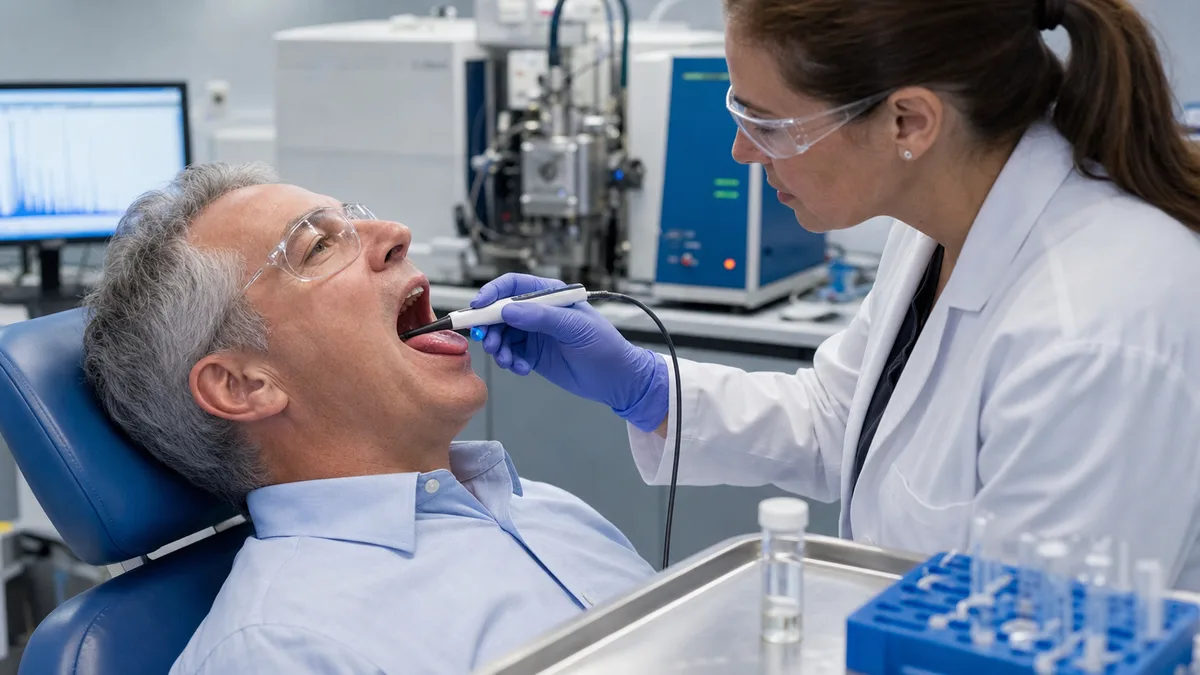
Oral Cavity Squamous Cell Carcinoma (OCSCC) is a common and deadly form of head and neck cancer which disproportionately afflicts low- and middle-income communities. Since the majority of OCSCC lesions are visible within the oral cavity, visual exam-guided biopsy remains the standard method for detection. However, visual examination can be subjective, biopsy can be painful, and pathological evaluation can be time consuming. With the goal of developing an accessible and noninvasive platform for OCSCC detection, we adapted the MSPen technology as a modular system for direct molecular analysis of OCSCC in vivo. The modular MSPen (Mod-MSPen) system consists of a controller unit and a disposable handheld device that directly contacts tissues, performs gentle liquid extraction of molecules, and collects the sample in a vial for subsequent mass spectrometric analysis. We have used the Mod-MSPen to analyze OCSCC and normal oral tissues spanning various anatomical areas: tongue, buccal mucosa, gingiva, and floor of mouth. The molecular data obtained presented distinct trends in the abundances of metabolites such as glutamate, which was consistently observed in higher relative abundances in OCSCC tissues when compared to normal oral tissues. These trends were corroborated using mass spectrometry imaging, which revealed clear spatio-molecular differences in OCSCC and adjacent normal oral mucosa tissues. Statistical classifiers built from the data provided high performance for disease detection, with >95% agreement with standard histopathology. To evaluate clinical suitability, we also deployed the Mod-MSPen for in vivo analysis of OCSCC and normal oral tissues alongside clinical procedures.

Read the original source →

Related Stories

Health & Medicine

Palmitoylation of TK1 exacerbates osteoarthritis by promoting JNK-mediated metabolic reprogramming.

Osteoarthritis (OA) lacks approved disease-modifying therapies. Here, by integrating quantitative proteomics with reanalysis of public single-cell RNA sequencing data from human articular cartilage, we identify thymidine kinase 1 (TK1) as a pathogenic regulator linking inflammatory stress to metabolic rewiring and matrix breakdown. TK1 is markedly upregulated in OA chondrocytes. Mechanistically, IL-1β enhances S-palmitoylation of TK1 at Cys153, which promotes USP9X-dependent deubiquitinati

Continue reading
Health & Medicine

Cryoelectron tomography reveals an age-related decline in mitoribosomes that contributes to T cell dysfunction in older individuals.

Mitochondrial dysfunction drives T cell aging in mice. Yet, due to fundamental differences in T cell aging mechanisms between species, whether human T cells exhibit similar mitochondrial alterations remains unclear, with existing evidence often conflicting. Using cryoelectron tomography, we resolved the structure and spatial organization of mitochondrial ribosomes in primary human CD8 + T cells under physiological conditions. Comparative analysis with human aging models revealed an age-related r

Continue reading
Health & Medicine

RelB NF-κB tunes Notch2 signaling to promote IL-23-secreting solitary isolated lymphoid tissue-resident DCs critical for gut immunity.

While preserving tolerance toward commensals, dendritic cells (DCs) also orchestrate response against pathogens. The noncanonical RelB NF-κB pathway in DCs curbs tolerogenic Tregs in the intestine. Whether RelB-dependent DC regulations also impact intestinal immunity remains less clear. Here, we show that genetic ablation of RelB in DCs compromises IL-23-dependent immune response in the intestine, imparting vulnerability in Relb ΔCD11c mice to infection with Citrobacter rodentium , a

Continue reading
Health & Medicine

X-linked SYTL4 missense variant disrupts RAB27A-dependent vesicle trafficking and synaptic transmission in autism.

Autism spectrum disorder (ASD) is a neurodevelopmental condition characterized by impaired social communication and repetitive behaviors, with genetic studies implicating widespread synaptic dysfunction. However, the contribution of presynaptic vesicle trafficking mechanisms to ASD pathogenesis remains incompletely understood. Here, we identify synaptotagmin-like protein 4 (SYTL4), a RAB27A effector previously characterized in secretory cells, as a regulator of presynaptic function in the mammal

Continue reading
Health & Medicine

Folic acid prevention of neural tube defects requires retinoic acid produced by ALDH1L1.

Folic acid (FA) supplementation during pregnancy is the commonly accepted treatment to prevent neural tube defects. The mechanism by which FA prevents neural tube defects (NTDs) remains unclear. FA also prevents other developmental malformations, including alcohol-induced malformations in Fetal Alcohol Syndrome models. We show that FA acts through a metabolic link to retinoic acid (RA) signaling. Using a pax3 -knockdown Xenopus model of FA-rescuable NTDs, we show that RA or its precursors equall

Continue reading