Artificial Intelligence

Viral protease-initiated lytic cell death as a universal antiviral mRNA therapy.
| Source: Cell

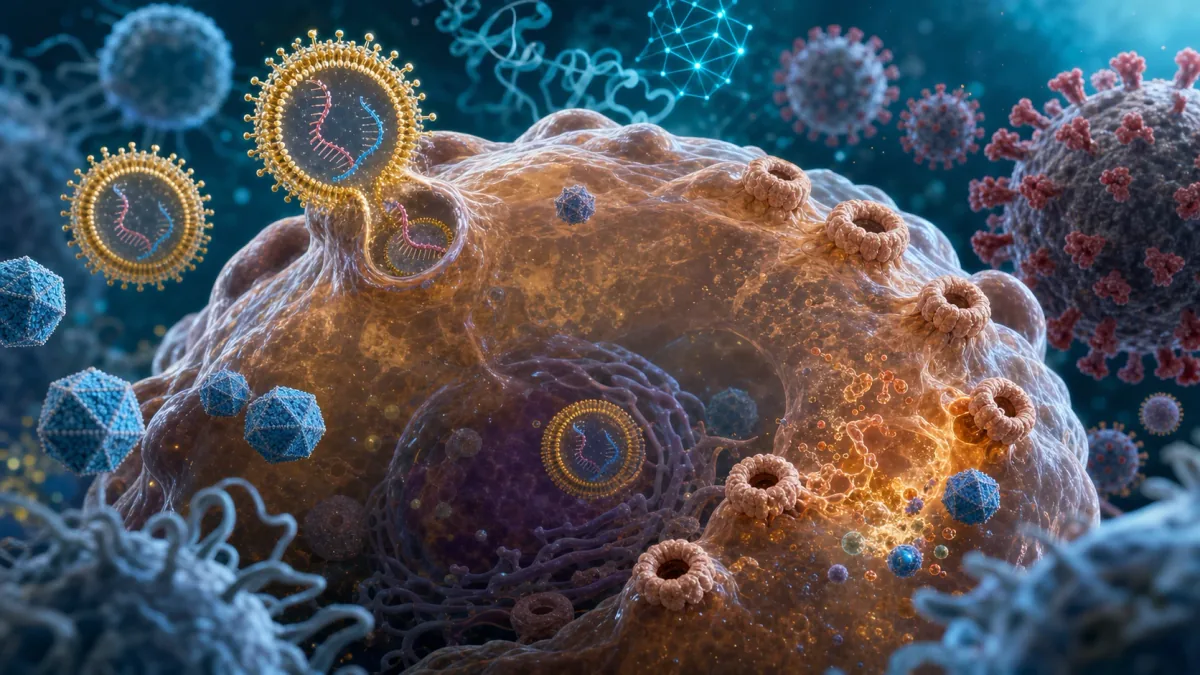
While gasdermin (GSDM)-mediated pyroptosis is a potent immune effector, its antiviral potential remains largely untapped. Here, we introduce viral protease-initiated lytic cell death (VID), a universal mRNA therapeutic platform inspired by the modular architecture of GSDM and the clinical success of mRNA vaccines. By engineering gasdermin-D (GSDMD) to harbor viral protease-specific cleavage motifs, we generated VID activators (VIDAs) that selectively trigger lytic cell death in virus-infected ce

While gasdermin (GSDM)-mediated pyroptosis is a potent immune effector, its antiviral potential remains largely untapped. Here, we introduce viral protease-initiated lytic cell death (VID), a universal mRNA therapeutic platform inspired by the modular architecture of GSDM and the clinical success of mRNA vaccines. By engineering gasdermin-D (GSDMD) to harbor viral protease-specific cleavage motifs, we generated VID activators (VIDAs) that selectively trigger lytic cell death in virus-infected cells. Using hepatitis A virus (HAV) as a model, lipid nanoparticle (LNP)-encapsulated VIDA mRNA abolished viral replication and shedding in vivo and mitigated liver injury through a coordinated "kill-and-alert" mechanism that primes bystander immunity. The platform's versatility was further demonstrated against Zika virus (ZIKV) and SARS-CoV-2. Leveraging a generative artificial intelligence (AI) framework, we designed de novo cleavage motifs for the SARS-CoV-2 main protease, yielding optimized VIDAs with superior antiviral potency. Collectively, our study establishes VIDA mRNA as a versatile, broadly applicable strategy for combating diverse viral threats.


Read the original source →

Related Stories

Artificial Intelligence

PLK1-mediated phosphorylation of PHGDH reprograms serine metabolism in advanced prostate cancer.

Metabolic reprogramming is a hallmark of cancer, enabling tumor cells to meet their increased biosynthetic and energetic demands. Although cells possess the capacity for de novo serine biosynthesis, most transformed cancer cells preferentially rely on exogenous serine uptake to sustain their growth, yet the regulatory mechanisms driving this metabolic dependency remain poorly understood. Here, we uncover a mechanism by which Polo-like kinase 1 (PLK1), frequently overexpressed in prostate cancer,

Continue reading
Artificial Intelligence

When coordination is avoidable: A monotonicity analysis of organizational tasks.

Organizations devote substantial resources to coordination, yet which tasks actually require it for correctness remains unclear. The problem is acute in multiagent AI systems, where coordination cost is directly measurable and can exceed the cost of the work itself. Distributed systems theory provides a precise criterion: Coordination is required when a task specification is nonmonotonic, meaning that as histories grow, new information can invalidate prior conclusions. Here we show that Thompson

Continue reading
Artificial Intelligence

Dapagliflozin and Acute Kidney Injury Following Cardiac Surgery: A Randomized Clinical Trial.

Two percent to 50% of patients undergoing elective cardiac surgery experience acute kidney injury (AKI) postoperatively. Medications to prevent AKI after elective cardiac surgery have not been identified. In patients undergoing elective cardiac surgery, to evaluate whether initiating dapagliflozin 1 day prior to surgery reduces the incidence of AKI at 7 days after cardiac surgery, compared with placebo. Multicenter, double-blind, placebo-controlled randomized clinical trial conducted at 2 academ

Continue reading
Artificial Intelligence

Context-aware multimodal AI navigates hidden pathways in five centuries of art evolution.

The rise of multimodal generative AI transforms the intersection of technology and art, offering richer insights into large-scale artworks. While significant research has focused on their creative potential, their ability to represent artworks in latent spaces remains underexamined. We use generative AI, specifically Stable Diffusion, to analyze 500 y of Western paintings by extracting two types of latent information with the model: formal aspects (e.g., colors) and contextual aspects (e.g., sub

Continue reading
Artificial Intelligence

Advancing cancer detection and treatment using longitudinal routine clinical data.

Cancer management remains fragmented across its continuum, from late-stage diagnosis and salvage therapies to non-personalized surveillance. Here, we present Oncoformer, a unified multimodal transformer model trained on the China Oncology Multimodal Prediction and Surveillance Study (COMPASS) cohort (3.67 million individuals, 17.7 million clinical visits) and validated on independent external cohorts, including the UK Biobank. Oncoformer integrates longitudinal electronic health records with che

Continue reading