Artificial Intelligence

Data-driven discovery and rapid, direct synthesis of MXenes.
| Source: Science (New York, N.Y.)

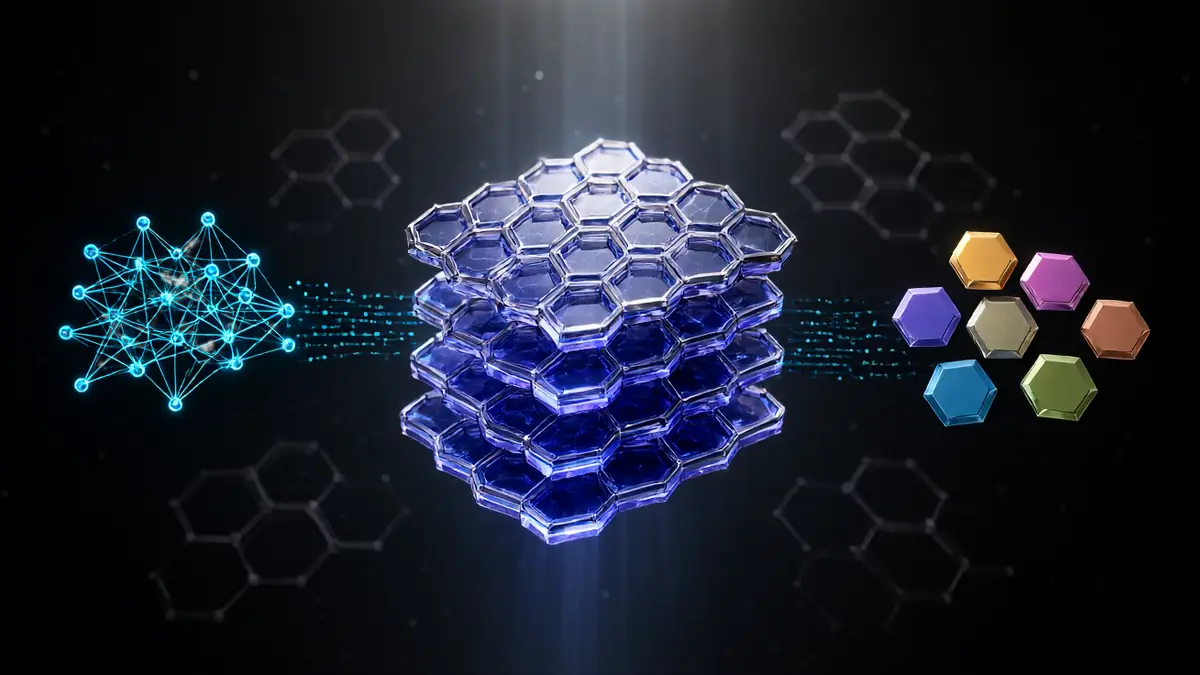
MXenes are a rapidly expanding family of two-dimensional transition metal carbides and nitrides, yet scalable synthesis routes remain limited and historical reports suggest a broader, largely unexplored chemical space. We used machine learning-assisted database mining to uncover hidden multilayer MXenes. Screening reveals 33 previously synthesized but unrecognized MXene candidates. Guided by these findings, we synthesized seven multilayer MXenes using a rapid, scalable self-propagating high-temp

MXenes are a rapidly expanding family of two-dimensional transition metal carbides and nitrides, yet scalable synthesis routes remain limited and historical reports suggest a broader, largely unexplored chemical space. We used machine learning-assisted database mining to uncover hidden multilayer MXenes. Screening reveals 33 previously synthesized but unrecognized MXene candidates. Guided by these findings, we synthesized seven multilayer MXenes using a rapid, scalable self-propagating high-temperature method that requires no sustained external heating and completes within minutes. We further realized 11 previously unexplored rare earth-based MXenes (M = praseodymium, neodymium, samarium, gadolinium, terbium, holmium, and thulium). Experiments and modeling suggest semiconducting behavior and diverse magnetic states across this family. Together, these results expand the MXene family and demonstrate a data-driven strategy for accelerating materials discovery through sustainable methods.

Read the original source →

Related Stories

Artificial Intelligence

Protein resource allocation across subcellular compartments revealed by large-scale absolute quantitative proteomics in yeast.

Subcellular compartmentalization within complex membrane-bound organelles is a hallmark of eukaryal life, enabling metabolic specialization through spatial segregation. Here, we compiled a dataset encompassing 300 absolute quantitative proteomes, the largest to date, across two yeast species under diverse experimental conditions. Leveraging big data analysis, formula fitting, and machine learning, quantitative correlations among protein abundance, resource allocation, and cellular phenotypes wer

Continue reading
Artificial Intelligence

Quantifying ancient architecture: Stone-level machine learning reveals architectural variation and settlement growth at Shivta.

Built environments provide durable evidence for how ancient settlements were organized, expanded, and transformed over time. Yet quantitative approaches to documenting architectural variability are generally labor-intensive, limited to individual structures, or dependent on aggregate volumetric estimates. We present a scalable, machine-learning-based framework that shifts the unit of analysis to the individual building stone and combines two complementary datasets: low-altitude drone imagery of

Continue reading
Artificial Intelligence

Intrinsic gestational timing governs human cerebellar development after preterm birth.

Intrinsic programs shape brain maturation; however, which of these programs are perturbed by prematurity as well as the molecular pathways involved remain unknown. The human cerebellum serves as a paradigm of extrauterine development-its accelerated growth and circuit formation align with the third trimester, a period disrupted by preterm delivery. Using multimodal datasets encompassing in vivo neuroimaging and neurodevelopmental outcomes with postmortem spatial-transcriptomic and histopathologi

Continue reading
Artificial Intelligence

CX3CL1 (fractalkine)-CX3CR1 interface drives CD8⁺ T cell-induced neurodegeneration in human brain organoids.

Immune-neuron interactions play a critical role in neuroinflammatory and neurodegenerative diseases, such as Alzheimer's disease (AD), but how CD8⁺ T cells contribute to brain pathology remains poorly understood. Amyloid-β (Aβ), a hallmark of AD, is known to trigger neuronal stress and inflammation. Here, we established a human cortical organoid (hCO) model to investigate CD8⁺ T cell responses to Aβ-induced neurodegenerative stress. Aβ exposure increased neu

Continue reading
Artificial Intelligence

Causality in liquid water as a hallmark of emergent glassy dynamics.

In molecular liquids such as water, time-delayed influences between microscopic or mesoscopic variables are typically probed using time-correlation functions, which are symmetric under detailed balance and therefore blind to dynamical asymmetries. Here, we characterize water's dynamics using a causal inference metric that captures asymmetric couplings between collective variables. Analyzing equilibrium molecular dynamics simulations at ambient conditions and in the high-density liquid (HDL) regi

Continue reading