Ultrabright Near-Infrared Lead-Free Perovskite Light-Emitting Diodes with Negligible Efficiency Roll-Off.
Lead-free halide perovskite semiconductors show great promise for light-emitting diodes (LEDs), benefiting from tunable optoelectronic properties and solution processability. However, their practical applications in high-current-density LEDs are fundamentally constrained by severe efficiency roll-off, primarily caused by nonradiative recombination and carrier-induced structural instabilities. In this study, we introduce a molecular N , N '-diphenylthiourea (DPTA)-engineered tin perovskite semico
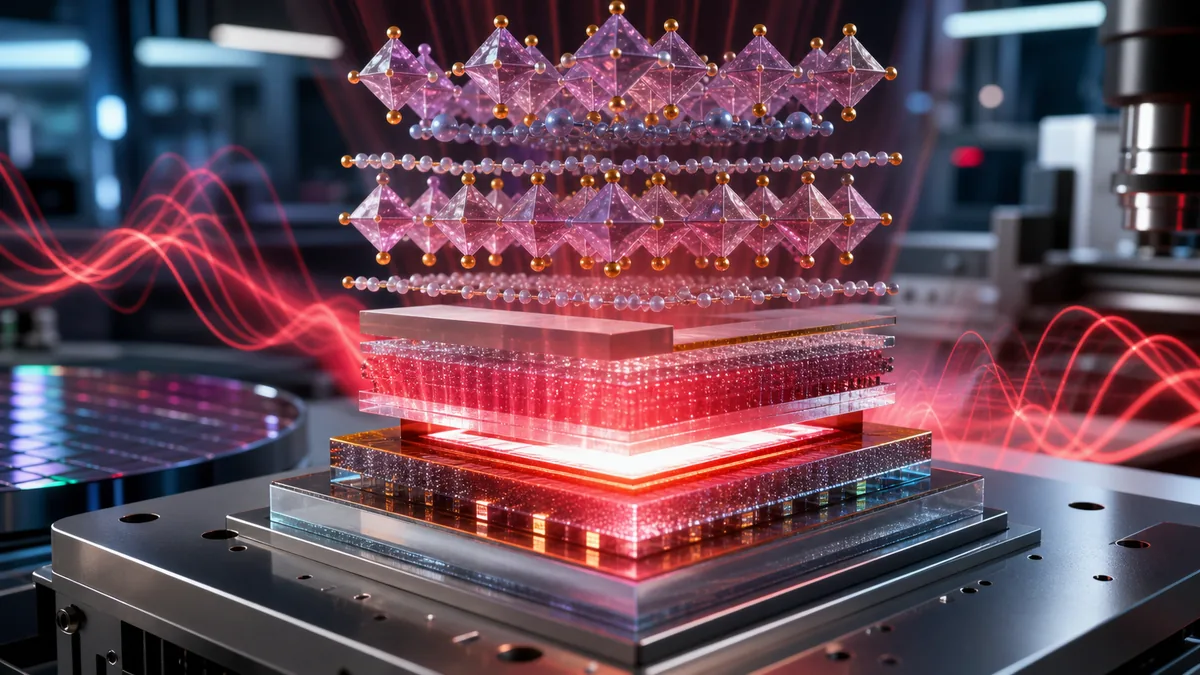
Lead-free halide perovskite semiconductors show great promise for light-emitting diodes (LEDs), benefiting from tunable optoelectronic properties and solution processability. However, their practical applications in high-current-density LEDs are fundamentally constrained by severe efficiency roll-off, primarily caused by nonradiative recombination and carrier-induced structural instabilities. In this study, we introduce a molecular N , N '-diphenylthiourea (DPTA)-engineered tin perovskite semiconductor (CsSnI 3 ) that achieves a photoluminescence quantum efficiency (PLQE) of 36% at a carrier concentration of 10 18 cm -3 . Our approach enables precise control over the charge-carrier concentration and lattice growth. High-resolution transmission electron microscopy further demonstrates that the uniform local strain distribution in the doped films enhances carrier wave-function overlap, leading to a substantial boost in PLQE. Leveraging the enhanced optoelectronic properties of DPTA-treated CsSnI 3 , we fabricate near-infrared LEDs that exhibit an external quantum efficiency (EQE) of 13.4% and an unprecedented peak radiance of 1248 W sr -1 m -2 , with minimal efficiency roll-off even at high current densities exceeding 3500 mA cm -2 in pulse-mode operation. This work introduces a new material-doping strategy for lead-free perovskites, demonstrating their potential for high-power optoelectronic applications and advancing the feasibility of electrically pumped perovskite laser diodes.