Ultra-narrowband organic room-temperature phosphorescence achieved by boosting low-frequency vibronic coupling.
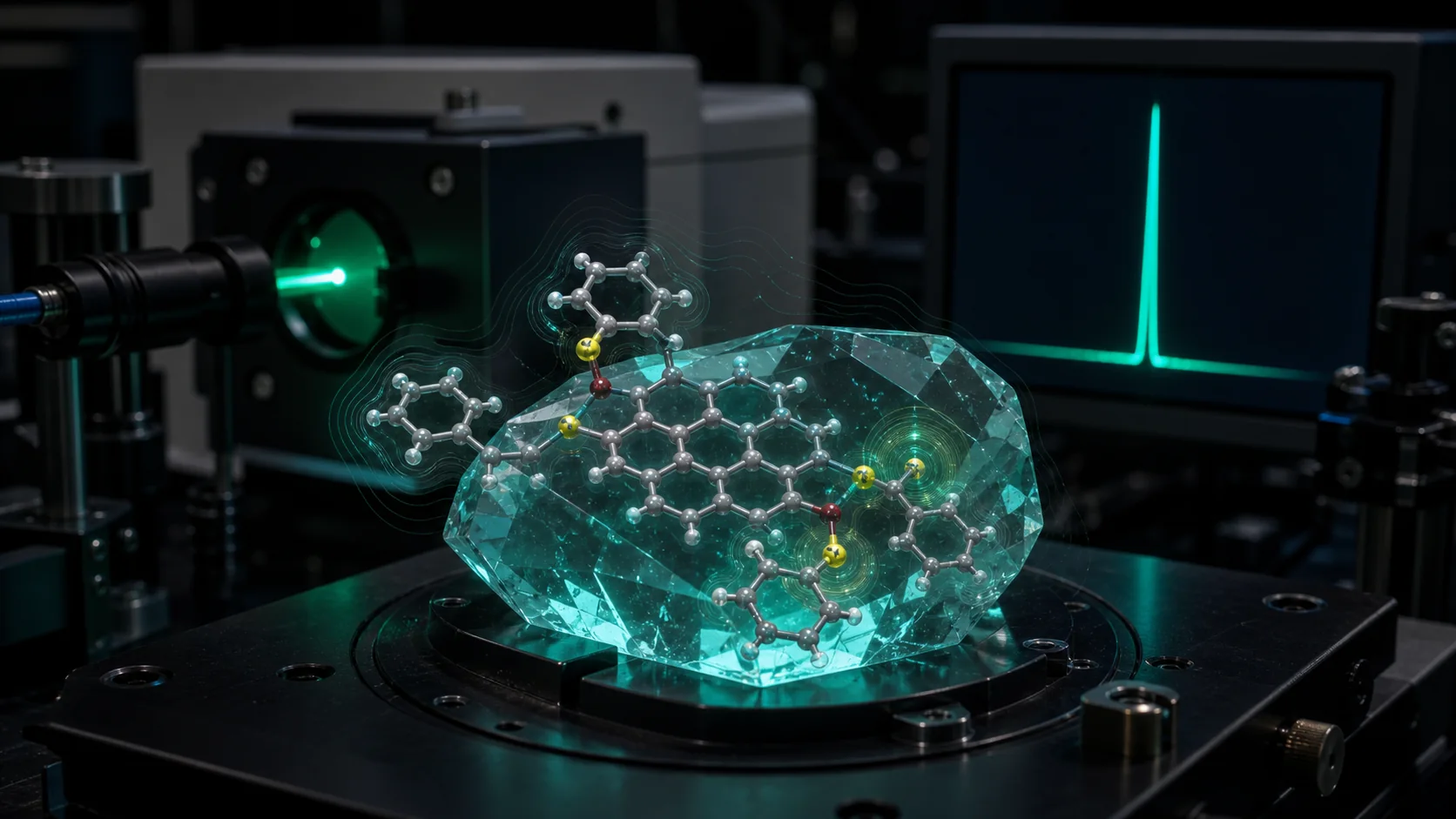
We pioneered a strategy based on low-frequency vibronic coupling to design narrowband room-temperature phosphorescent (RTP) materials. Here we select coronene derivative (CoDe) system and report that attaching aroyl group to the coronene core disrupts its intrinsic symmetry and introduces abundant low-frequency vibrational modes, thereby affording efficient room-temperature phosphorescence with a full width at half maximum (FWHM) of approximately 25 nm or narrower. In CoDe systems functionalized
We pioneered a strategy based on low-frequency vibronic coupling to design narrowband room-temperature phosphorescent (RTP) materials. Here we select coronene derivative (CoDe) system and report that attaching aroyl group to the coronene core disrupts its intrinsic symmetry and introduces abundant low-frequency vibrational modes, thereby affording efficient room-temperature phosphorescence with a full width at half maximum (FWHM) of approximately 25 nm or narrower. In CoDe systems functionalized with additional thioether groups, ultra-narrowband organic phosphorescence materials with exceptionally small FWHM (9.6 nm), high afterglow efficiency (50%), and long phosphorescence lifetimes (1.5 s) are achieved in host matrices under ambient conditions. Mechanistic studies reveal that this spectral narrowing relates to the selective amplification of low-frequency vibronic coupling through a moderate heavy-atom effect provided by the thioether groups. Equally crucial would be the suppression of excited-state relaxation and spectral broadening via relatively strong noncovalent interactions between the thioether groups and the host matrices (sulfur bonding interactions) at room temperature.