Health & Medicine

The next generation of antibody-drug conjugates.
| Source: Nature medicine

Antibody-drug conjugates (ADCs)-composed of a monoclonal antibody linked to a payload-were designed to deliver high concentrations of cytotoxic agents to cancer cells. Since their inception, a deeper understanding of the mechanisms of action and resistance to ADCs in patients has generated a wealth of advances in the chemistry of ADC constructs, together with rational therapeutic combinations. However, the pace of innovation now exceeds clinical trial capacity. Also, any single modification or c

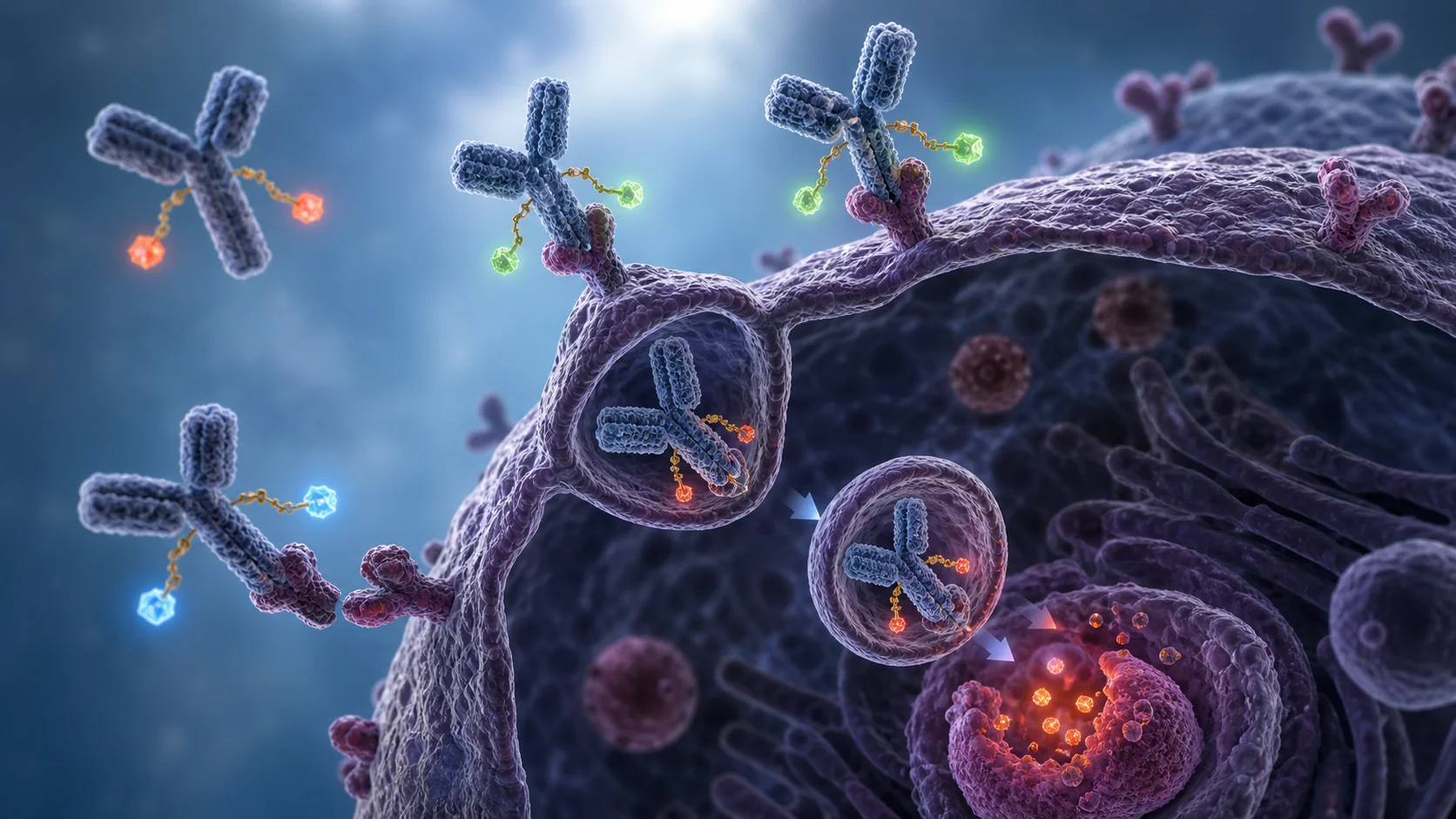
Antibody-drug conjugates (ADCs)-composed of a monoclonal antibody linked to a payload-were designed to deliver high concentrations of cytotoxic agents to cancer cells. Since their inception, a deeper understanding of the mechanisms of action and resistance to ADCs in patients has generated a wealth of advances in the chemistry of ADC constructs, together with rational therapeutic combinations. However, the pace of innovation now exceeds clinical trial capacity. Also, any single modification or combination is unlikely to generate clinically meaningful benefit on its own. In this context, there is a need to integrate multiple chemistry advances into individual ADCs and to develop frameworks, infrastructures and tools to accelerate and de-risk the preclinical and early clinical development of these agents. In addition, the development of multidimensional molecular tools to predict ADC sensitivity, together with the optimal use of new ADCs in early-stage cancers, should contribute to improved outcomes for patients. We discuss these opportunities and challenges and predict that in the longer term, the development of diversified ADC libraries incorporating distinct constructs and drug-to-antibody ratios will enable personalized treatment strategies aligned with individual tumor biology.
Read the original source →

Related Topics

Related Stories

Health & Medicine

Palmitoylation of TK1 exacerbates osteoarthritis by promoting JNK-mediated metabolic reprogramming.

Osteoarthritis (OA) lacks approved disease-modifying therapies. Here, by integrating quantitative proteomics with reanalysis of public single-cell RNA sequencing data from human articular cartilage, we identify thymidine kinase 1 (TK1) as a pathogenic regulator linking inflammatory stress to metabolic rewiring and matrix breakdown. TK1 is markedly upregulated in OA chondrocytes. Mechanistically, IL-1β enhances S-palmitoylation of TK1 at Cys153, which promotes USP9X-dependent deubiquitinati

Continue reading
Health & Medicine

Cryoelectron tomography reveals an age-related decline in mitoribosomes that contributes to T cell dysfunction in older individuals.

Mitochondrial dysfunction drives T cell aging in mice. Yet, due to fundamental differences in T cell aging mechanisms between species, whether human T cells exhibit similar mitochondrial alterations remains unclear, with existing evidence often conflicting. Using cryoelectron tomography, we resolved the structure and spatial organization of mitochondrial ribosomes in primary human CD8 + T cells under physiological conditions. Comparative analysis with human aging models revealed an age-related r

Continue reading
Health & Medicine

RelB NF-κB tunes Notch2 signaling to promote IL-23-secreting solitary isolated lymphoid tissue-resident DCs critical for gut immunity.

While preserving tolerance toward commensals, dendritic cells (DCs) also orchestrate response against pathogens. The noncanonical RelB NF-κB pathway in DCs curbs tolerogenic Tregs in the intestine. Whether RelB-dependent DC regulations also impact intestinal immunity remains less clear. Here, we show that genetic ablation of RelB in DCs compromises IL-23-dependent immune response in the intestine, imparting vulnerability in Relb ΔCD11c mice to infection with Citrobacter rodentium , a

Continue reading
Health & Medicine

X-linked SYTL4 missense variant disrupts RAB27A-dependent vesicle trafficking and synaptic transmission in autism.

Autism spectrum disorder (ASD) is a neurodevelopmental condition characterized by impaired social communication and repetitive behaviors, with genetic studies implicating widespread synaptic dysfunction. However, the contribution of presynaptic vesicle trafficking mechanisms to ASD pathogenesis remains incompletely understood. Here, we identify synaptotagmin-like protein 4 (SYTL4), a RAB27A effector previously characterized in secretory cells, as a regulator of presynaptic function in the mammal

Continue reading
Health & Medicine

Folic acid prevention of neural tube defects requires retinoic acid produced by ALDH1L1.

Folic acid (FA) supplementation during pregnancy is the commonly accepted treatment to prevent neural tube defects. The mechanism by which FA prevents neural tube defects (NTDs) remains unclear. FA also prevents other developmental malformations, including alcohol-induced malformations in Fetal Alcohol Syndrome models. We show that FA acts through a metabolic link to retinoic acid (RA) signaling. Using a pax3 -knockdown Xenopus model of FA-rescuable NTDs, we show that RA or its precursors equall

Continue reading