Projection-defined modules reveal mouse motor cortex architecture.
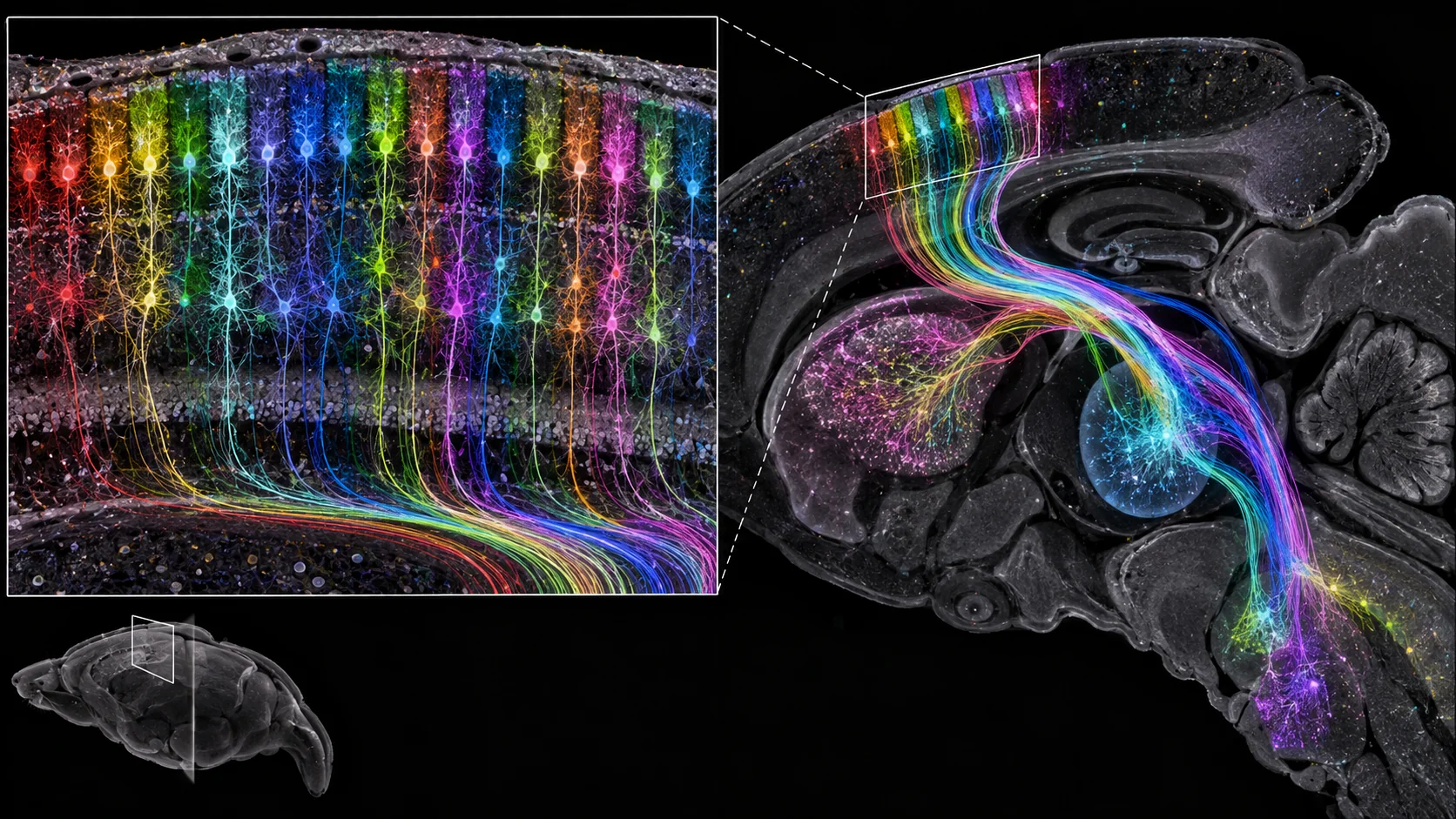
The motor cortex (MO) coordinates movement through its complex connectivity. However, despite evidence for functionally and anatomically distinct areas, organizing principles of MO lack consensus. Here, we show that the subcortical projections of mouse MO define 16 different modules. Subcortical output divergence aligns with variation in modular corticocortical connectivity and cell-type composition, delineating two spatial MO axes. Along one axis, primary MO couples reciprocally to somatosensor
The motor cortex (MO) coordinates movement through its complex connectivity. However, despite evidence for functionally and anatomically distinct areas, organizing principles of MO lack consensus. Here, we show that the subcortical projections of mouse MO define 16 different modules. Subcortical output divergence aligns with variation in modular corticocortical connectivity and cell-type composition, delineating two spatial MO axes. Along one axis, primary MO couples reciprocally to somatosensory cortex and secondary MO to frontal areas, with differential excitatory neuron compositions specifying the two regions. Along the orthogonal axis, somatosensory cortex inputs stratify modules, together with non-sensorimotor cortical wiring and aligned cell-type signatures. The cortical two-axis logic extends to subcortical targets, with the striatum, thalamus, and brainstem following distinct convergence-divergence rules, differentially integrating cortical inputs. Together, this work reveals a logic by which the anatomical architecture of the mouse MO integrates into brainwide and specific neuronal networks.