Health & Medicine

Multiscale Brownian dynamics simulations reveal effects of macromolecular crowding on protein-ligand association.
| Source: Proceedings of the National Academy of Sciences of the United States of America

Macromolecular crowding is known to influence the diffusive, binding, kinetic, and equilibrium properties of proteins in a range of environments such as occur inside biological cells or in highly concentrated solutions of protein therapeutics. However a quantitative understanding of the effects of macromolecular crowding on the rates of protein-small molecule binding is lacking. Here, we present an adaptive model to simulate the association of two solutes in a macromolecularly crowded environmen

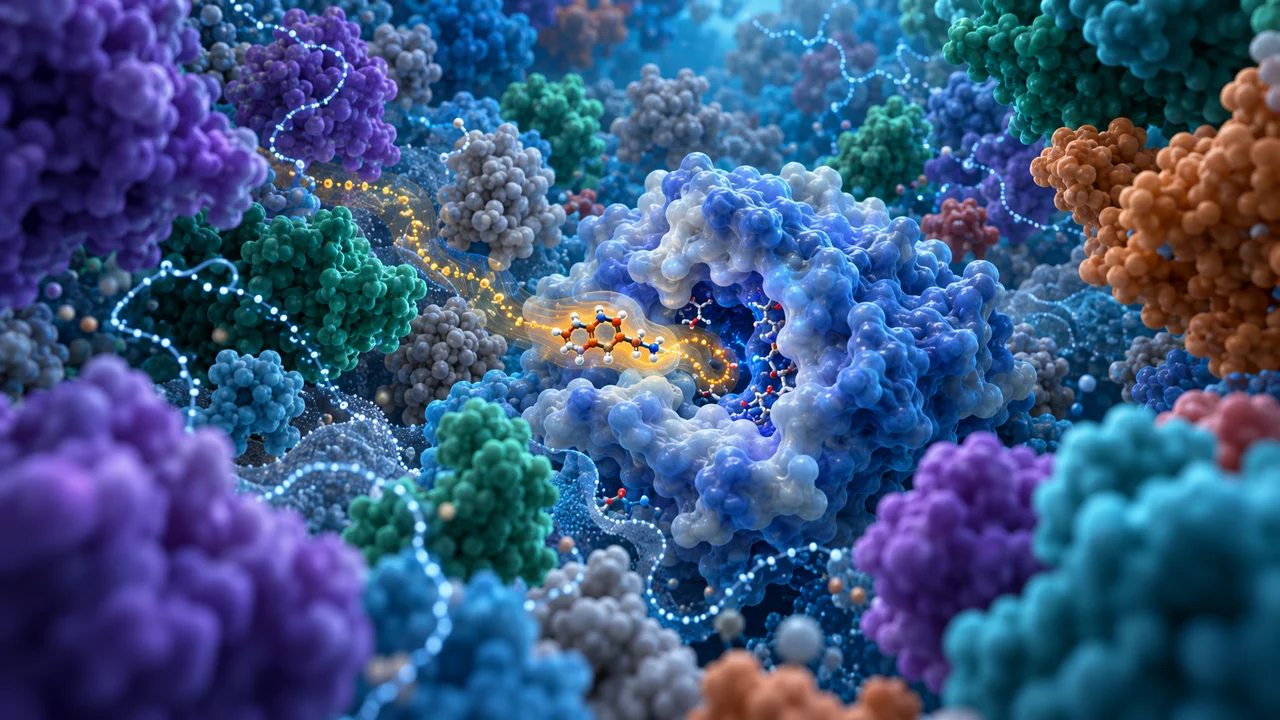
Macromolecular crowding is known to influence the diffusive, binding, kinetic, and equilibrium properties of proteins in a range of environments such as occur inside biological cells or in highly concentrated solutions of protein therapeutics. However a quantitative understanding of the effects of macromolecular crowding on the rates of protein-small molecule binding is lacking. Here, we present an adaptive model to simulate the association of two solutes in a macromolecularly crowded environment using Brownian dynamics and to compute the corresponding bimolecular association rate constant. The adaptive model represents interactions with atomistic detail for short-range crowder-noncrowder interactions, while using a coarse-grained approach for long-range crowder-noncrowder interactions and all crowder-crowder interactions. This multiscale approach is integrated in the Simulation of Diffusional Association (SDA) software for Brownian dynamics simulation of biomolecular diffusion. We applied this model to compute the rates of association for two contrasting protein-small molecule inhibitor complexes in environments varying in macromolecular crowder type and density, and we used Markov State modeling of the encounter trajectories to analyze the binding pathways. The results reveal competing effects: While the presence of the crowders can hinder ligand binding by reducing the translational diffusion rates of the solutes and obstructing the protein binding sites, crowders can also enhance the bimolecular association rate by other mechanisms, including channeling and the caging effect.

Read the original source →

Related Topics

Related Stories

Health & Medicine

An innervated and vascularized HNSCC-on-a-chip model built on defined and tunable engineered extracellular matrices.

Understanding the tumor microenvironment requires experimental platforms that faithfully recapitulate its key components. Here, we present an innervated and vascularized head and neck squamous cell carcinoma (HNSCC)-on-a-chip platform built with fully defined and tunable engineered extracellular matrices (eECMs). In a stepwise increase of complexity, we first cocultured patient-derived HNSCC cells, cancer-associated fibroblasts, and endothelial cells within tailored eECMs, revealing extracellula

Continue reading
Health & Medicine

Septin binding restricts Shigella growth and triggers intracellular tolerance.

Pathogen survival relies on their ability to adapt to changing environments, yet how intracellular bacteria tolerate cell-autonomous immunity remains unclear. Septins assemble into cage-like structures around cytoplasmic Shigella targeted by autophagy, but their antibacterial activity was unknown. Using advanced microscopy and cell-free reconstitution, we show that septins polymerize into circumferentially oriented filaments that inhibit bacterial growth. RNA-sequencing reveals that septin bindi

Continue reading
Health & Medicine

DCAF6 reprograms TGF-β responses through TRIM33 destruction.

TGF-β signaling plays a pivotal role in regulating numerous cellular processes, primarily through the Smad-dependent pathway. Disruptions of the pathway are associated with developmental disorders and life-threatening diseases, such as cancer. It has been reported that TRIM33 inactivates Smad4 signaling and also drives its own signaling responses. However, the mechanism controlling TRIM33 activity has remained unclear. In this study, we identify DCAF6 as a previously unrecognized ubiquitin

Continue reading
Health & Medicine

Origami state machine with time-varying magnetic fields.

Achieving reliable, remote control over multiple stable states in modular systems remains a challenge due to the coupling between modules and history-dependent transitions. Here, we present magnetic origami state machines that enable deterministic navigation from any unknown initial state to any target state under magnetic actuation. By assuming mutually distinct energy barriers in modular Kresling origami assemblies, we realize fully accessible transition graphs with scalable state spaces. Guid

Continue reading
Health & Medicine

Deep mutational scanning of the GPCR rhodopsin reveals pleiotropic mutational effects and their roles in modulating receptor signaling.

Biophysical pleiotropy, the phenomenon in which a mutation affects multiple protein properties, underlies many genetic diseases and shapes protein evolution, yet remains poorly understood, limiting synthetic biology and therapeutic development. Although extensively studied in soluble proteins, little is known about how pleiotropic effects shaped the evolution of receptor protein functions. Here, we developed a cell-based assay designed to assess pleiotropic effects in G protein-coupled receptors

Continue reading