Artificial Intelligence

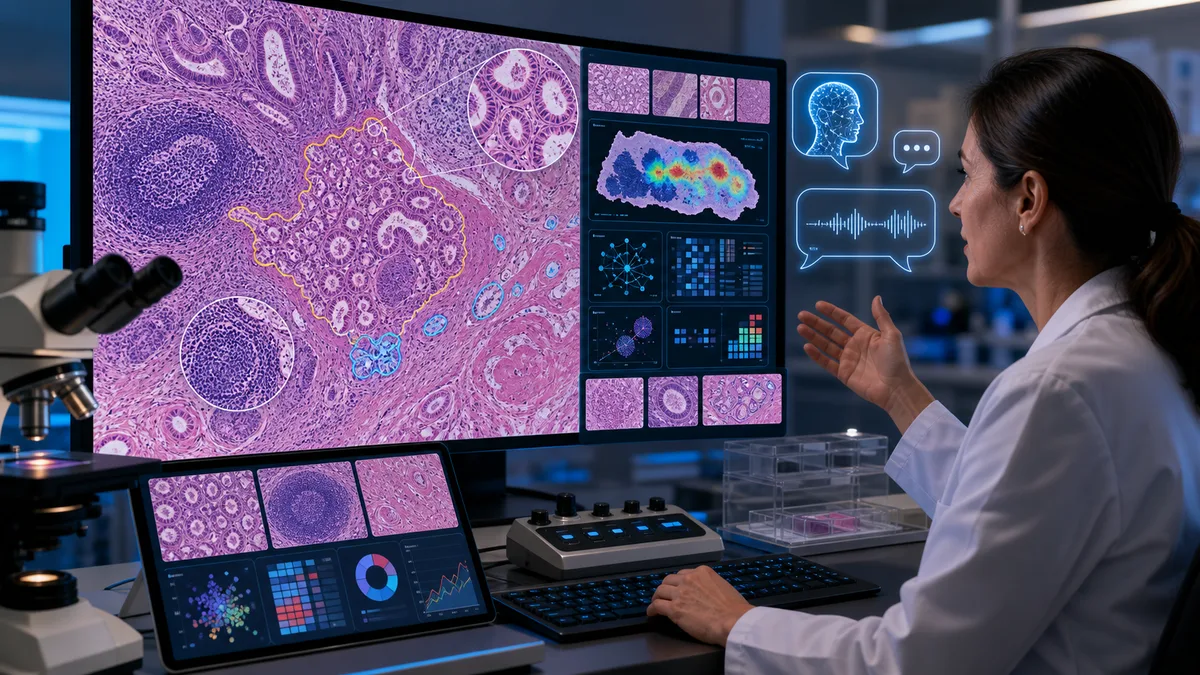
End-to-end multimodal pathology foundation model with clinical dialogue.
| Source: Nature medicine

Recent rapid progress in the field of computational pathology has been enabled by foundation models. These models are beginning to move beyond encoding image patches toward whole-slide understanding, but their clinical utility remains limited. Here we present PRISM2, a multimodal slide-level foundation model trained on 2.3 million whole-slide images and 14 million question-answer pairs derived from 700,000 pathology reports. Through clinical dialogue supervision, PRISM2 aligns histomorphology wi

Recent rapid progress in the field of computational pathology has been enabled by foundation models. These models are beginning to move beyond encoding image patches toward whole-slide understanding, but their clinical utility remains limited. Here we present PRISM2, a multimodal slide-level foundation model trained on 2.3 million whole-slide images and 14 million question-answer pairs derived from 700,000 pathology reports. Through clinical dialogue supervision, PRISM2 aligns histomorphology with diagnostic reasoning, yielding representations that support both prompt-based inference and transferable embeddings for downstream tasks. With prompt-based inference, PRISM2 achieves or exceeds (P < 0.05) the balanced accuracy of clinical-grade products calibrated for cancer detection in the prostate, breast and breast lymph node. Additionally, across comprehensive diagnostic, biomarker and survival benchmarks, PRISM2 embeddings never statistically underperform previous foundation models via linear probing (P < 0.05). Furthermore, task-specific fine-tuning on survival prediction outperforms training from scratch on the same large survival dataset. PRISM2 demonstrates how language-supervised pretraining provides a scalable, clinically grounded signal for generalizable pathology representations, bridging human diagnostic reasoning and foundation model performance.

Read the original source →

Related Stories

Artificial Intelligence

PLK1-mediated phosphorylation of PHGDH reprograms serine metabolism in advanced prostate cancer.

Metabolic reprogramming is a hallmark of cancer, enabling tumor cells to meet their increased biosynthetic and energetic demands. Although cells possess the capacity for de novo serine biosynthesis, most transformed cancer cells preferentially rely on exogenous serine uptake to sustain their growth, yet the regulatory mechanisms driving this metabolic dependency remain poorly understood. Here, we uncover a mechanism by which Polo-like kinase 1 (PLK1), frequently overexpressed in prostate cancer,

Continue reading
Artificial Intelligence

When coordination is avoidable: A monotonicity analysis of organizational tasks.

Organizations devote substantial resources to coordination, yet which tasks actually require it for correctness remains unclear. The problem is acute in multiagent AI systems, where coordination cost is directly measurable and can exceed the cost of the work itself. Distributed systems theory provides a precise criterion: Coordination is required when a task specification is nonmonotonic, meaning that as histories grow, new information can invalidate prior conclusions. Here we show that Thompson

Continue reading
Artificial Intelligence

Dapagliflozin and Acute Kidney Injury Following Cardiac Surgery: A Randomized Clinical Trial.

Two percent to 50% of patients undergoing elective cardiac surgery experience acute kidney injury (AKI) postoperatively. Medications to prevent AKI after elective cardiac surgery have not been identified. In patients undergoing elective cardiac surgery, to evaluate whether initiating dapagliflozin 1 day prior to surgery reduces the incidence of AKI at 7 days after cardiac surgery, compared with placebo. Multicenter, double-blind, placebo-controlled randomized clinical trial conducted at 2 academ

Continue reading
Artificial Intelligence

Context-aware multimodal AI navigates hidden pathways in five centuries of art evolution.

The rise of multimodal generative AI transforms the intersection of technology and art, offering richer insights into large-scale artworks. While significant research has focused on their creative potential, their ability to represent artworks in latent spaces remains underexamined. We use generative AI, specifically Stable Diffusion, to analyze 500 y of Western paintings by extracting two types of latent information with the model: formal aspects (e.g., colors) and contextual aspects (e.g., sub

Continue reading
Artificial Intelligence

Advancing cancer detection and treatment using longitudinal routine clinical data.

Cancer management remains fragmented across its continuum, from late-stage diagnosis and salvage therapies to non-personalized surveillance. Here, we present Oncoformer, a unified multimodal transformer model trained on the China Oncology Multimodal Prediction and Surveillance Study (COMPASS) cohort (3.67 million individuals, 17.7 million clinical visits) and validated on independent external cohorts, including the UK Biobank. Oncoformer integrates longitudinal electronic health records with che

Continue reading