Dynamic Coordination-Enabled Metal-Dependent Configurational Switching in a Covalent Organic Framework.
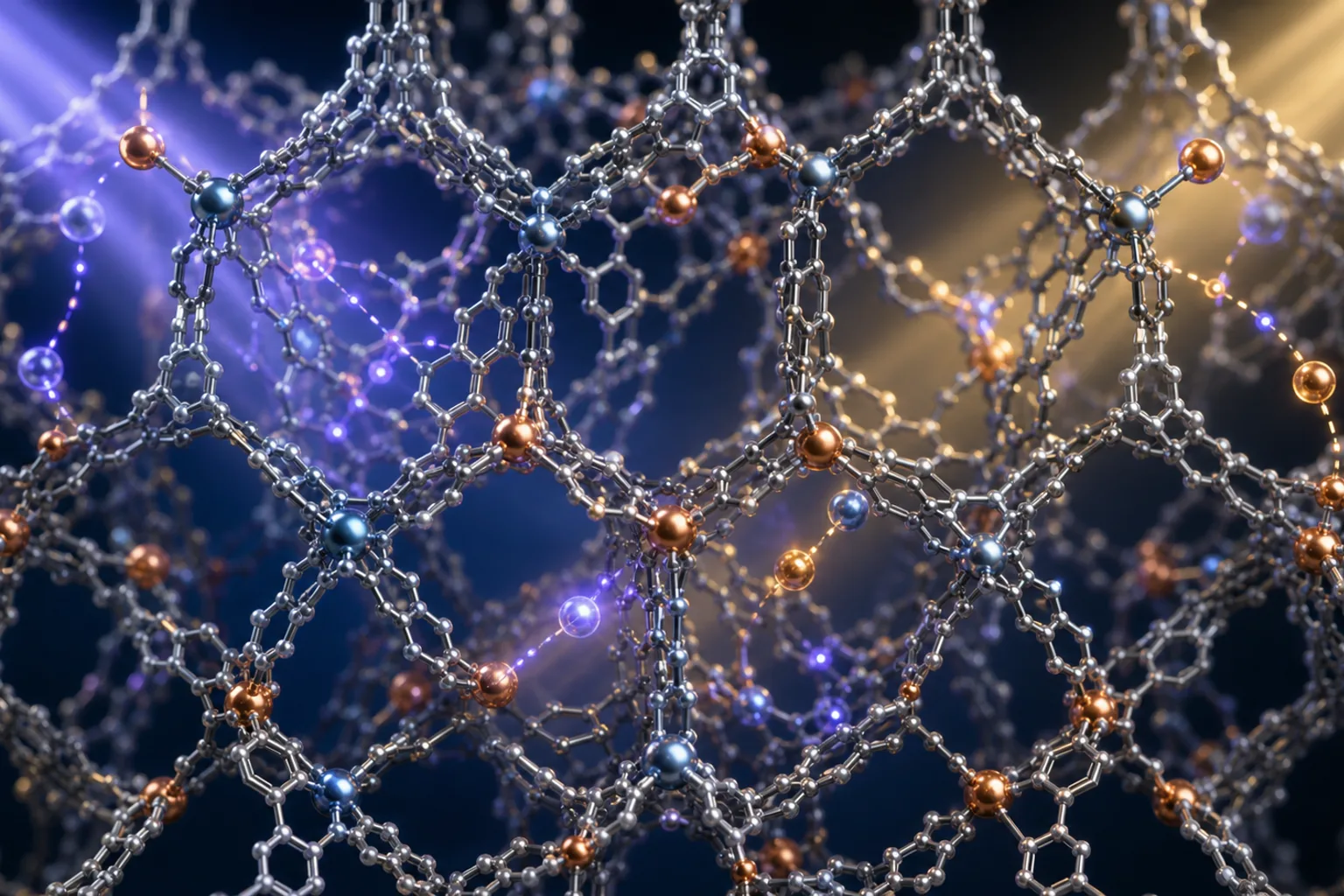
The synthesis of crystalline materials capable of precise and chemically triggered structural transformations remains a significant challenge. Herein, we report a dynamic coordination-mediated strategy for constructing a highly stable bis-acylhydrazone-linked covalent organic framework, COF-LIFM20-Zn, featuring an adjustable U-shaped pentadentate Zn coordination center. The dynamic coordination behavior of Zn 2+ enables reversible interconversions between U- and W-shaped configurations through d
The synthesis of crystalline materials capable of precise and chemically triggered structural transformations remains a significant challenge. Herein, we report a dynamic coordination-mediated strategy for constructing a highly stable bis-acylhydrazone-linked covalent organic framework, COF-LIFM20-Zn, featuring an adjustable U-shaped pentadentate Zn coordination center. The dynamic coordination behavior of Zn 2+ enables reversible interconversions between U- and W-shaped configurations through demetalation and remetalation, as evidenced by 96.2% Zn 2+ removal, a remetalation efficiency of up to 97.9%, and retained reversibility over three U-W switching cycles. Furthermore, incorporation of Cu 2+ , which exhibits a distinct coordination preference, reprograms the framework into a J-shaped configuration. Consequently, interconversions among the U-, W-, and J-shaped configurations are triggered by metal coordination within a single crystalline framework. These coordination-programmed structural transformations systematically modulate the pore structures and metal-dependent photophysical properties of the COFs. Among them, COF-LIFM20-Zn exhibits efficient visible-light-driven NAD + regeneration, whereas COF-LIFM20-Cu significantly suppresses the activity, enabling metal-induced configurational regulation of photocatalytic performance. This work establishes a versatile strategy for constructing reconfigurable COFs through the integration of dynamic covalent and coordination chemistry, providing new opportunities for developing adaptive crystalline materials with programmable structures and tunable functionalities.