Cerebellar microcircuits enable robust evidence-based decisions through cortico-cerebellar coupling.
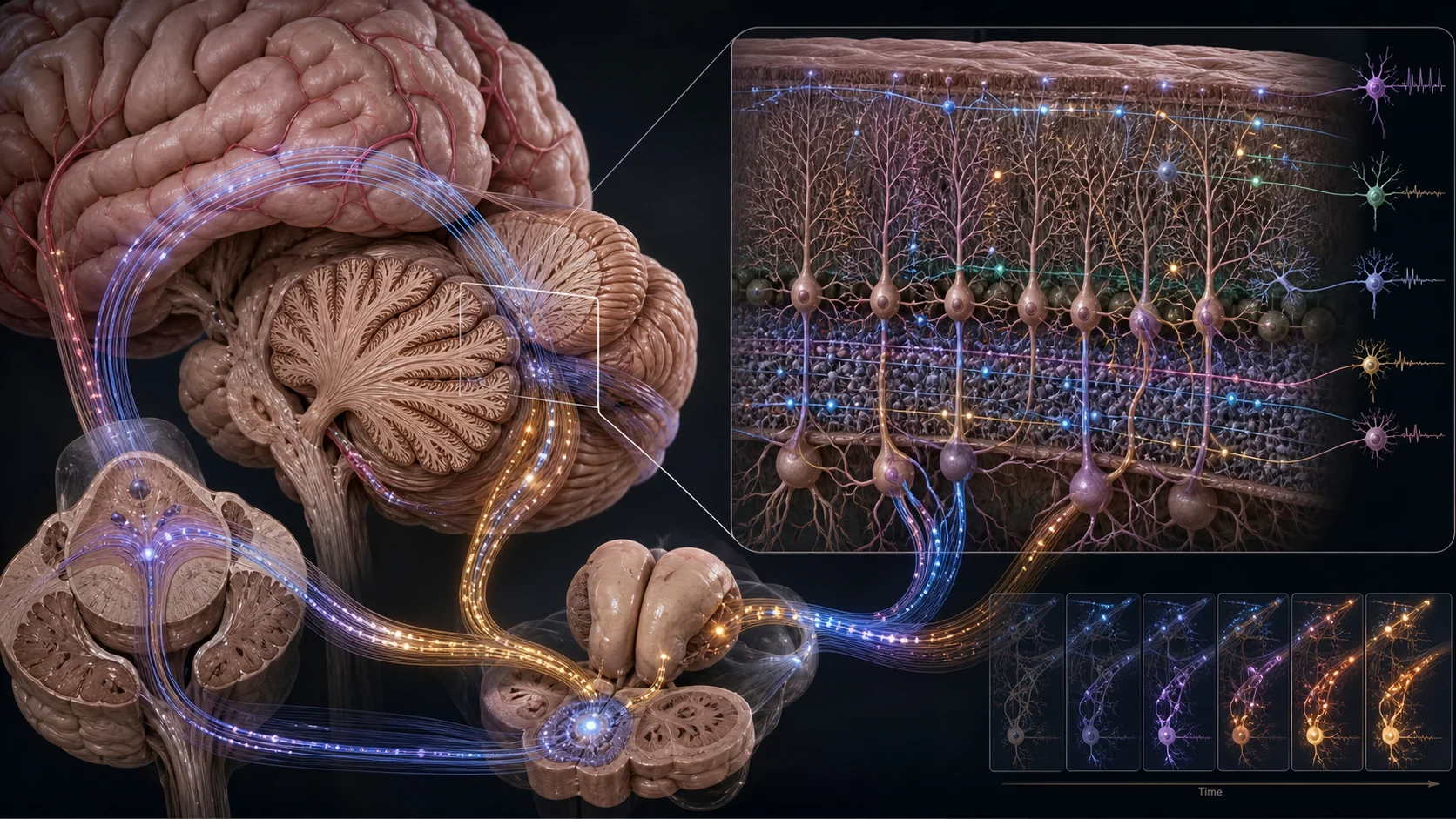
The cerebellum is increasingly implicated in perceptual decision-making, yet it remains unclear how the cerebellar cortex can support sparse evidence accumulation over behavioral time scales without assuming cortical-style dense local excitatory recurrence. We present a biologically constrained modeling framework showing that cerebellar microcircuits can implement graded accumulation and competition in the absence of such recurrence. In our model, type-II Purkinje-neuron excitability generates f
The cerebellum is increasingly implicated in perceptual decision-making, yet it remains unclear how the cerebellar cortex can support sparse evidence accumulation over behavioral time scales without assuming cortical-style dense local excitatory recurrence. We present a biologically constrained modeling framework showing that cerebellar microcircuits can implement graded accumulation and competition in the absence of such recurrence. In our model, type-II Purkinje-neuron excitability generates firing-rate hysteresis that prolongs the impact of brief inputs far beyond intrinsic membrane and synaptic time constants, enabling accumulation across long interevent intervals. Purkinje neuron collateral inhibition produces competitive divergence and tunes temporal evidence weighting, revealing a trade-off between commitment and primacy bias. In a bidirectionally coupled cortico-cerebello-cortical model, cerebellar processing reduces primacy while cortical processing reduces indecision, improving robustness. Finally, granule-layer sparsification improves the separability of correlated inputs, enhancing discrimination under biologically realistic stimulus statistics. Together, these simulation results propose a mechanistic division of labor that positions the cerebellum as an active computational partner in perceptual decisions.