Distinct nanoscale architectures of GABAergic inhibitory synapses predict diverse synaptic output.
GABAergic synaptic inhibition is heterogenous across neuronal compartments, and plays a critical role in shaping local, cellular, and circuit excitability. In pyramidal neurons, inhibition is mediated by GABA A receptors (GABA A Rs) clustered at the inhibitory postsynaptic domain (iPSD). Synaptic strength depends not only on the number of GABA A Rs within the iPSD, but also on their precise nanoscale organization into discrete subsynaptic domains (SSDs). These SSDs often align with presynaptic G
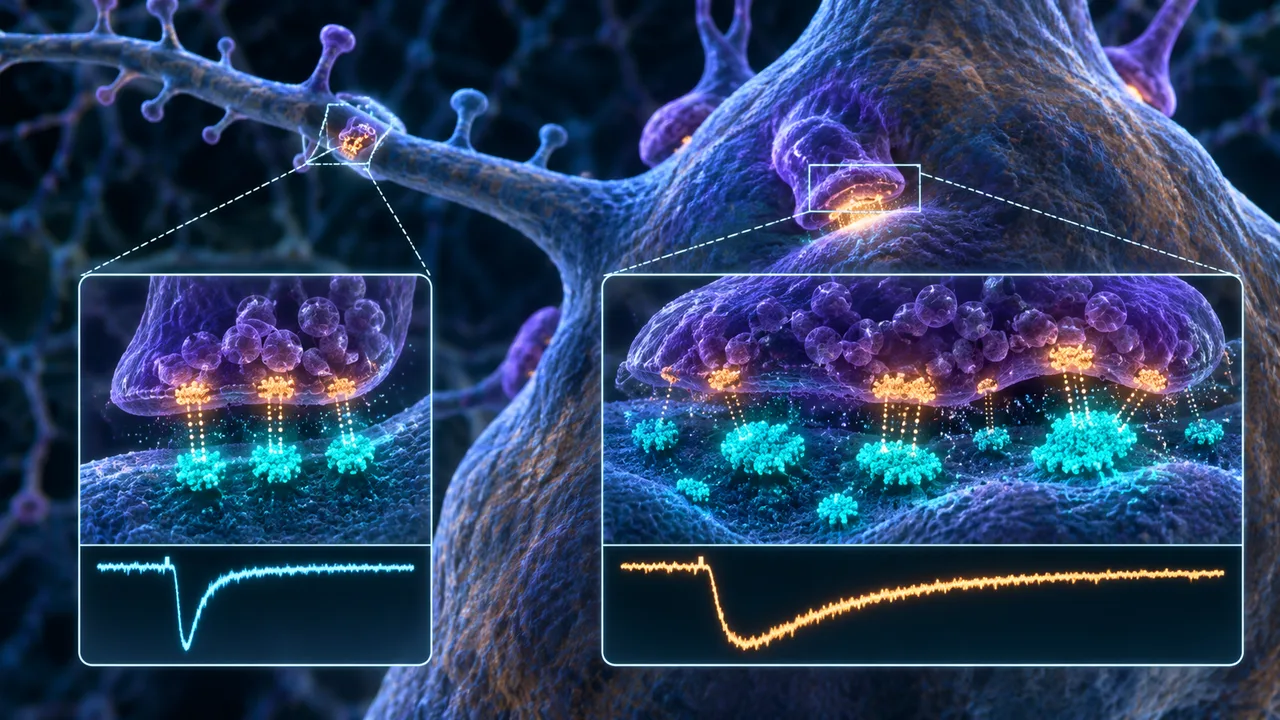
GABAergic synaptic inhibition is heterogenous across neuronal compartments, and plays a critical role in shaping local, cellular, and circuit excitability. In pyramidal neurons, inhibition is mediated by GABA A receptors (GABA A Rs) clustered at the inhibitory postsynaptic domain (iPSD). Synaptic strength depends not only on the number of GABA A Rs within the iPSD, but also on their precise nanoscale organization into discrete subsynaptic domains (SSDs). These SSDs often align with presynaptic GABA release sites to form nanocolumn structures that enhance synaptic efficacy. While nanocolumn organization is increasingly recognized as a key determinant of synaptic function, most studies of GABAergic synapses have focused on archetypal dendritic synapses, which control the plasticity and integration of excitatory inputs. Nonetheless, it remains unclear whether somatic synapses-which deliver robust inhibition to suppress neuronal output-share a similar nanoarchitecture. Here, we used complementary superresolution imaging approaches to directly compare inhibitory synapses in somatic and dendritic compartments. We found that somatic synapses are larger and exhibit greater structural diversity and nanoscale complexity than dendritic synapses. Dendritic synapses display relatively compact architectures with GABA A R SSDs frequently arranged into nanocolumns. In contrast, somatic synapses show a broader range of organizations, including aligned nanocolumns as well as more disorganized configurations with misaligned release sites or receptor SSDs, arrangements that likely exhibit input-specificity. Computational modeling revealed that these structural differences produce distinct functional outcomes, including increased inhibitory postsynaptic current amplitude and altered kinetics at somatic synapses. Together, our findings demonstrate that nanoscale organization differentially shapes inhibitory strength and signaling properties across neuronal compartments.