Balancing N 2 Activation in Two-Dimensional Electrides for Ammonia Synthesis.
Two-dimensional (2D) electrides, featuring interlayer-delocalized anionic electrons, hold promise for N 2 activation but face challenges in catalytic ammonia synthesis due to structural instability under reaction conditions. Here, we introduce a dual-site catalyst using the robust 2D metal carbide Y 2 C electride as a platform, where N 2 is activated at electron-rich interlayers and H 2 dissociates on supported Ni nanoparticles, enabling efficient and stable ammonia production. Through Raman spe
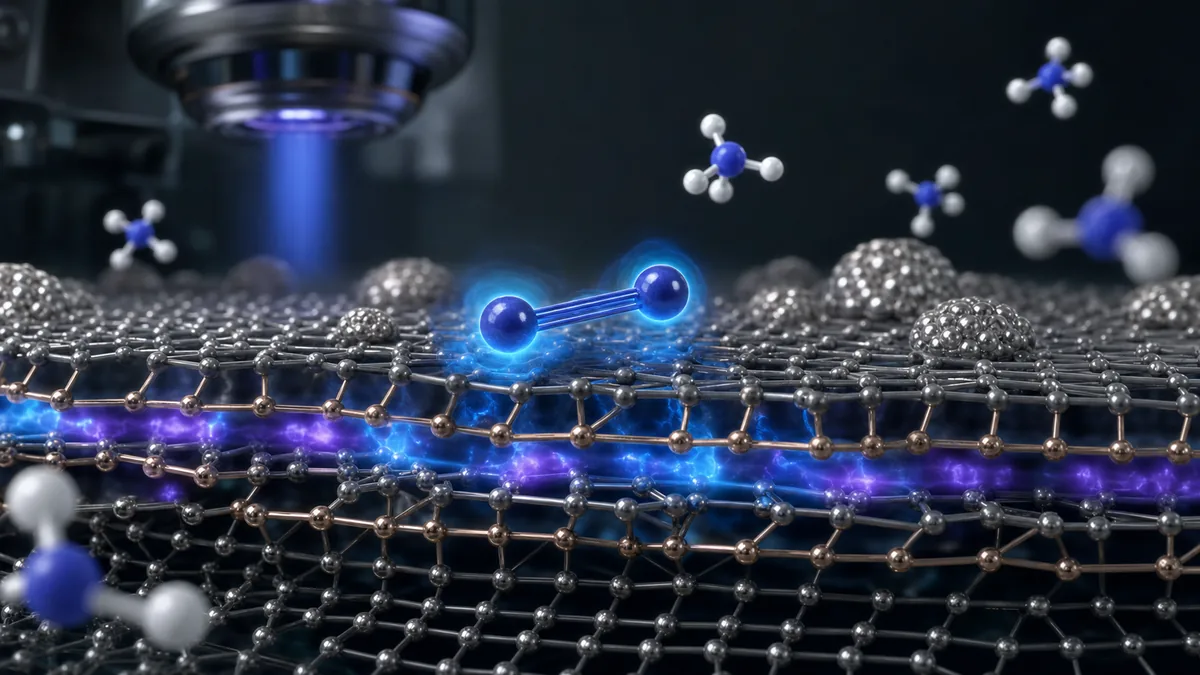
Two-dimensional (2D) electrides, featuring interlayer-delocalized anionic electrons, hold promise for N 2 activation but face challenges in catalytic ammonia synthesis due to structural instability under reaction conditions. Here, we introduce a dual-site catalyst using the robust 2D metal carbide Y 2 C electride as a platform, where N 2 is activated at electron-rich interlayers and H 2 dissociates on supported Ni nanoparticles, enabling efficient and stable ammonia production. Through Raman spectroscopy, XPS, and DFT calculations, we uncover a scaling relationship for N 2 activation in 2D electrides: intermediate N 2 binding strength correlates with the formation of reactive (N 2 ) δ- intermediates, crucial for efficient NH 3 production. Leveraging this insight, La-doped Y 2 C (La-Y 2 C) optimizes N 2 activation, and the Ni/La-Y 2 C catalyst achieves an exceptional activity of 34.6 mmol·g -1 ·h -1 at 400 °C and 1.0 MPa, surpassing reported Ni-based catalysts, the benchmark Cs-Ru/MgO, and industrial wüstite-based Fe under identical conditions. These findings provide a rational framework for designing advanced 2D electrides for controllable N 2 activation and sustainable ammonia synthesis.