Health & Medicine

A global men's health epidemiology within an intersectional framework.
| Source: Lancet (London, England)

Males have lower life expectancies and greater disability-adjusted life-years (DALYs) than females, and particularly poor outcomes are seen among males in marginalised contexts. In this paper, we provide an epidemiological overview and highlight the intersectional nature of men's health. We analyse mortality and DALYs data from the 1990-2023 Global Burden of Diseases, Injuries, and Risk Factors Studies to illustrate our intersectional framework and draw attention to how health varies in men and

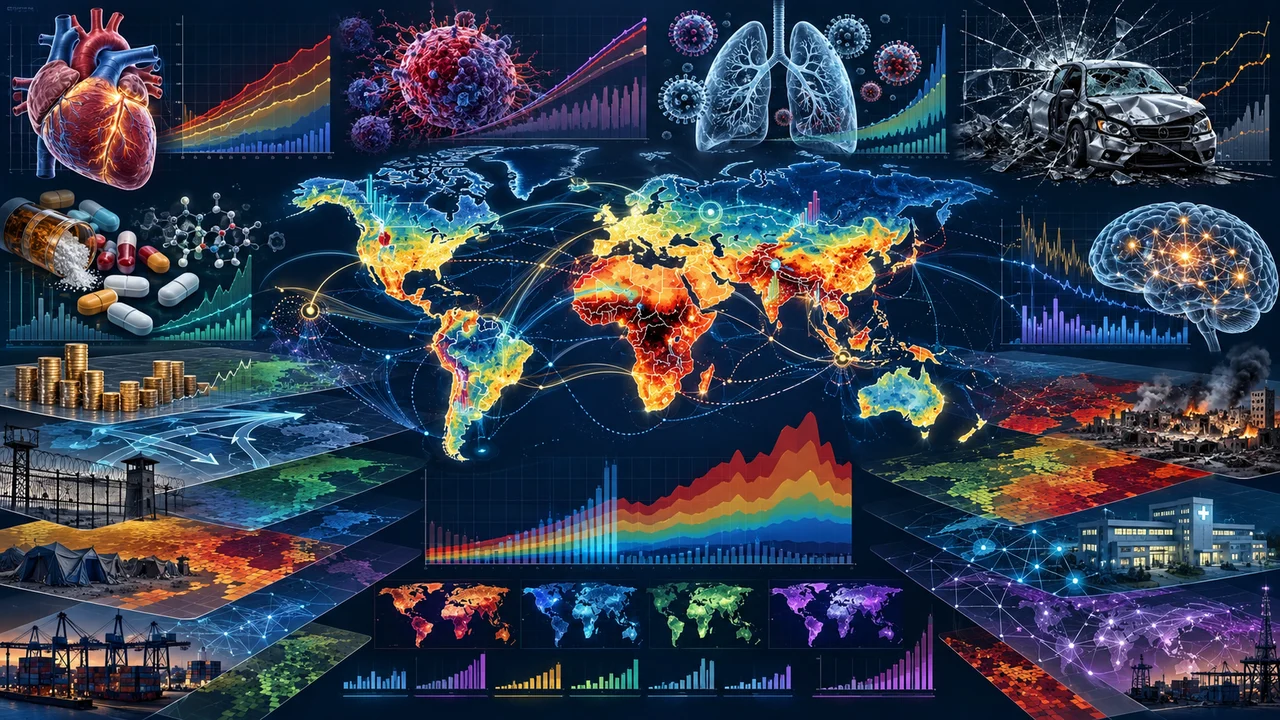
Males have lower life expectancies and greater disability-adjusted life-years (DALYs) than females, and particularly poor outcomes are seen among males in marginalised contexts. In this paper, we provide an epidemiological overview and highlight the intersectional nature of men's health. We analyse mortality and DALYs data from the 1990-2023 Global Burden of Diseases, Injuries, and Risk Factors Studies to illustrate our intersectional framework and draw attention to how health varies in men and to show key themes. Conditions that contribute most to the poor health of males include non-communicable diseases (eg, cardiovascular diseases and cancers), substance use, suicide, injuries (eg, road traffic incidents and interpersonal violence), and respiratory infections (eg, tuberculosis and COVID-19). Although cardiovascular disease and cancer make the largest contributions to men's higher mortality rates, determinants of health such as violence and war, migration, economic stagnation, and labour market changes due to automation and new technologies will disproportionally affect their health in the future. Injuries, violence, and other external morbidity causes often occur at a young age and in unequal distributions across the sexes, making a large contribution to DALYs. Although biology plays a role, the pattern of many diseases contributing to health differences reflects the intersection of health behaviours, shaped by patriarchy, ideas of masculinity, and structural drivers (including commercial determinants of health); many of these are preventable. Although improvements in some health behaviours are seen, exceptions occur in marginalising social conditions (eg, incarcerated men, men experiencing homelessness, men with mental illnesses, men with substance use disorders, men with low income, men who have sex with men, and those who are gender non-conforming). Multiple data sources detail men's shorter life expectancies and the drivers compared with women, but going beyond sex disaggregation remains challenging and is an urgent priority for research and health monitoring.


Read the original source →

Related Topics

Related Stories

Health & Medicine

An innervated and vascularized HNSCC-on-a-chip model built on defined and tunable engineered extracellular matrices.

Understanding the tumor microenvironment requires experimental platforms that faithfully recapitulate its key components. Here, we present an innervated and vascularized head and neck squamous cell carcinoma (HNSCC)-on-a-chip platform built with fully defined and tunable engineered extracellular matrices (eECMs). In a stepwise increase of complexity, we first cocultured patient-derived HNSCC cells, cancer-associated fibroblasts, and endothelial cells within tailored eECMs, revealing extracellula

Continue reading
Health & Medicine

Septin binding restricts Shigella growth and triggers intracellular tolerance.

Pathogen survival relies on their ability to adapt to changing environments, yet how intracellular bacteria tolerate cell-autonomous immunity remains unclear. Septins assemble into cage-like structures around cytoplasmic Shigella targeted by autophagy, but their antibacterial activity was unknown. Using advanced microscopy and cell-free reconstitution, we show that septins polymerize into circumferentially oriented filaments that inhibit bacterial growth. RNA-sequencing reveals that septin bindi

Continue reading
Health & Medicine

DCAF6 reprograms TGF-β responses through TRIM33 destruction.

TGF-β signaling plays a pivotal role in regulating numerous cellular processes, primarily through the Smad-dependent pathway. Disruptions of the pathway are associated with developmental disorders and life-threatening diseases, such as cancer. It has been reported that TRIM33 inactivates Smad4 signaling and also drives its own signaling responses. However, the mechanism controlling TRIM33 activity has remained unclear. In this study, we identify DCAF6 as a previously unrecognized ubiquitin

Continue reading
Health & Medicine

Reframing the manosphere: a public health response to a commercial ecosystem.

The manosphere, a diffuse commercial ecosystem and loose collection of online communities united by shared beliefs about masculinity, misogyny, and male victimisation, is an under-recognised determinant of health harms. This network has been implicated in considerable health harms: widespread mental health impacts, especially in young people; violence against women, girls, and gender minorities; and delegitimising help-seeking in boys and men. In this Viewpoint, we argue that the manosphere is b

Continue reading
Health & Medicine

Charting a course to men's health and wellbeing: applying a lens of power and politics to improve men's health outcomes.

Despite long-standing evidence of poor health and life expectancy outcomes among men, particularly among men who are socially or structurally marginalised, men's health has generally received little and uneven attention in health policy and practice. Its gendered and intersectional aspects have been especially overlooked. This third paper in the Lancet Men's Health Series examines why men's health has received so little policy attention and proposes strategies to raise men's health on national a

Continue reading