Visible light leaves evaporation and interfacial structure of neat water unchanged at the air-water interface.
Visible light-induced "photomolecular" enhancement of water evaporation has been proposed as a fundamentally new mode of light-matter interaction at aqueous interfaces, with far-reaching implications for climate processes and light-driven water technologies. Yet, the response of neat interfacial water to visible photons has not been directly quantified at both macroscopic and molecular scales. Here, we combine high-precision confocal displacement measurements with a surface-specific vibrational
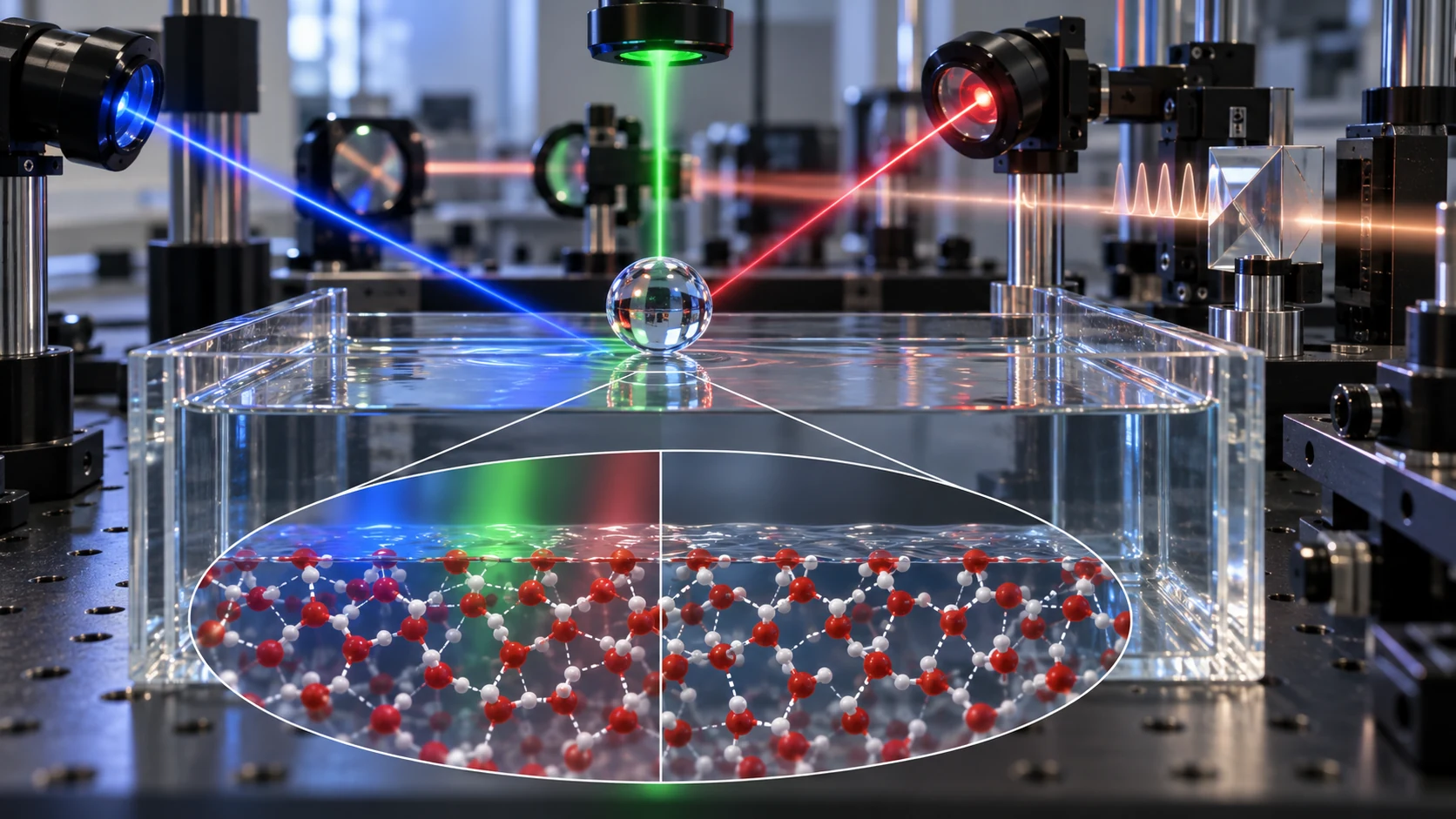
Visible light-induced "photomolecular" enhancement of water evaporation has been proposed as a fundamentally new mode of light-matter interaction at aqueous interfaces, with far-reaching implications for climate processes and light-driven water technologies. Yet, the response of neat interfacial water to visible photons has not been directly quantified at both macroscopic and molecular scales. Here, we combine high-precision confocal displacement measurements with a surface-specific vibrational probe that detects the OH-stretch vibrations of interfacial water molecules with subnanometer depth sensitivity, allowing us to resolve even subtle blue shifts of the hydrogen-bonded continuum and changes in the amplitude and position of the free-OH peak that report on interfacial hydrogen-bond strength and molecular orientation. This approach enables us to track both evaporation kinetics and molecular structure at the air-water boundary. Continuous 450, 532, and 635 nm illumination leaves the macroscopic evaporation rate unchanged over a wide range of humidities, while the interfacial vibrational spectra show no detectable modification of water hydrogen-bonding or molecular orientation under identical environmental conditions. To directly test a nonthermal, field-driven mechanism, we further exposed the interface to femtosecond visible and near-infrared pulses spanning 515, 800, and 1030 nm; the peak intensities were increased by more than ten orders of magnitude, and no structural change was observed. Together, these measurements show that the neat air-water interface is remarkably insensitive to visible irradiation, implying that any substantial light-enhanced evaporation is most consistent with photothermal or geometric effects in complex materials rather than from a new, nonthermal and nonresonant pathway intrinsic to liquid water.