Manure to insect farming for feed mitigates nitrogen and greenhouse gas emissions.
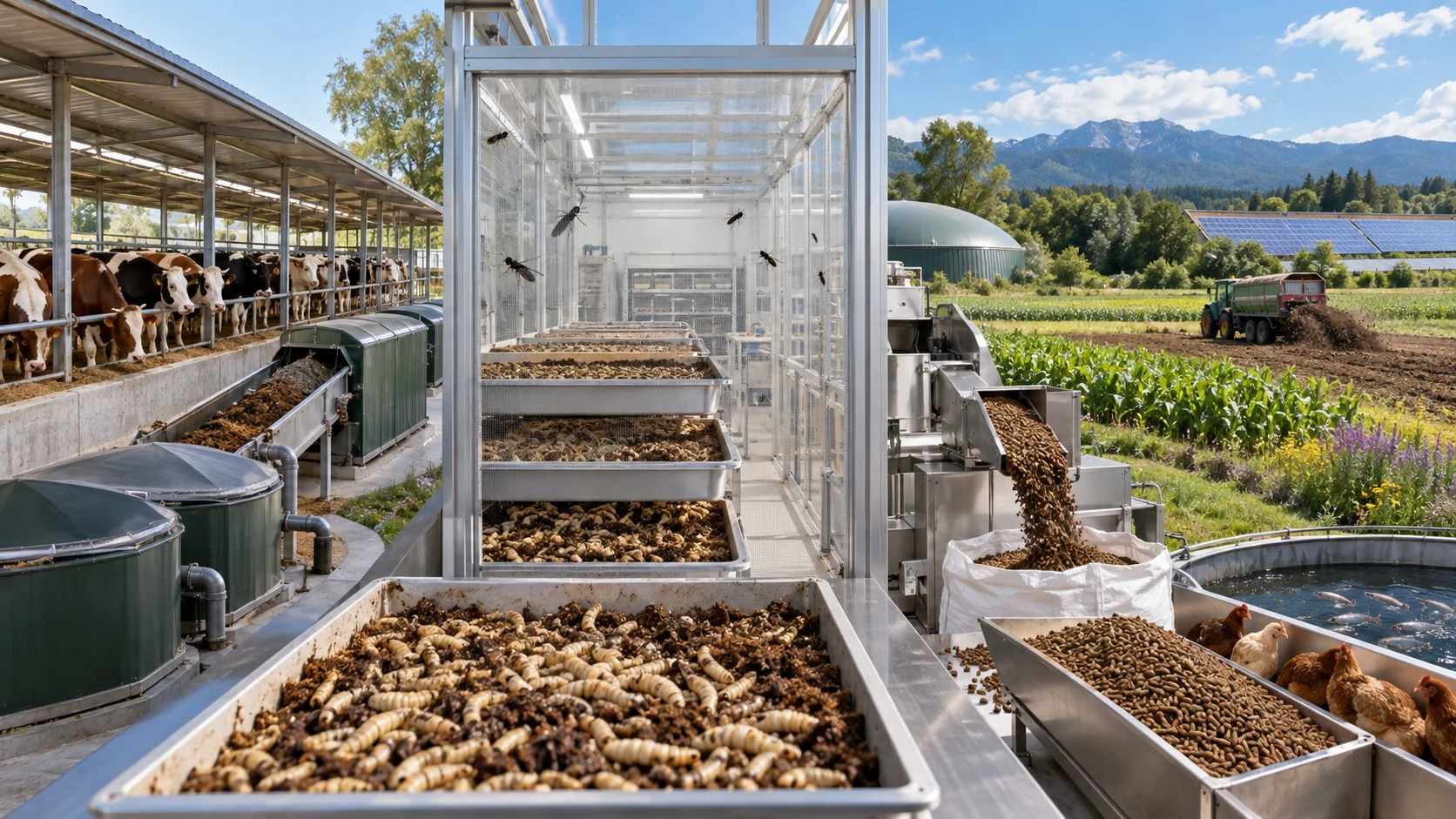
Livestock manure is nutrient-rich and represents a promising feedstock for insect farming, with insect protein offering a high-quality alternative to conventional crop-based livestock feed. This pathway has substantial potential to mitigate nitrogen (N) and greenhouse gas (GHG) emissions from livestock systems. Here, we integrate global livestock models with trade, land-use, and cost-benefit analysis to quantify the environmental and economic implications of manure-to-insect conversion while ens
Livestock manure is nutrient-rich and represents a promising feedstock for insect farming, with insect protein offering a high-quality alternative to conventional crop-based livestock feed. This pathway has substantial potential to mitigate nitrogen (N) and greenhouse gas (GHG) emissions from livestock systems. Here, we integrate global livestock models with trade, land-use, and cost-benefit analysis to quantify the environmental and economic implications of manure-to-insect conversion while ensuring the recycling of manure to croplands to maintain soil fertility across 166 countries. We show that insect farming could yield approximately 4.2 (3.4 to 5.5) million tonnes (Mt) N of insect protein to substitute crop-based feed and release up to 45 million hectares of cropland. This transition could reduce N and GHG emissions by 6.0 (5.5 to 6.8) Mt N and 1,277 (1,081 to 1,634) Mt CO 2 -e, respectively, during feed cultivation and manure storage. The residual manure, after insect processing, can be returned to fields as a high-quality organic fertilizer, offsetting 25 Mt N of synthetic fertilizers. With an estimated implementation cost of 25 billion USD, this strategy could deliver combined economic and environmental benefits of 226 billion USD. These results position manure-based insect farming as a cost-effective and circular solution to enhance global food system resilience under environmental pressures.