Environment

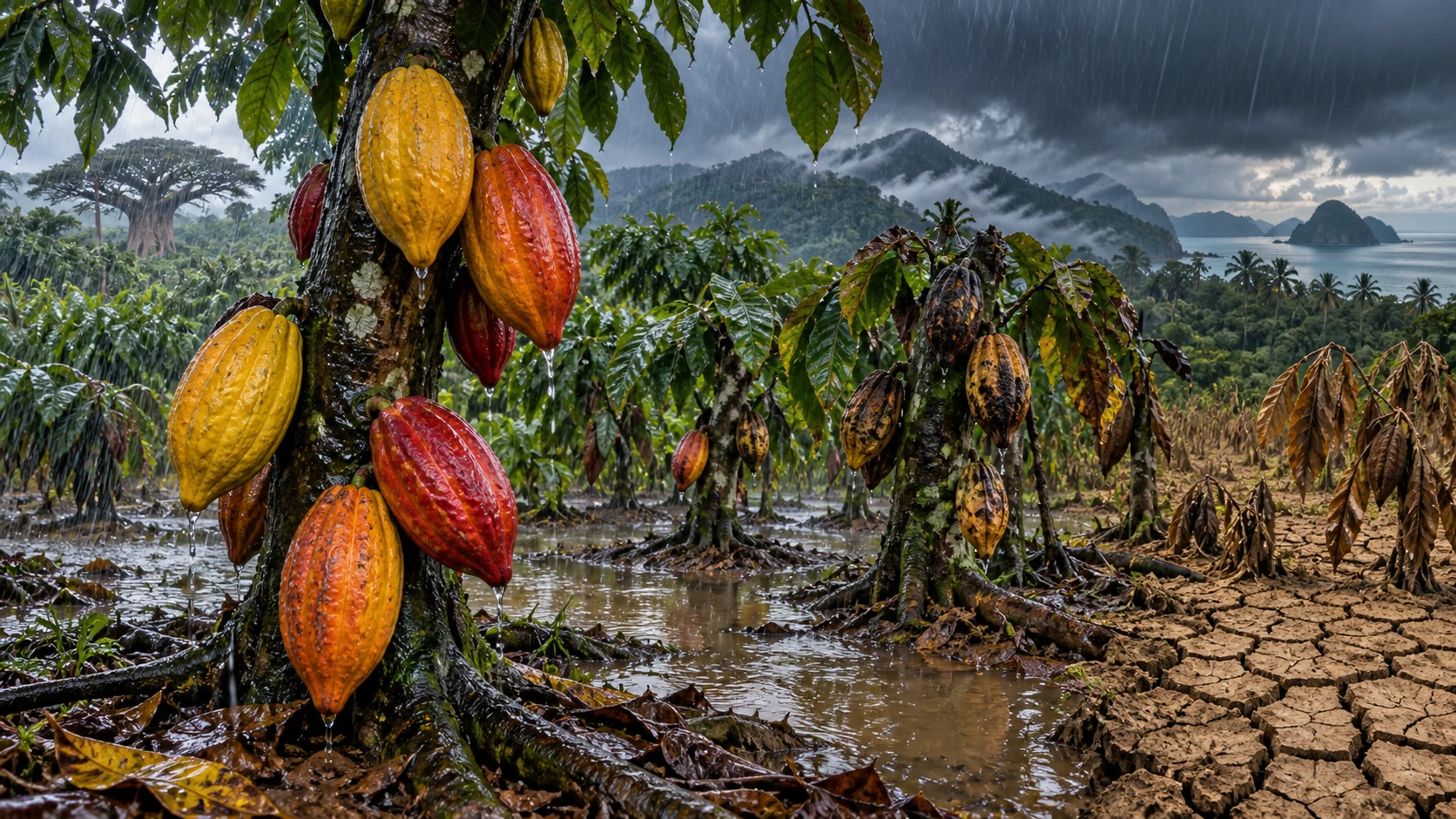
Rainfall extremes drive cocoa yield losses across the tropics.
| Source: Proceedings of the National Academy of Sciences of the United States of America

There is a growing need for human-centered weather and climate forecasts that provide actionable information to farmers and other stakeholders. Cocoa, which sustains the livelihoods of nearly six million smallholder farmers, illustrates this need: Recent production shortfalls have threatened incomes, yet their underlying causes remain unclear, with explanations invoking both climatic and nonclimatic factors. Here we show that heavy rainfall, rather than temperature or mean water availability, is

There is a growing need for human-centered weather and climate forecasts that provide actionable information to farmers and other stakeholders. Cocoa, which sustains the livelihoods of nearly six million smallholder farmers, illustrates this need: Recent production shortfalls have threatened incomes, yet their underlying causes remain unclear, with explanations invoking both climatic and nonclimatic factors. Here we show that heavy rainfall, rather than temperature or mean water availability, is the dominant climatic constraint on cocoa yields across major producing regions. Using newly available district-level production records from Ghana combined with daily rainfall and temperature data, we find that excess wet-season rainfall and dry-season drought together explain 68% of interannual yield variability. National yield data from Ecuador and Indonesia also give a consistent negative response to heavy rainfall, indicating a common mechanism across the tropics, likely linked to damage and disease risks associated with intense precipitation during key phenological stages. Because rainfall extremes covary with El Niño and other sea surface temperature patterns, and there is a robust physical expectation of increases in rainfall extremes with warming, these results provide a physical basis for risk forecasts. By shifting attention from average climate conditions to extreme precipitation, we highlight an underappreciated constraint on a perennial tropical crop and identify opportunities for adaptation and forecast-informed decision-making.
Read the original source →

Related Stories

Environment

Manure to insect farming for feed mitigates nitrogen and greenhouse gas emissions.

Livestock manure is nutrient-rich and represents a promising feedstock for insect farming, with insect protein offering a high-quality alternative to conventional crop-based livestock feed. This pathway has substantial potential to mitigate nitrogen (N) and greenhouse gas (GHG) emissions from livestock systems. Here, we integrate global livestock models with trade, land-use, and cost-benefit analysis to quantify the environmental and economic implications of manure-to-insect conversion while ens

Continue reading
Environment

Air pollution after the shutdown of US embassy monitoring.

For more than a decade, US embassies and consulates provided independent, publicly accessible air-quality information in cities worldwide. In 2025, this program was abruptly suspended, generating sharp drops in the availability of trusted pollution information. We evaluate the consequences of this change using real-time satellite-derived aerosol optical depth (AOD) and a matched difference-in-differences design with same-country control cities. Across 46 cities, we find no systematic trends prio

Continue reading
Environment

Earthquake-triggered cascading hazards under Arctic amplification.

Arctic warming is reshaping permafrost and glacierized terrains, potentially changing their natural hazards in response to seismic shaking. On 10 March 2025, a Mw 6.5 oceanic transform fault earthquake near Jan Mayen Island in the Arctic Ocean triggered a large rock avalanche that buried part of the Kjerulf Glacier, generating infrasound signals and glacier calving. Using seismic, Global Navigation Satellite System data, infrasound records, satellite imagery, and long-term climatological records

Continue reading
Environment

At least a fivefold gap in effective global marine protection.

The Convention on Biological Diversity's ambitious target to "effectively conserve" 30% of the world's oceans in protected areas by 2030 risks being undermined by a primary focus on total area protected rather than realized conservation outcomes. Area-based assessments can overstate success because few marine protected areas (MPAs) possess strong restrictions and high compliance. Here, we estimate the extent that conservation outcomes are realized across the global MPA network for shallow reefs

Continue reading
Environment

Visible light leaves evaporation and interfacial structure of neat water unchanged at the air-water interface.

Visible light-induced "photomolecular" enhancement of water evaporation has been proposed as a fundamentally new mode of light-matter interaction at aqueous interfaces, with far-reaching implications for climate processes and light-driven water technologies. Yet, the response of neat interfacial water to visible photons has not been directly quantified at both macroscopic and molecular scales. Here, we combine high-precision confocal displacement measurements with a surface-specific vibrational

Continue reading