Artificial Intelligence

The Virtual Biotech: A multi-agent AI framework for therapeutic discovery and development
| Source: Science

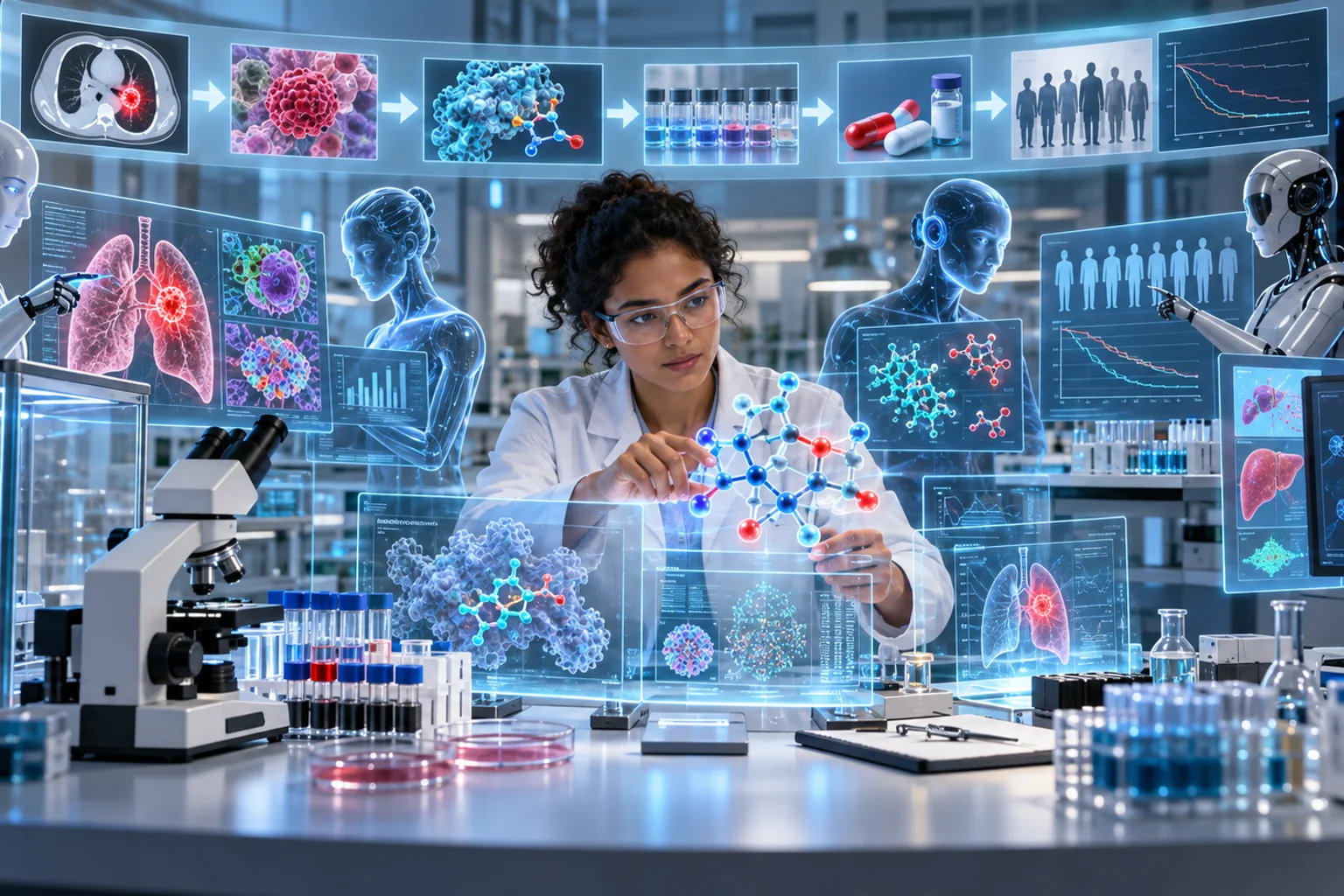
Drug development requires evidence integration across biological scales and modalities, but relevant tools are fragmented. We introduce the Virtual Biotech, an organization of artificial intelligence (AI) agents modeled on a drug-development company, with agentic divisions spanning target discovery, safety assessment, modality selection, and clinical development. We demonstrate its utility at three drug-development decision points. First, over 37,000 agents annotated outcomes from 55,984 trials

Drug development requires evidence integration across biological scales and modalities, but relevant tools are fragmented. We introduce the Virtual Biotech, an organization of artificial intelligence (AI) agents modeled on a drug-development company, with agentic divisions spanning target discovery, safety assessment, modality selection, and clinical development. We demonstrate its utility at three drug-development decision points. First, over 37,000 agents annotated outcomes from 55,984 trials and found that drugs targeting cell-type-specific genes were 48% more likely to reach market with 32% fewer adverse events. Second, it integrated multimodal evidence to propose a therapeutic strategy in lung cancer. Third, it analyzed a terminated ulcerative colitis trial and inferred potential mechanisms of failure. These results demonstrate that human-guided multi-agent systems can conduct transparent, multiscale analyses to inform therapeutic-development decisions.

Read the original source →

Related Stories

Artificial Intelligence

Where intention goes, responsibility flows: Grounding AI accountability in the machine learning paradigm.

An opening salvo of lawsuits in US courts has begun holding AI companies accountable through independent doctrinal routes: Product liability and agency law cut as swords, while the shields of Section 230 immunity and First Amendment doctrine begin to crack. This Perspective points out that these converging paths share a unifying principle, built on the very engineering architecture of machine learning (ML) itself. Every ML system, across all variants, is constituted by a human-specified objectiv

Continue reading
Artificial Intelligence

Protein resource allocation across subcellular compartments revealed by large-scale absolute quantitative proteomics in yeast.

Subcellular compartmentalization within complex membrane-bound organelles is a hallmark of eukaryal life, enabling metabolic specialization through spatial segregation. Here, we compiled a dataset encompassing 300 absolute quantitative proteomes, the largest to date, across two yeast species under diverse experimental conditions. Leveraging big data analysis, formula fitting, and machine learning, quantitative correlations among protein abundance, resource allocation, and cellular phenotypes wer

Continue reading
Artificial Intelligence

Quantifying ancient architecture: Stone-level machine learning reveals architectural variation and settlement growth at Shivta.

Built environments provide durable evidence for how ancient settlements were organized, expanded, and transformed over time. Yet quantitative approaches to documenting architectural variability are generally labor-intensive, limited to individual structures, or dependent on aggregate volumetric estimates. We present a scalable, machine-learning-based framework that shifts the unit of analysis to the individual building stone and combines two complementary datasets: low-altitude drone imagery of

Continue reading
Artificial Intelligence

In-context learning as a retraining-free paradigm for constitutive modeling.

Constitutive modeling is fundamental to computational solid mechanics, yet most existing approaches remain material-specific and require retraining or recalibration when materials change. Here we introduce In-Context Modeling (ICM), a retraining-free paradigm for constitutive modeling that infers constitutive behavior from physical context rather than material-specific optimization. Using hyperelasticity as a testbed, we demonstrate that ICM can be trained once on equilibrium deformation fields

Continue reading
Artificial Intelligence

Data-driven discovery and rapid, direct synthesis of MXenes.

MXenes are a rapidly expanding family of two-dimensional transition metal carbides and nitrides, yet scalable synthesis routes remain limited and historical reports suggest a broader, largely unexplored chemical space. We used machine learning-assisted database mining to uncover hidden multilayer MXenes. Screening reveals 33 previously synthesized but unrecognized MXene candidates. Guided by these findings, we synthesized seven multilayer MXenes using a rapid, scalable self-propagating high-temp

Continue reading