Environment

The genomic origins and evolutionary path to a key innovation in the world's most venomous snakes.
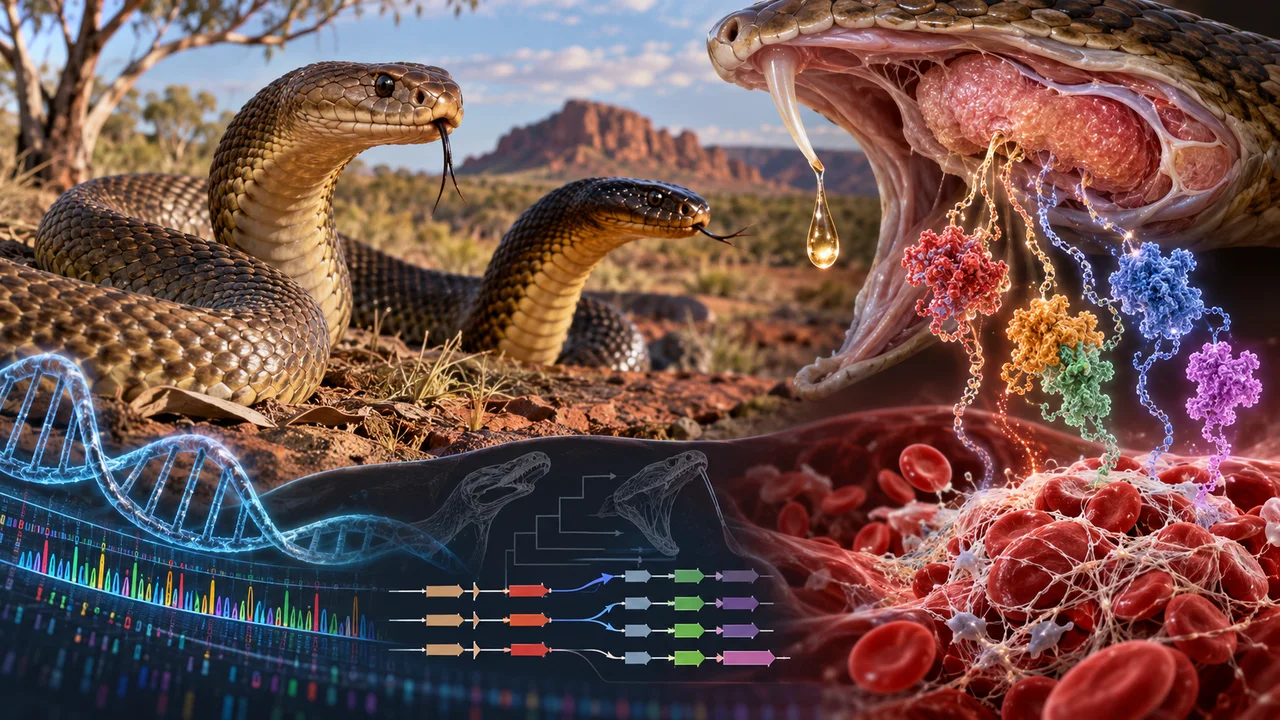
| Source: Proceedings of the National Academy of Sciences of the United States of America

Evolutionary innovation is a catalyst for the colonization of new environments and the adaptive radiations of major groups. Novel traits typically evolve through the modification of preexisting characters, but the genetic paths underlying their origin have been challenging to trace, and the general requirements for and relative order of different kinds of gene mutations have been difficult to assess. Here, we trace the genomic origins of four procoagulant venom toxins (factor X, factor V, group

Evolutionary innovation is a catalyst for the colonization of new environments and the adaptive radiations of major groups. Novel traits typically evolve through the modification of preexisting characters, but the genetic paths underlying their origin have been challenging to trace, and the general requirements for and relative order of different kinds of gene mutations have been difficult to assess. Here, we trace the genomic origins of four procoagulant venom toxins (factor X, factor V, group I phospholipase A 2 , and Kunitz-type toxins) that collectively underlie a novel, especially potent blood-clotting venom type in the recently evolved Australian brown snake and taipan clade. We find evidence for a previously unknown fifth toxin, coagulation factor VII, and show that the toxins evolved through two distinct genetic paths. The factor X and factor V toxins evolved through the sequential de novo co-option of ancestral clotting factor proteins that entailed their heterotopic expression in the venom gland, the fixation of segmental duplications containing each locus, and subsequent gain-of-function mutations that rendered factor X and factor V constitutively active. In contrast, the phospholipase A 2 and Kunitz-type toxins evolved by modifying the functions of neurotoxins that were part of the venom arsenal. Our findings support models in which innovative mutations in single-copy genes precede gene duplication in the evolution of novel proteins and offer a rare view into the genesis of a complex trait that has played a central role in a major adaptive radiation.


Read the original source →

Related Stories

Environment

Co-option of ancestral stem regulators drove recurrent evolution of underground storage organs.

Geophytes are plants that produce underground storage organs such as tubers, rhizomes, and bulbs, to facilitate asexual reproduction and withstand a myriad of environmental challenges. While the potato ( Solanum tuberosum L.) serves as the primary model for studying tuberization, the genetic mechanisms encoding this trait across diverse angiosperm lineages remains unclear. This study utilized a phylogenomic-transcriptomic approach to compare tuber development across nine tuberizing species with

Continue reading
Environment

Major role for internal variability in tropical Pacific warming pattern over satellite era.

Home to El Niño, the tropical Pacific is a key player in the global climate system. While most of the planet has warmed during the satellite era of 1982-2024, the eastern tropical Pacific surface has mysteriously cooled. What is troubling is that fully coupled global climate models mostly fail to simulate this distinctive pattern. By replacing wind stress applied to the ocean with observations, here we show that climate models successfully reproduce the La Niña-like (LN) trend pattern

Continue reading
Environment

Reconstruction of an extinct soundscape reveals ultrasonic communication in the Jurassic.

Very little is known about the acoustic landscape of long-gone environments, such as the Jurassic forests. The sounds made by dinosaurs and other charismatic vertebrates are not definitively known because their vocal organs rarely preserve well in fossils. Unlike tetrapod vocal cords, the sound-producing organs present in the sclerotized cuticle of some arthropods do fossilize well. For example, the stridulatory structures (file, plectrum) can be observed and measured in the fossilized forewings

Continue reading
Environment

State-sponsored agenda setting: Measuring the impact of narrative laundering.

Foreign information manipulation and interference (FIMI) is an important part of the digital information ecosystem, yet its effects are poorly understood. Most research analyzing FIMI to date is descriptive, exposing efforts to erode trust, promote favorable narratives, and target specific communities. Existing work evaluating the impacts of FIMI contrasts those directly exposed to FIMI messaging (by viewing the original messages) with those who were not, finding little evidence of changes in be

Continue reading
Environment

Psilocybin prevents chemotherapy-induced peripheral neuropathy through mitochondrial trafficking preservation.

Chemotherapy-induced peripheral neuropathy (CIPN) is a disabling, often irreversible toxicity that affects millions of patients, limits life-saving cancer therapy, and lacks proven treatment. In this work, we show that as little as two doses of psilocybin before chemotherapy durably prevented the onset of CIPN across platinum- and taxane-based models, including repeated chemotherapy cycles, without impairing antitumor efficacy. Peripherally, psilocybin maintained tactile sensitivity and intraepi

Continue reading