Artificial Intelligence

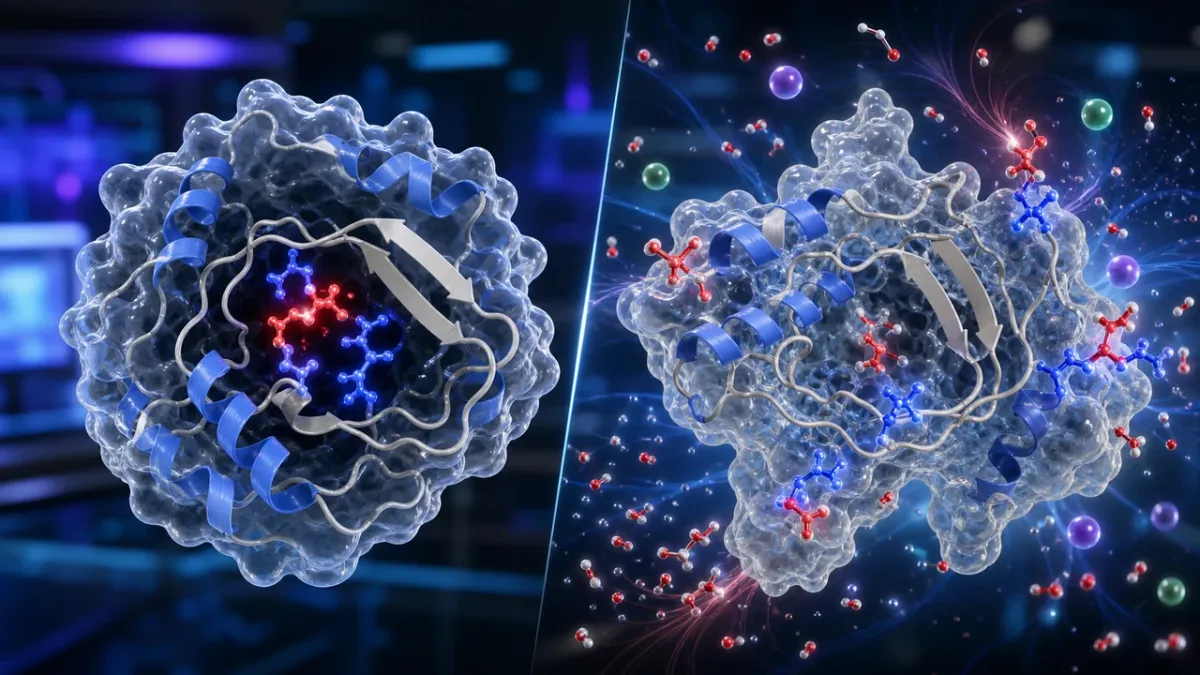
The accuracy of electrostatic interactions captured by AI protein structure prediction models.
| Source: Proceedings of the National Academy of Sciences of the United States of America

A variant of the U1A protein containing four substitutions to ionizable residues was generated serendipitously due to a miscommunication. Biophysical measurements reveal this variant has twice the helical structure of wild-type U1A and is trimeric, unlike the monomeric wild type. In sharp contrast, structures predicted by deep-learning (AlphaFold2, RoseTTAFold2) and transformer-based tools (OmegaFold, ESMFold) are nearly identical to the wild-type (backbone RMSD < 1 Å). Surprisingly, the

A variant of the U1A protein containing four substitutions to ionizable residues was generated serendipitously due to a miscommunication. Biophysical measurements reveal this variant has twice the helical structure of wild-type U1A and is trimeric, unlike the monomeric wild type. In sharp contrast, structures predicted by deep-learning (AlphaFold2, RoseTTAFold2) and transformer-based tools (OmegaFold, ESMFold) are nearly identical to the wild-type (backbone RMSD < 1 Å). Surprisingly, these models predict ionizable residues buried within the nonpolar core, contradicting established physico-chemical principles. To explore this effect further, we generated sequences containing up to all twelve residues that make up the nonpolar core of U1A. Across thousands of sequences, and depending on the AI model used, the majority of predicted structures contained fully buried ionizable residues while still maintaining the overall U1A fold. We then examined two additional proteins of comparable size, acylphosphatase and the de novo designed TOP7 fold, and observed the same phenomenon: AI models frequently predicted structures with buried ionizable residues that nevertheless retained the parent fold. However, short (50 ns) molecular dynamics simulations with physics-based force fields (CHARMM/AMBER) rapidly relaxed these structures, exposing the ionizable residues. We conclude that while AI-based tools perform exceptionally on natural sequences, they do not reliably encode the physico-chemical principles governing ionizable residue placement. We propose including brief molecular dynamics simulations as a vital validation step for AI-generated structures.

Read the original source →

Related Stories

Artificial Intelligence

PLK1-mediated phosphorylation of PHGDH reprograms serine metabolism in advanced prostate cancer.

Metabolic reprogramming is a hallmark of cancer, enabling tumor cells to meet their increased biosynthetic and energetic demands. Although cells possess the capacity for de novo serine biosynthesis, most transformed cancer cells preferentially rely on exogenous serine uptake to sustain their growth, yet the regulatory mechanisms driving this metabolic dependency remain poorly understood. Here, we uncover a mechanism by which Polo-like kinase 1 (PLK1), frequently overexpressed in prostate cancer,

Continue reading
Artificial Intelligence

When coordination is avoidable: A monotonicity analysis of organizational tasks.

Organizations devote substantial resources to coordination, yet which tasks actually require it for correctness remains unclear. The problem is acute in multiagent AI systems, where coordination cost is directly measurable and can exceed the cost of the work itself. Distributed systems theory provides a precise criterion: Coordination is required when a task specification is nonmonotonic, meaning that as histories grow, new information can invalidate prior conclusions. Here we show that Thompson

Continue reading
Artificial Intelligence

Dapagliflozin and Acute Kidney Injury Following Cardiac Surgery: A Randomized Clinical Trial.

Two percent to 50% of patients undergoing elective cardiac surgery experience acute kidney injury (AKI) postoperatively. Medications to prevent AKI after elective cardiac surgery have not been identified. In patients undergoing elective cardiac surgery, to evaluate whether initiating dapagliflozin 1 day prior to surgery reduces the incidence of AKI at 7 days after cardiac surgery, compared with placebo. Multicenter, double-blind, placebo-controlled randomized clinical trial conducted at 2 academ

Continue reading
Artificial Intelligence

Context-aware multimodal AI navigates hidden pathways in five centuries of art evolution.

The rise of multimodal generative AI transforms the intersection of technology and art, offering richer insights into large-scale artworks. While significant research has focused on their creative potential, their ability to represent artworks in latent spaces remains underexamined. We use generative AI, specifically Stable Diffusion, to analyze 500 y of Western paintings by extracting two types of latent information with the model: formal aspects (e.g., colors) and contextual aspects (e.g., sub

Continue reading
Artificial Intelligence

Advancing cancer detection and treatment using longitudinal routine clinical data.

Cancer management remains fragmented across its continuum, from late-stage diagnosis and salvage therapies to non-personalized surveillance. Here, we present Oncoformer, a unified multimodal transformer model trained on the China Oncology Multimodal Prediction and Surveillance Study (COMPASS) cohort (3.67 million individuals, 17.7 million clinical visits) and validated on independent external cohorts, including the UK Biobank. Oncoformer integrates longitudinal electronic health records with che

Continue reading