Subsistence transition preceded population turnover in the eastern Colombian Andes.
The Altiplano Cundiboyacense in the eastern Colombian Andes preserves one of the Americas' most continuous archaeological sequences, recording cultural and demographic change. We generated genome-wide data from 212 individuals spanning over 7,000 years, including early-middle and middle Holocene hunter-gatherers, initial late Holocene groups with mixed economies and the earliest isotopic evidence of maize consumption, and increasingly sedentary Herrera and Muisca populations. Individuals predati
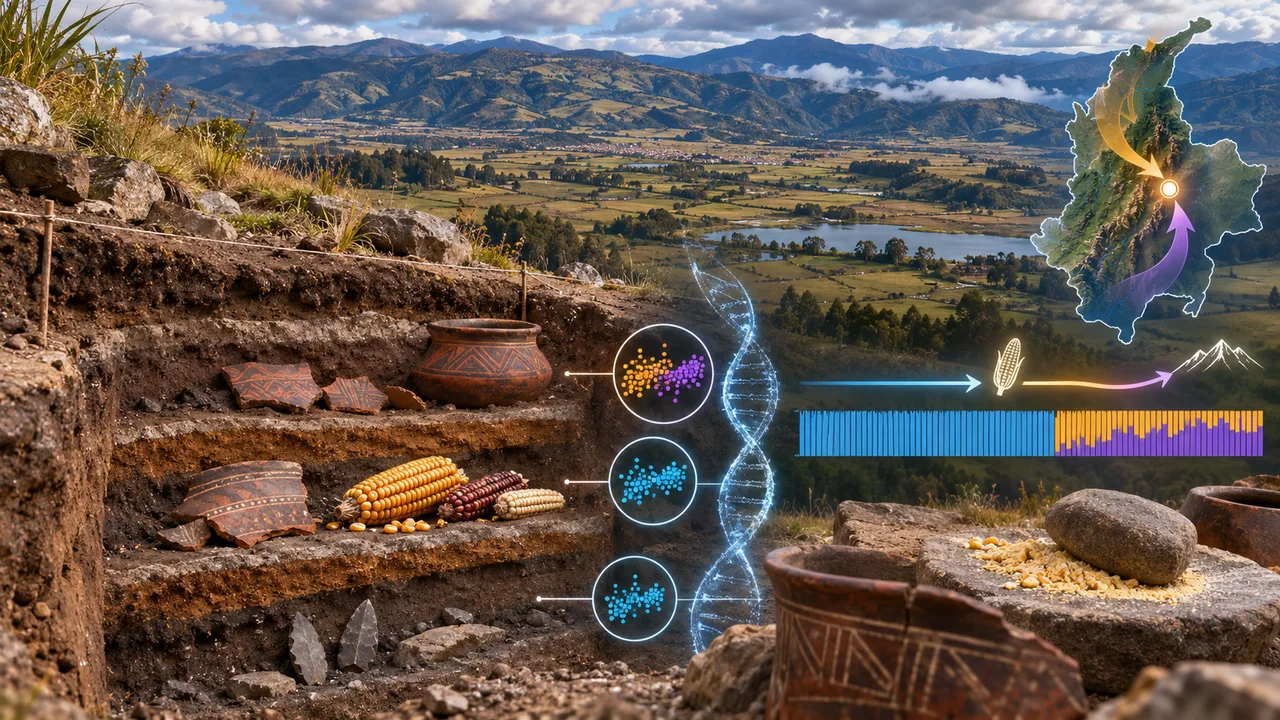
The Altiplano Cundiboyacense in the eastern Colombian Andes preserves one of the Americas' most continuous archaeological sequences, recording cultural and demographic change. We generated genome-wide data from 212 individuals spanning over 7,000 years, including early-middle and middle Holocene hunter-gatherers, initial late Holocene groups with mixed economies and the earliest isotopic evidence of maize consumption, and increasingly sedentary Herrera and Muisca populations. Individuals predating the Herrera Period form a lineage that persisted for five millennia, structured by drift in small groups without external gene flow. Two individuals dating ∼2,800 years before present (BP) retain autochthonous ancestry while showing isotopic signatures consistent with maize consumption, decoupling subsistence change from population replacement. The emergence of Herrera culture ∼2,200 BP coincided with a sharp genetic break by ∼2,000 BP, which reflects migration by people descended from admixture ∼4,000 BP between groups with Chibchan- and Amazonian-Andean-related ancestries. Herrera and Muisca Period individuals show north-south genetic substructure paralleling archaeological differentiation.