Structural Chemistry of [V 2 As 17 ] 3- and [V 2 Sb 17 ] 4- : A Complex Interplay between V-Pn and Pn-Pn Bonding.
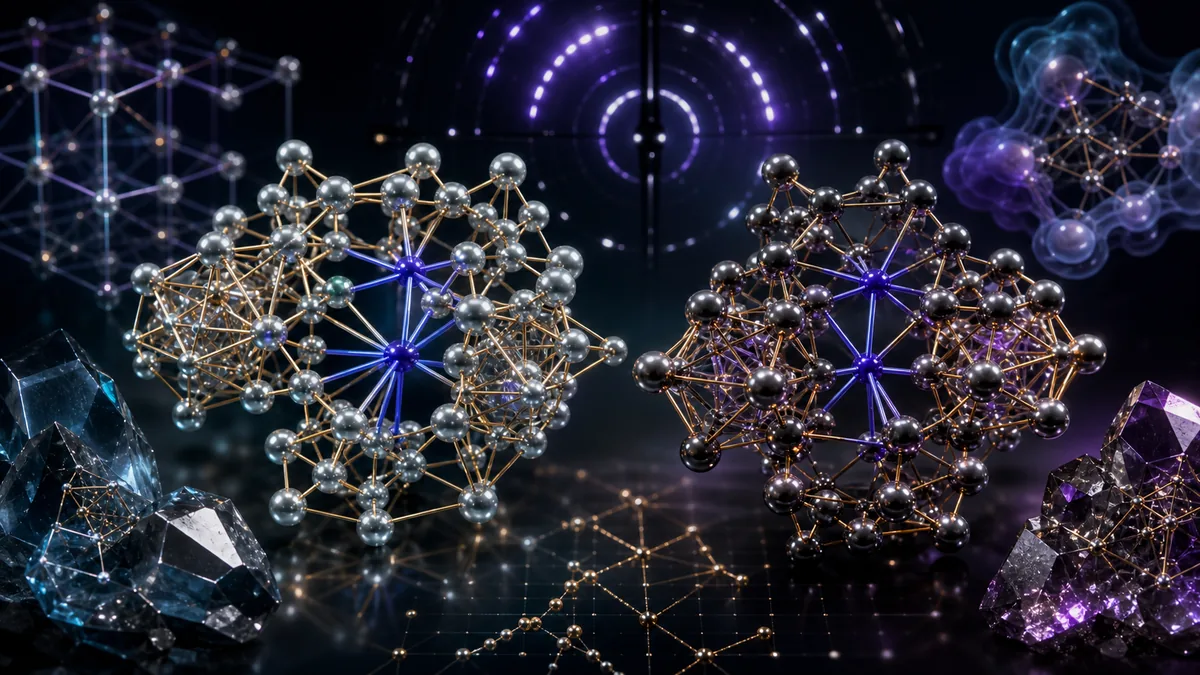
The ability of the heavier pnictogen elements, P, As, Sb and Bi, to form extensively catenated structures is well established, and a wide range of architectures is known, both for the isolated ions and for their coordination complexes. In this work, we report two new vanadium clusters, [V 2 As 17 ] 3- and [V 2 Sb 17 ] 4- , which contain crown-like VPn 8 units, linked by a single bridging atom. Reaction monitoring using ESI-MS suggests a growth pathway involving both VPn 8 and VPn 9 units, the la
The ability of the heavier pnictogen elements, P, As, Sb and Bi, to form extensively catenated structures is well established, and a wide range of architectures is known, both for the isolated ions and for their coordination complexes. In this work, we report two new vanadium clusters, [V 2 As 17 ] 3- and [V 2 Sb 17 ] 4- , which contain crown-like VPn 8 units, linked by a single bridging atom. Reaction monitoring using ESI-MS suggests a growth pathway involving both VPn 8 and VPn 9 units, the latter appearing transiently in the reaction mixture. Density functional theory reveals that the redox-active orbital has Pn-Pn antibonding character: the two clusters can therefore be considered to map a segment of the potential energy surface linking the entirely separated fragments to a single fused Pn 17 unit.