Environment

Steric Hindrance of Proton Donors Modulates Heterogeneous Electrochemical Nitrogen Reduction Reaction Selectivity in Nonaqueous Electrolytes.
| Source: Journal of the American Chemical Society

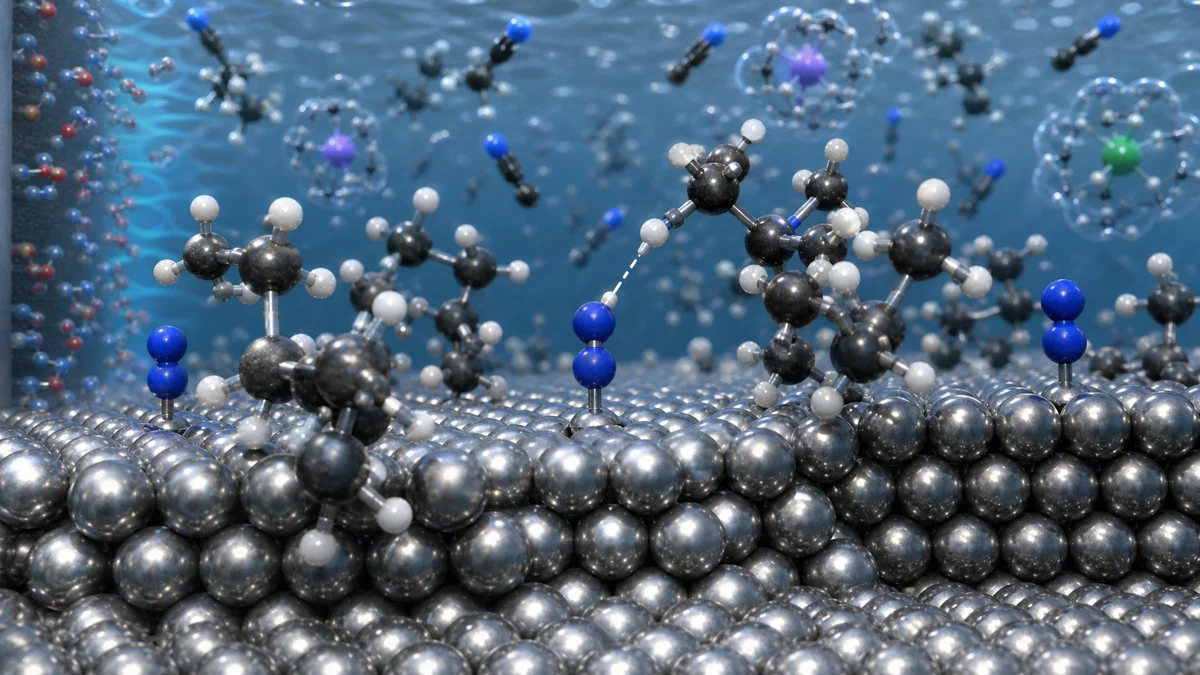
The electrochemical nitrogen reduction reaction (NRR) in aqueous electrolytes is severely limited by the early buildup of adsorbed H (*H) at cathodic potentials, which suppresses N 2 adsorption (*N 2 ) and promotes the hydrogen evolution reaction (HER). Nonaqueous electrolytes containing molecular proton donors offer a route to mitigate this competition, but molecular design principles that suppress the HER without comparably slowing the NRR remain poorly defined. Here, density functional theory

The electrochemical nitrogen reduction reaction (NRR) in aqueous electrolytes is severely limited by the early buildup of adsorbed H (*H) at cathodic potentials, which suppresses N 2 adsorption (*N 2 ) and promotes the hydrogen evolution reaction (HER). Nonaqueous electrolytes containing molecular proton donors offer a route to mitigate this competition, but molecular design principles that suppress the HER without comparably slowing the NRR remain poorly defined. Here, density functional theory calculations, potential-dependent free energy analysis, and microkinetic modeling show that proton donor steric hindrance selectively gates interfacial proton-coupled electron transfer (PCET) on Ru(0001) in acetonitrile. Increasing donor steric bulk substantially raises the barrier for the HER Volmer step, while only weakly perturbing the rate-determining *N 2 protonation step. This asymmetry originates from the proton acceptor geometry: proton transfer to a flat metal site requires a close donor approach to the surface and is increasingly blocked by bulky substituents, whereas the distal N atom of adsorbed *N 2 protrudes from the surface and remains comparatively accessible. Consistent with this picture, the effective symmetry factor for the HER decreases with donor steric bulk, suppressing the HER in both the barrier height and potential response. Microkinetic simulations predict that bulky proton donors widen the cathodic potential window over which high NRR faradaic efficiency is maintained, while intrinsic NRR activity remains largely catalyst-limited. These findings identify donor-acceptor accessibility as a molecular design principle for selective interfacial PCET in nonaqueous electrocatalysis.

Read the original source →

Related Stories

Environment

Reversing vegetable biodiversity loss to diversify diets.

Vegetables are a critical component of diets, with inadequate intake of this essential food group leading to poor dietary quality and malnutrition. Food system assessments identify insufficient production, comparatively high prices, and sociocultural barriers as key constraints to vegetable consumption. We argue that vegetable biodiversity, spanning vegetable species and their varieties, as well as their wild relative species, is a central yet underutilized lever for enhancing vegetable consumpt

Continue reading
Environment

Sediment accumulation rate predicts the temporal resolution of marine fossil assemblages.

Time averaging (TA), the mixing of noncontemporaneous organisms in fossil assemblages, governs the resolution of paleontological data and determines which biological and environmental processes are recorded in the geological record. To assess variation in TA and its dependence on external drivers, we used amino acid and radiocarbon methods to individually date 7,593 specimens across 384 samples from late Quaternary marine assemblages of calcifying organisms. Bivalve mollusks dominated the data,

Continue reading
Environment

Geometry controls momentum flux in the sprinkler problem.

Hydro- and aero-mechanical devices convert fluid flows into useful motions, force, and power. The operating principles can involve subtle and poorly understood physics, as epitomized by open questions about systems that aspirate flows through curving tubular arms. Since its introduction by Mach and popularization by Feynman, the so-called reverse sprinkler problem has evoked many competing theories and fluid mechanical effects that have not to date been distinguished by experiments. Here we cond

Continue reading
Environment

Guanidine fuels rapid resurrection of desert cyanobacteria.

In desert ecosystems, microbial activity is driven by brief hydration pulses but is severely limited by persistent nutrient scarcity. Cyanobacteria serve as essential pioneer photoautotrophs, maintaining biogeochemical cycles and ecosystem stability in these arid landscapes. However, their ability to quickly reactivate after rehydration is critically restricted by nitrogen availability. Although the nitrogen demand can be met later by biological nitrogen fixation, it is ineffective and irrelevan

Continue reading
Environment

The unique Efg1 fungal virulence regulon in the catheterized bladder environment.

Urinary catheterization, a frequent procedure in hospitals, nursing homes, and other healthcare facilities, is a primary driver of nosocomial infections. The most common of these are catheter-associated urinary tract infections (CAUTIs), which often progress to severe complication, sepsis, and ultimately death. The fungus Candida albicans is a primary causative agent of CAUTIs; yet, its tissue-specific pathogenesis remains poorly understood, which complicates development of efficient treatments.

Continue reading