Health & Medicine

Single-cell variant-to-enhancer-to-gene map for coronary artery disease.
| Source: Nature

Although coronary artery disease (CAD) genome-wide association studies (GWAS) have identified hundreds of loci, most variants lie in non-coding regions, obscuring the causal gene programmes and cell types driving disease 1,2 . Here we performed single-nucleus multi-omic profiling of gene expression and chromatin accessibility in human coronary arteries from 44 people to construct a genome-wide single-cell variant-to-enhancer-to-gene map. We identified 11,269 chromatin accessibility quantitative

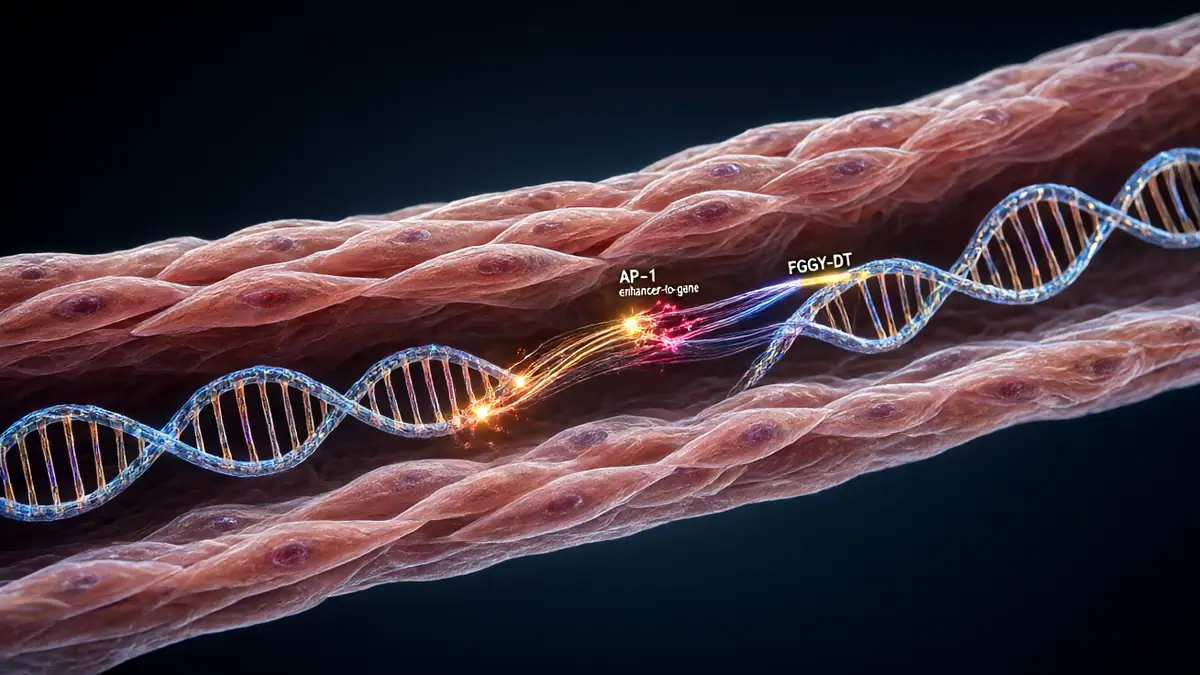
Although coronary artery disease (CAD) genome-wide association studies (GWAS) have identified hundreds of loci, most variants lie in non-coding regions, obscuring the causal gene programmes and cell types driving disease 1,2 . Here we performed single-nucleus multi-omic profiling of gene expression and chromatin accessibility in human coronary arteries from 44 people to construct a genome-wide single-cell variant-to-enhancer-to-gene map. We identified 11,269 chromatin accessibility quantitative trait loci (caQTLs) across principal vascular cell types, including CAD-associated caQTLs in smooth muscle cells (SMCs). Using dynamic single-cell caQTL modelling 3 , we show that variant effects on chromatin vary across SMC states. For example, rs658956 -mediated suppression of the FGGY-DT enhancer through disruption of an AP-1 motif is amplified as SMCs transition towards a fibromyocyte fate. We next performed genome-wide high-throughput chromosome conformation capture (Hi-C) in 15 human coronary arteries, showing that rs4887091 in the ADAMTS7 CAD locus has allele-dependent effects on CCCTC-binding factor occupancy and loop strength. Integrating Hi-C, Hi-C with chromatin immunoprecipitation and in vitro clustered regularly interspaced short palindromic repeats interference (CRISPRi) nominated AMOTL2 as a distal SMC-specific CAD gene whose loss promotes proliferation and suppresses contractile identity. Finally, arrayed Perturb-seq of GWAS-nominated enhancers converged on extracellular matrix remodelling as a core SMC disease programme. Together, these findings provide a framework for mapping non-coding GWAS variants to cell types, chromatin states and gene programmes in human disease.

Read the original source →

Related Stories

Health & Medicine

Phosphorylation-dependent ATPase activity regulates subunit shuffling dynamics in cyanobacterial circadian clock proteins.

Protein complexes are essential for cellular functions, with their dynamics increasingly recognized as key regulatory elements. In the cyanobacterial circadian clock, the KaiC hexamer is highly dynamic, undergoing phosphorylation-dependent monomer shuffling that synchronizes individual oscillators. However, the molecular mechanism of monomer shuffling is not fully understood. Here we combine a chromatography-based method with single-molecule fluorescence microscopy to quantify subunit exchange i

Continue reading
Health & Medicine

Telehealth to Support Coordinated Spontaneous Awakening and Breathing Trials in Invasive Ventilation: The TEACH Cluster Randomized Clinical Trial.

Coordinated spontaneous awakening trials and spontaneous breathing trials (C-SAT/SBT) improve outcomes for patients receiving invasive mechanical ventilation, but implementation remains inadequate. To evaluate whether a telehealth intervention added to a standard audit and feedback implementation of C-SAT/SBT increases adherence and improves outcomes compared with standard audit and feedback implementation alone (control). A cluster randomized type 2 hybrid effectiveness-implementation clinical

Continue reading
Health & Medicine

Heterogeneity co-evolves with architecture to determine colon cancer outcome.

Intratumoural heterogeneity, originating from genetic, epigenetic and phenotypic diversity, is pervasive in cancer and a fundamental barrier to curative treatment 1,2 . How these heterogeneous cell states emerge and co-evolve within tumours remains poorly understood. Here we develop a deep-learning framework that quantifies colorectal cancer tissue architecture and nuclear morphology at subcellular resolution to predict patient outcome. Integrating this with spatial transcriptomics, multiplex im

Continue reading
Health & Medicine

Transcription from megabase-scale heterochromatin generates neural barcodes.

Heterochromatin typically represses genes 1,2 , yet some genes paradoxically require it for activation 3-7 . How can the same chromatin environment both silence and promote transcription? Here we address this question by interrogating the clustered protocadherin (Pcdh) locus, where subsets of genes are stochastically expressed while most remain silent 8 . In neurons, stochastic and combinatorial expression of Pcdh genes generates unique cell-surface barcodes required for self-non-self discrimina

Continue reading
Health & Medicine

Structural basis of RNA-guided DNA integration by type I CAST systems.

CRISPR-associated transposases (CASTs) achieve site-specific DNA integration by combining the RNA-guided targeting action of a nuclease-deficient CRISPR-Cas system with the assembly of a Tn7-like transpososome complex 1,2 . Understanding the detailed mechanisms of this elaborate process is paramount to engineering CAST systems into programmable genetic tools 3-6 . Type I-F Pseudoalteromonas CAST (PseCAST) shows the highest activity in mammalian cells so far 7 and has been adapted extensivel

Continue reading