Selective Reduction of Carbon Dioxide in Water Using [M(bpy 2+ )(CO) 3 (I)] 2+ (M = Mn, Re) Electrocatalysts with Pendent Cations.
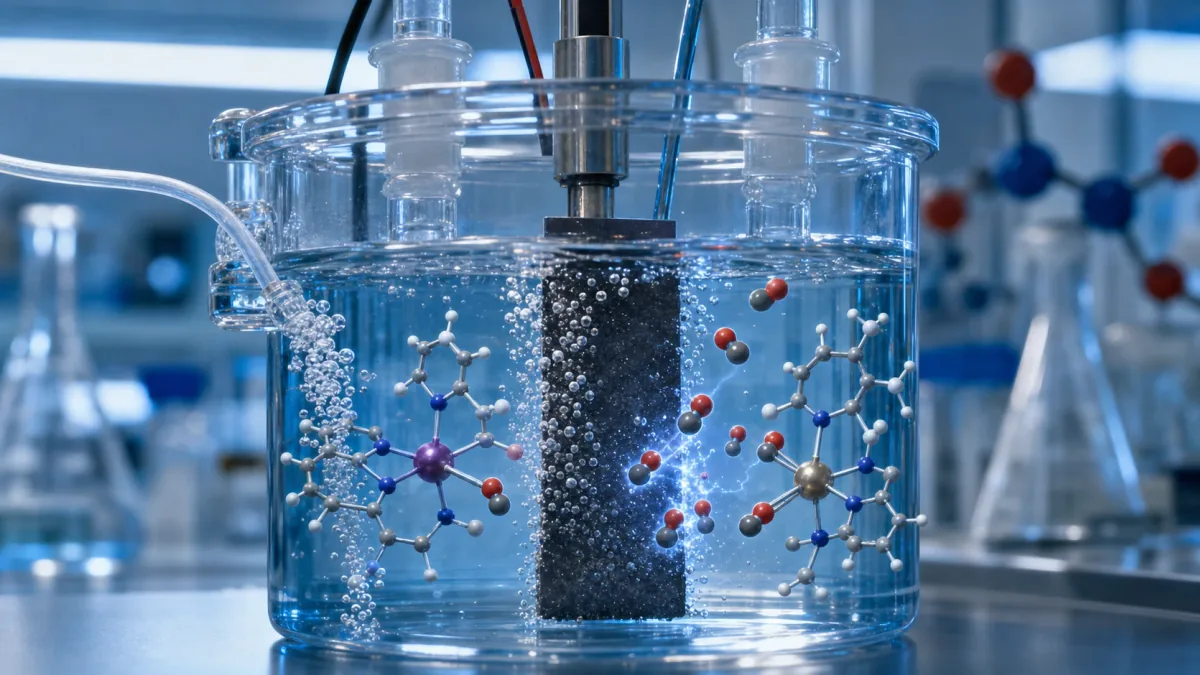
Manganese(I) carbonyl complexes are promising electrocatalysts for CO 2 reduction, yet their application in homogeneous aqueous media remains limited by poor solubility and selectivity. Here, we report water-soluble Mn(I) and Re(I) complexes fac -[M(bpy 2+ )(CO) 3 X] 2+ (X = I or Cl), featuring bipyridine ligands functionalized with -Ph-CH 2 -(NMe 3 ) + cationic ammonium groups that integrate water solubility with secondary-sphere stabilization. In a bicarbonate buffer at pH 6.8, the Mn catalyst
Manganese(I) carbonyl complexes are promising electrocatalysts for CO 2 reduction, yet their application in homogeneous aqueous media remains limited by poor solubility and selectivity. Here, we report water-soluble Mn(I) and Re(I) complexes fac -[M(bpy 2+ )(CO) 3 X] 2+ (X = I or Cl), featuring bipyridine ligands functionalized with -Ph-CH 2 -(NMe 3 ) + cationic ammonium groups that integrate water solubility with secondary-sphere stabilization. In a bicarbonate buffer at pH 6.8, the Mn catalyst is completely selective for CO production at a low overpotential (η = 0.3 V), operating by a protonation-first mechanism with observed rates of ∼10 s -1 . Pulse radiolysis reveals that the one-electron-reduced Mn species undergoes dimerization in the absence of CO 2 but reacts competitively with CO 2 through an initial pre-equilibrium followed by fast formation of a dinuclear CO 2 -bridged species (Δ G o = -12.4 kcal mol -1 ). At a higher 0.6 V overpotential, a faster reduction-first pathway (∼100 s -1 ) is available upon reduction of the metallocarboxylic acid intermediate, Mn-CO 2 H 2+ ; however, this regime is functionally limited by the formation of a resistive, noncatalytic film on the electrode surface. Comparison to the analogous water-soluble Re catalyst ( k obs = 440 s -1 , η = 0.6 V) highlights the distinct mechanistic advantages of earth-abundant Mn in low-potential catalysis. These results demonstrate how cationic second-sphere design enables selective, homogeneous CO 2 reduction in water while revealing competing radical and electrode-mediated processes that govern catalytic performance.