Radiotherapy versus observation following surgical resection of WHO grade 2 atypical meningioma (ROAM/EORTC-1308): an international, multicentre, open-label, phase 3, randomised controlled trial.
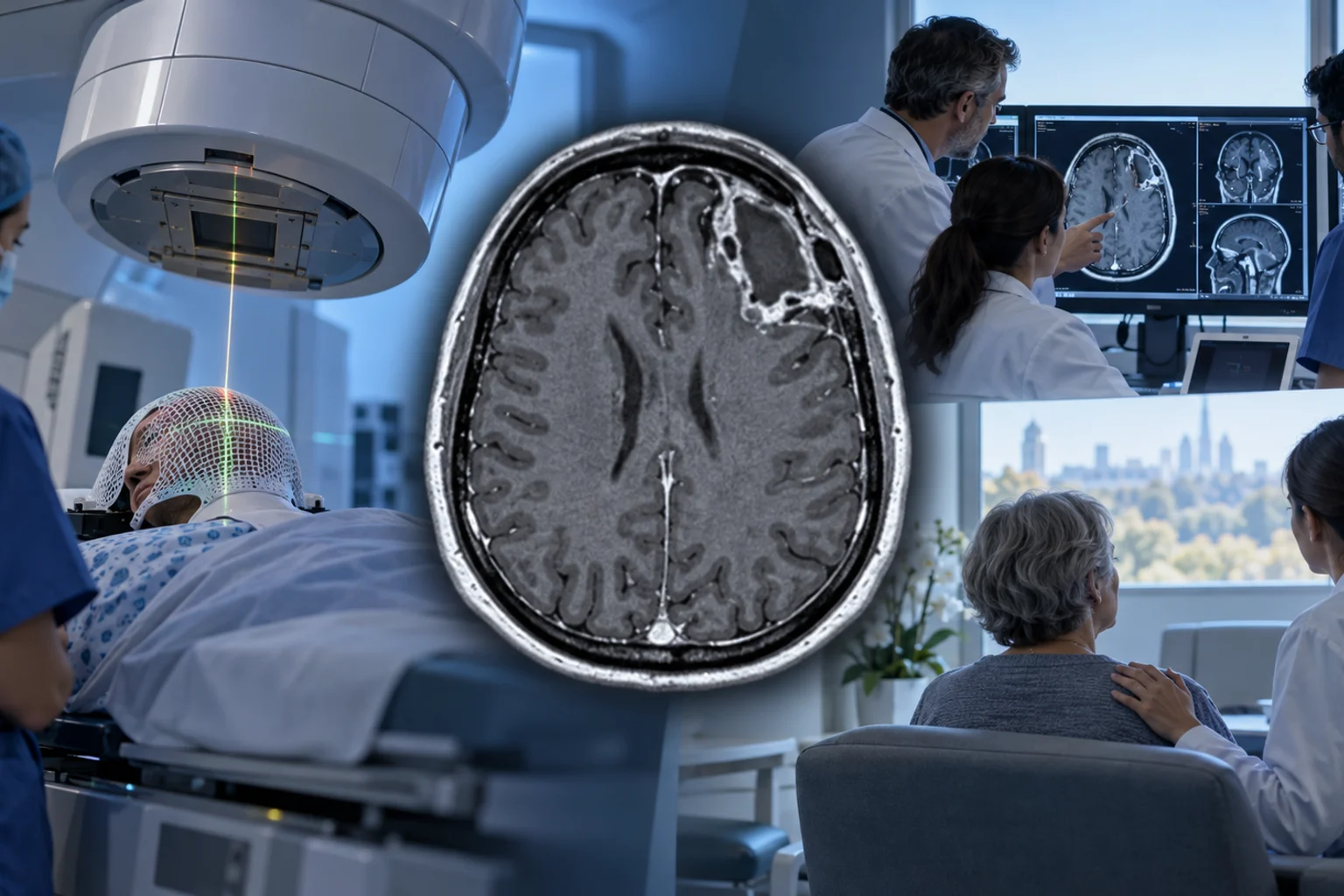
WHO grade 2 atypical meningioma is a primary brain tumour with a high risk of recurrence even after complete surgical resection. The role of adjuvant radiotherapy remains uncertain. We aimed to assess whether adjuvant radiotherapy reduces recurrence compared with observation in patients with a newly diagnosed atypical meningioma who have undergone complete surgical resection. ROAM/EORTC-1308 was an international, multicentre, open-label, phase 3, randomised controlled trial, conducted at 58 hosp
WHO grade 2 atypical meningioma is a primary brain tumour with a high risk of recurrence even after complete surgical resection. The role of adjuvant radiotherapy remains uncertain. We aimed to assess whether adjuvant radiotherapy reduces recurrence compared with observation in patients with a newly diagnosed atypical meningioma who have undergone complete surgical resection. ROAM/EORTC-1308 was an international, multicentre, open-label, phase 3, randomised controlled trial, conducted at 58 hospitals and academic centres in 11 countries. Eligible sites had appropriate multidisciplinary expertise, neurosurgery, and radiotherapy facilities. Patients aged 16 years or older who had undergone a surgeon-assessed complete surgical resection of newly diagnosed atypical meningioma were randomly assigned (1:1) to adjuvant radiotherapy or observation. Randomisation was done using a web-based interface using random variable blocks of sizes two and four, stratified by location (UK or non-UK). Participants assigned to the radiotherapy group received fractionated external-beam intensity-modulated radiotherapy at a total dose of 60 Gy in 30 fractions over 6 weeks. Participants were followed up for a minimum of 4 years. The primary outcome was disease-free survival, defined as time from surgery to MRI-confirmed recurrence or death due to any cause, analysed in all randomly assigned participants in their assigned treatment group. Harms analysis was done in the as-treated population. The trial was registered with ISRCTN, ISRCTN71502099, and has completed. Between April 28, 2016, and May 21, 2021, 990 patients were assessed for eligibility, 157 of whom were randomly assigned to radiotherapy (n=78) or observation (n=79). Median age was 57·40 years (IQR 49·09-66·93); 84 (54%) participants were female and 73 (46%) were male. At a median follow-up of 64 months (IQR 50-75), meningioma recurrence occurred in 11 (14%) of 78 participants in the radiotherapy group and 24 (30%) of 79 in the observation group. 5-year disease-free survival was 79·9% (95% CI 67·6-87·9) in the radiotherapy group and 64·3% (51·9-74·2) in the observation group (absolute difference 15·6% percentage points [95% CI 0·6-30·5]). Disease-free survival was improved in the radiotherapy group compared with the observation group (hazard ratio 0·51 [95% CI 0·27-0·97]; p=0·0396). Grade 2 or 3 radiation-related serious adverse events occurred in five (8%) of 66 participants in the radiotherapy group, with no treatment-related deaths. Our findings suggest that adjuvant radiotherapy should be considered in patients with atypical meningioma after complete surgical resection of atypical meningioma when the prevention of recurrence is valued higher than the potential delayed adverse effects of radiotherapy. This practice will benefit patients by reducing meningioma recurrence. Decisions should be based on individual discussion with the patient. National Institute for Health and Care Research Health Technology Assessment programme, the European Organisation for Research and Treatment of Cancer Brain Tumour Group and Radiation Oncology Group, and the Heath Research and Medical Research Council of Australia.