Quantitative calibration of a spatial QSP model identifies fibroblast impact on HCC immunotherapy.
Computational models are increasingly used to predict treatment response and optimize cancer therapeutic strategies. Quantitative systems pharmacology (QSP) models mechanistically simulate tumor progression and pharmacological interventions, enabling virtual clinical trials, model-informed drug development, and biomarker discovery, but they lack spatial resolution to represent tumor microenvironment (TME) architecture. Coupling QSP with agent-based modeling creates spatial QSP (spQSP) frameworks
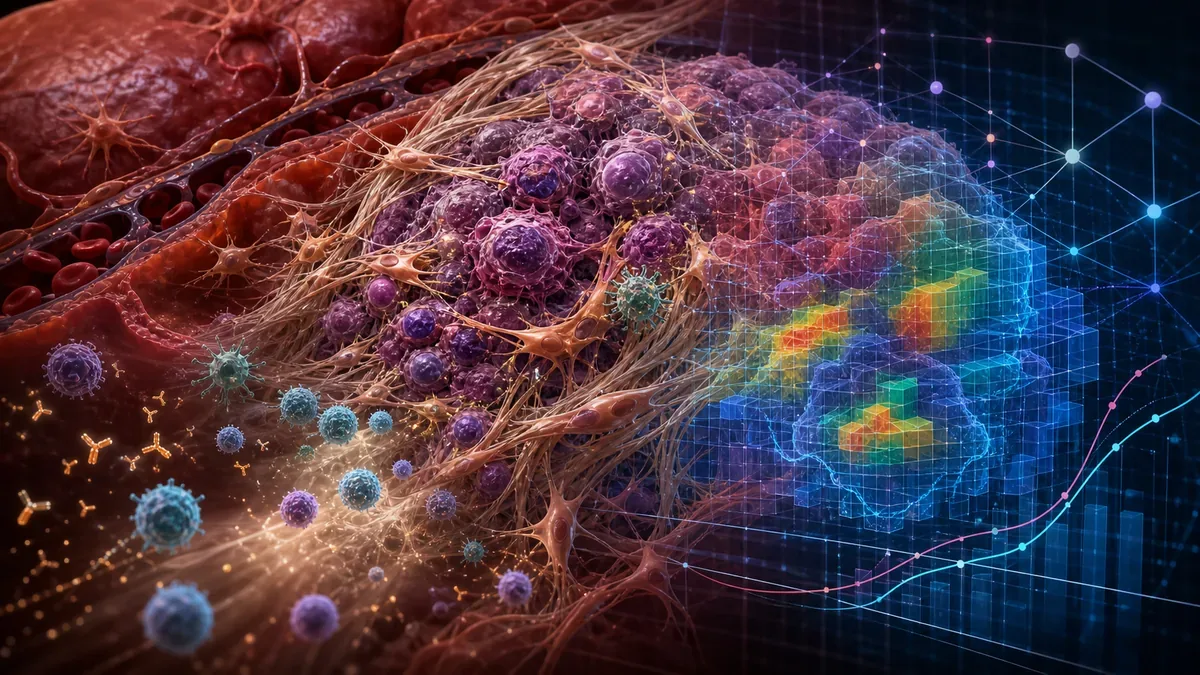
Computational models are increasingly used to predict treatment response and optimize cancer therapeutic strategies. Quantitative systems pharmacology (QSP) models mechanistically simulate tumor progression and pharmacological interventions, enabling virtual clinical trials, model-informed drug development, and biomarker discovery, but they lack spatial resolution to represent tumor microenvironment (TME) architecture. Coupling QSP with agent-based modeling creates spatial QSP (spQSP) frameworks capable of resolving tissue-level organization at single-cell resolution; however, parameterizing these models with human tumor data remains challenging. Here, we extend an existing spQSP model of liver cancer by mechanistically incorporating a fibroblast module and develop an Approximate Bayesian Computation-Sequential Monte Carlo calibration pipeline that integrates spatial molecular data. This calibration framework matches tumor architectures between spQSP simulations and spatial molecular data by fitting statistical summaries of cellular neighborhoods. The calibrated model reproduces fibroblast-mediated exclusion of lymphocyte infiltration observed in spatial transcriptomics and predicts posttreatment spatial tumor states in an independent cohort receiving immune checkpoint inhibitor and tyrosine kinase inhibitor combination therapy. Finally, we identify spatial and nonspatial pretreatment biomarkers associated with therapeutic response. Together, this study demonstrates how integrating spatial omics with mechanistic modeling enables quantitative calibration, reveals the spatial role of fibroblasts in shaping immunosuppressive TMEs, and supports in silico biomarker discovery toward personalized cancer therapy.