Machine Learning-Assisted Development of High-Performance Ethanol Synthesis Catalysts via CO 2 Hydrogenation.
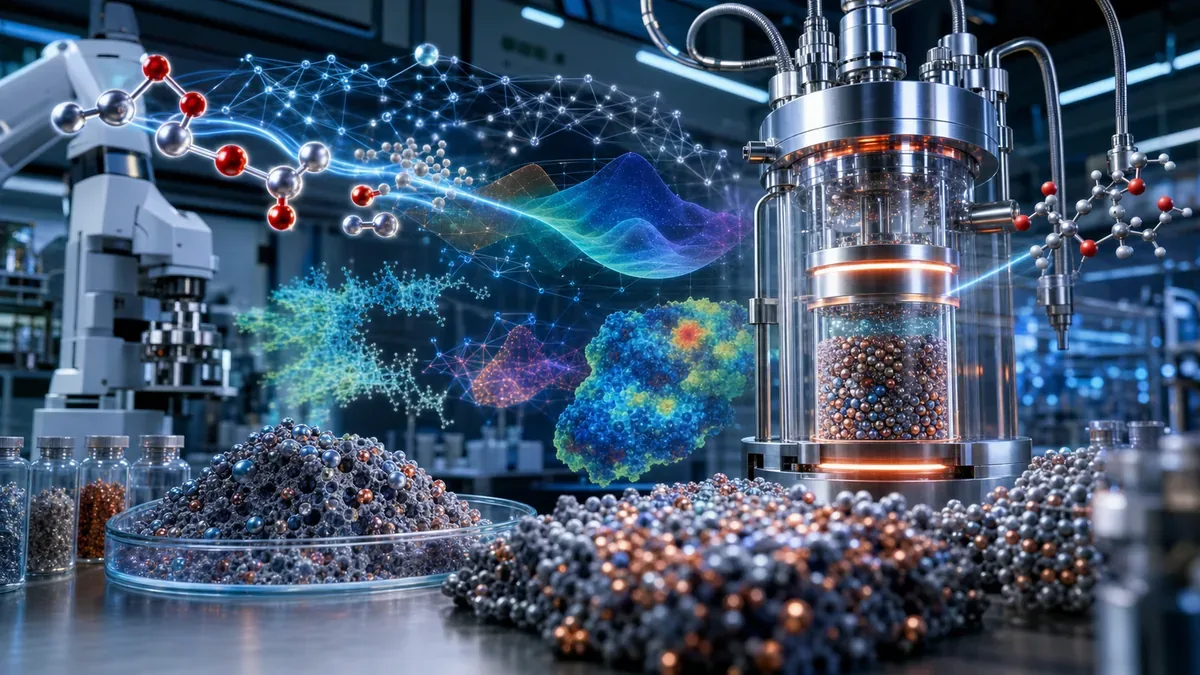
The discovery and development of high-performance catalysts, which is crucial across all catalysis areas, requires advanced technologies and innovative approaches. Recently, machine learning (ML) has shown promise in accelerating this process, but its capability and examples of discovery of truly novel catalysts have remained limited. In this study, we describe an ML approach that goes beyond the traditional element pool, incorporating elements that have not been previously studied, to develop h
The discovery and development of high-performance catalysts, which is crucial across all catalysis areas, requires advanced technologies and innovative approaches. Recently, machine learning (ML) has shown promise in accelerating this process, but its capability and examples of discovery of truly novel catalysts have remained limited. In this study, we describe an ML approach that goes beyond the traditional element pool, incorporating elements that have not been previously studied, to develop highly efficient catalysts for ethanol synthesis via CO 2 hydrogenation. Starting with an initial data set of 58 catalysts (274 data points obtained at reaction temperatures ranging from 240-400 °C), we conducted 24 iterations of a closed-loop discovery system (ML predictions + experimental validation), testing a total of 555 catalysts (2477 data points), and building a large experimental data set. More than 50 catalysts with superior activity were discovered through this data-driven approach. The multielemental Pd(0.8)-Au(0.3)/K(2.5)-Sr(1)-Fe(20)-Zn(4)-Cd(2)-Yb(1)-Re(1)/CeO 2 (25%)-ZrO 2 catalyst, where the numbers in parentheses represent weight percent (wt %), was identified as the most effective catalyst for ethanol synthesis (ethanol space-time yield: 8.2 mmol g cat -1 h -1 with a CO 2 conversion of 57.6% and an ethanol selectivity of 23.2% under reaction conditions of 360 °C, 4 MPa, 12 L g cat -1 h -1 , H 2 /CO 2 = 3/1). Comprehensive characterizations, including in situ/operando techniques such as X-ray absorption spectroscopy (XAS), ambient-pressure X-ray photoelectron spectroscopy (AP-XPS), and diffuse reflectance infrared Fourier transform spectroscopy (DRIFTS), enable us to highlight the critical roles of each constituting element in improving ethanol synthesis efficiency.