Localized sample-based quantum diagonalization for strongly correlated chemistry.
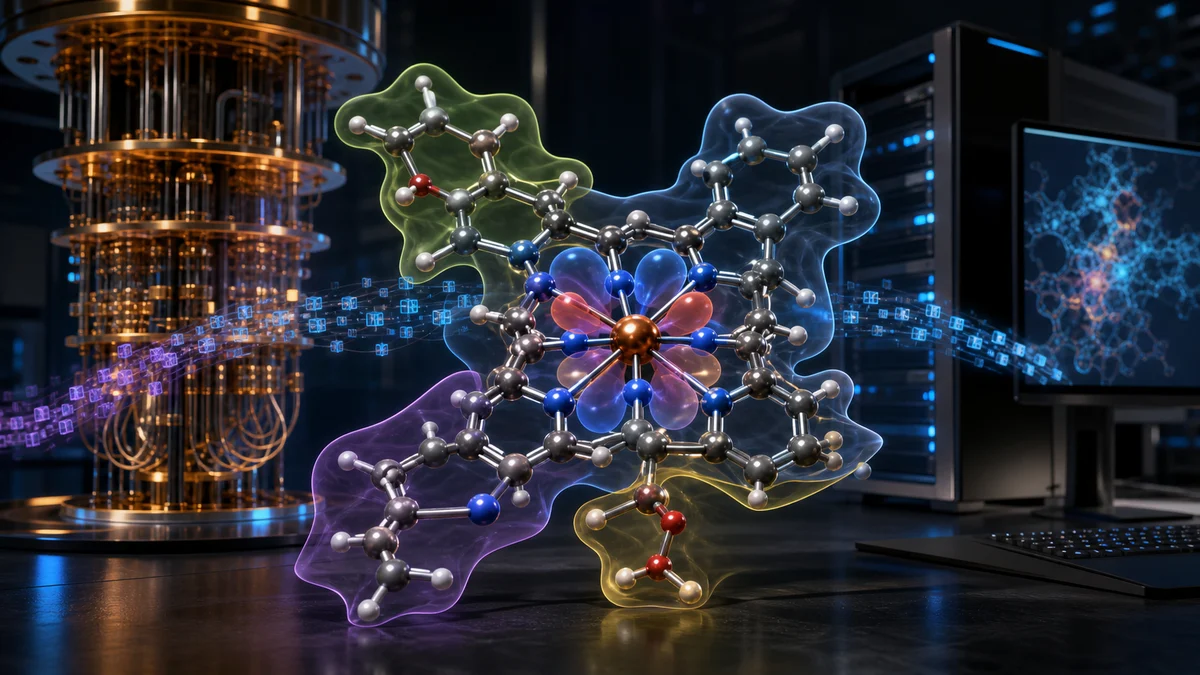
We develop a hybrid quantum-classical workflow combining sample-based quantum diagonalization (SQD) and the localized active space self-consistent field method (LASSCF) to solve for the ground states of transition-metal complexes, a longstanding challenge for both classical and quantum algorithms. The resulting approach, named LASSQD, integrates quantum sampling with fragment-based multireference theory to reduce the computational cost of solving strongly correlated active spaces. We test LASSQD
We develop a hybrid quantum-classical workflow combining sample-based quantum diagonalization (SQD) and the localized active space self-consistent field method (LASSCF) to solve for the ground states of transition-metal complexes, a longstanding challenge for both classical and quantum algorithms. The resulting approach, named LASSQD, integrates quantum sampling with fragment-based multireference theory to reduce the computational cost of solving strongly correlated active spaces. We test LASSQD on multiple iron-based complexes and demonstrate that it agrees with LASSCF within 1 kcal/mol, albeit at a much reduced computational cost. The cost reduction originates from the use of a sparse approximation of the exact and combinatorially large ground-state wavefunction, which also enables LASSQD to treat fragment sizes that are computationally inaccessible to LASSCF, as demonstrated by our computation of the spin gap of iron-porphyrin. These results establish that LASSQD is a scalable strategy for generating reliable multireference wave functions, providing a robust starting point for post-SCF correlation methods that recover dynamic correlation beyond the active space, and a promising pathway toward quantum-enhanced electronic structure calculations.