Leveraging room-temperature plastic deformation for tailoring inorganic thermoelectrics.
Mg 3 (Sb, Bi) 2 has emerged as a promising material due to its favorable combination of high thermoelectric performance and ductility. However, a key question remains regarding how plastic deformation affects its thermoelectric properties. Here we investigate the evolution of deformation-induced defects and their influence on the transport and mechanical properties of Mg 3 (Sb, Bi) 2 . Compressive deformation introduces high densities of dislocations and deformation twins, accompanied by a prono
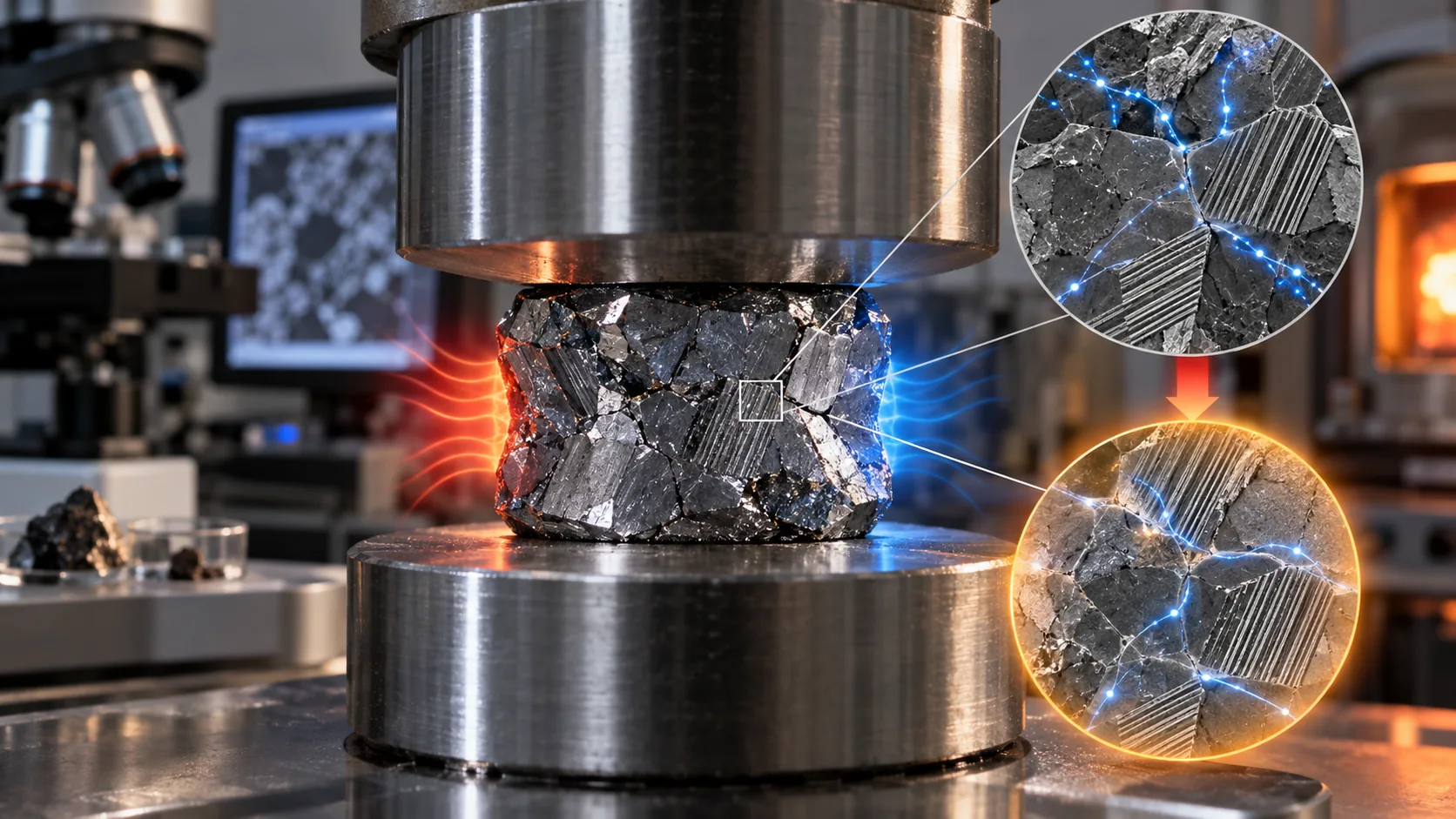
Mg 3 (Sb, Bi) 2 has emerged as a promising material due to its favorable combination of high thermoelectric performance and ductility. However, a key question remains regarding how plastic deformation affects its thermoelectric properties. Here we investigate the evolution of deformation-induced defects and their influence on the transport and mechanical properties of Mg 3 (Sb, Bi) 2 . Compressive deformation introduces high densities of dislocations and deformation twins, accompanied by a pronounced deterioration in electrical properties near room temperature. After annealing, the thermoelectric properties can be largely restored to their initial values as the dislocation density decreases substantially, whereas the twin fraction remains nearly unchanged. These results identify dislocations, rather than twins, as the predominant deformation-induced scattering centers of electrons. Meanwhile, the retained twins enable effective mechanical strengthening. The yield strengths of Mg 3.2 Sb 1.5 Bi 0.49 Te 0.01 and Mg 3.2 Sb 0.49 Bi 1.5 Te 0.01 increased by approximately 83.4% and 37.5%, respectively, while their hardness values increased by approximately 28% and 17%. These findings establish room-temperature plastic deformation and subsequent annealing as an effective strategy for achieving mechanically robust materials without compromising thermoelectric performance.