Intuitive knowledge of object acoustics enables perceptual separation of physical variables from impact sounds.
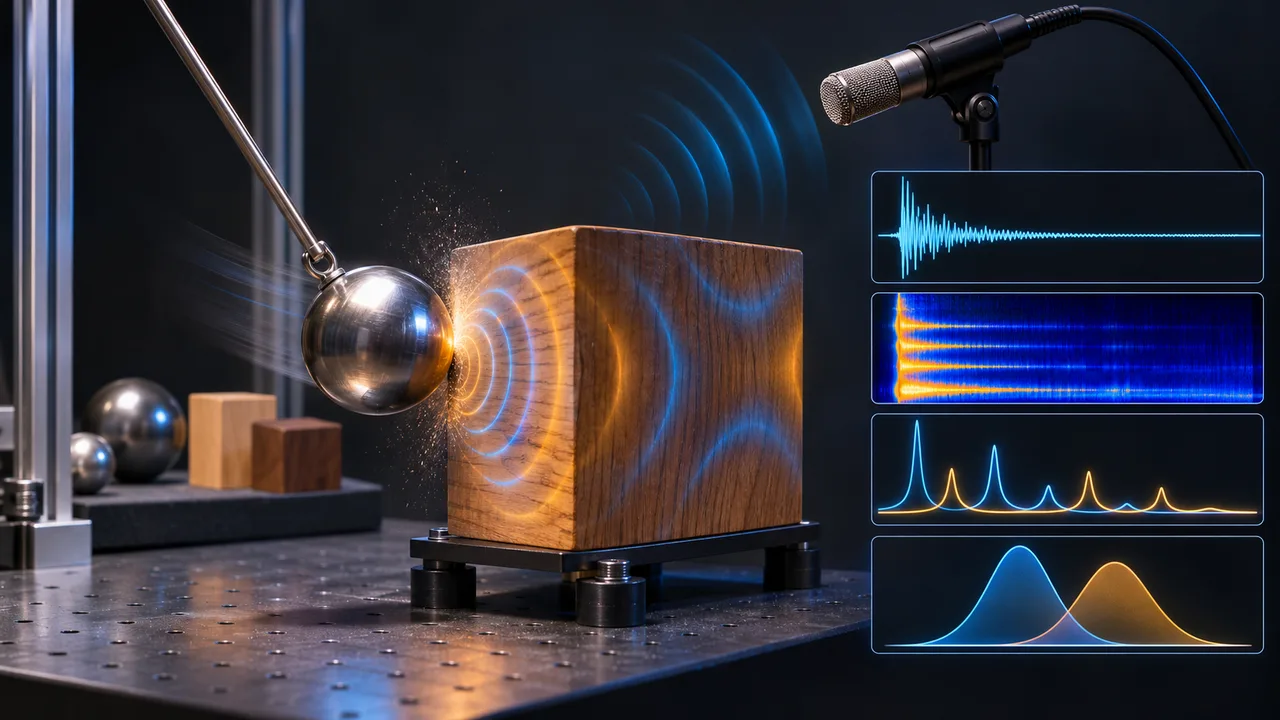
Upon hearing objects collide, humans can estimate physical attributes such as material and mass. Although the physics of sound generation is well established, the inverse problem that listeners solve-of inferring physical parameters from sound-remains poorly understood. Classical accounts posit the use of acoustic cues that correlate with physical variables but do not explain how humans might distinguish multiple concurrent physical causes. To study this problem, we measured impulse responses fr
Upon hearing objects collide, humans can estimate physical attributes such as material and mass. Although the physics of sound generation is well established, the inverse problem that listeners solve-of inferring physical parameters from sound-remains poorly understood. Classical accounts posit the use of acoustic cues that correlate with physical variables but do not explain how humans might distinguish multiple concurrent physical causes. To study this problem, we measured impulse responses from hundreds of everyday objects, extracted their resonances, and used statistics of the resonances to build a probabilistic generative model of impact sounds. We then used the model to synthesize and manipulate stimuli for experiments measuring judgments of physical variables. Humans accurately judged object properties from collision sounds. However, when both of the colliding objects varied, performance was impaired if the distribution of object resonances deviated from those measured in real-world objects. The results suggest that humans have internalized the statistical regularities of real-world object acoustics, and use this knowledge to separate the acoustic contributions of the distinct objects in the world that give rise to sounds.