Mapping the Slow Propagation of Disorder across a Photoreceptor's Tertiary Structure with Time-Resolved Crystallography.
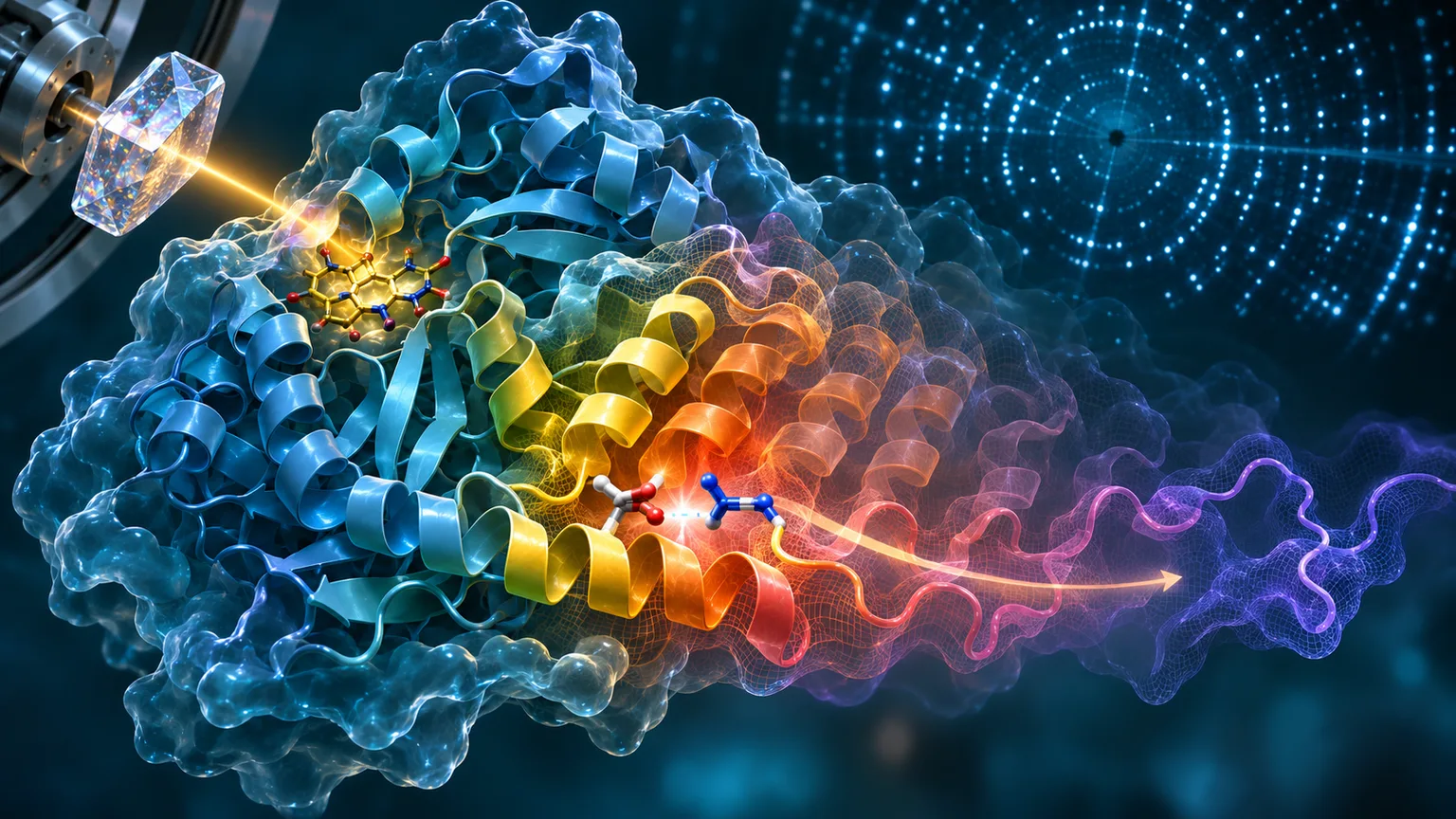
Order-disorder transitions allow many proteins to shift between compact and flexible/unfolded states, thereby acting as structural switches that regulate catalysis, signaling, recognition, and allostery. We applied time-resolved serial oscillation crystallography to establish the structural kinetics of the light-triggered order-disorder transition of an animal-like cryptochrome as a six-second-long molecular movie with near-atomic all-residue spatial resolution and millisecond temporal resolutio
Order-disorder transitions allow many proteins to shift between compact and flexible/unfolded states, thereby acting as structural switches that regulate catalysis, signaling, recognition, and allostery. We applied time-resolved serial oscillation crystallography to establish the structural kinetics of the light-triggered order-disorder transition of an animal-like cryptochrome as a six-second-long molecular movie with near-atomic all-residue spatial resolution and millisecond temporal resolution. Our 29 structural snapshots mapped the propagation of disorder across the tertiary structure motifs of a cryptochrome's C-terminal region, triggered by a single broken D321-R492 salt bridge. The order-disorder transition followed a nucleation-propagation mechanism reminiscent of helix-coil dynamics and proceeded over up to five seconds, with regions distal to the D321-R492 trigger initially undergoing slow zero-order disordering before switching to first-order unfolding kinetics. Our per-residue density analysis provides a detailed structural-kinetic basis for understanding how order-disorder transitions emerge through directional propagation across protein tertiary structures, as occurring in signaling and many other biological systems.