Intermittent gas-liquid rearrangement controls the mixing of gases in porous media.
Gas mixing in porous media governs important environmental and industrial applications in which multiple gas components share the available pore space with liquid water, simultaneously undergoing gas mixing and gas-liquid redistribution. Currently, this process is represented by macroscopic models that ignore pore scale dynamics. We demonstrate that this is not generally valid, and can lead to large errors in the mixing rate. We use 4D X-ray imaging to investigate nitrogen injection into a porou
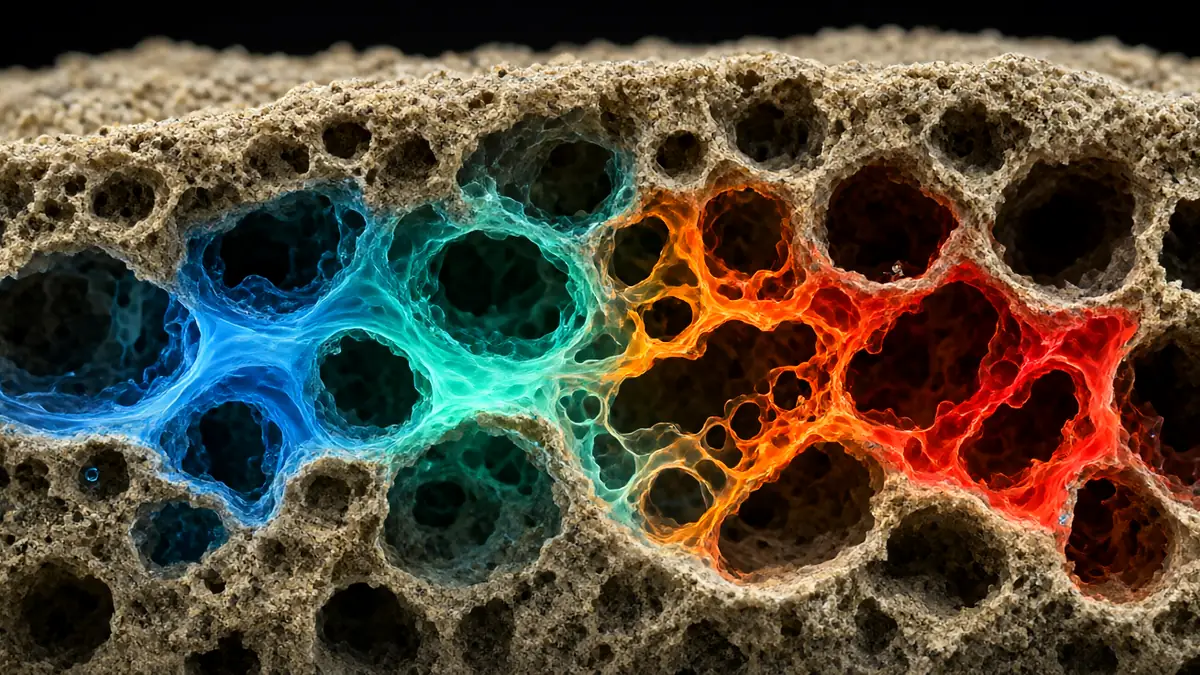
Gas mixing in porous media governs important environmental and industrial applications in which multiple gas components share the available pore space with liquid water, simultaneously undergoing gas mixing and gas-liquid redistribution. Currently, this process is represented by macroscopic models that ignore pore scale dynamics. We demonstrate that this is not generally valid, and can lead to large errors in the mixing rate. We use 4D X-ray imaging to investigate nitrogen injection into a porous sandstone saturated with krypton and water, jointly imaging the gas mixture composition evolution and multiphase flow of gas and water. In contrast to the smooth, continuous representation of the conventional advection-diffusion model, our results show that gas mixing evolves through a sequence of distinct regimes controlled by gas connectivity. Initially, immiscible gas-water displacement generates gas composition variance as the different gases occupy neighboring pores separated by water. As gas connectivity increases, intermittent gas-liquid interfacial rearrangements rapidly connect regions of contrasting gas composition, driving a fast decay in composition variance. Once connectivity stabilizes, mixing is controlled by a confined diffusion process within the quasi-static gas network. At later times, further mixing is driven slowly by multicomponent Ostwald ripening, whereby trapped gas ganglia exchange solutes through the surrounding liquid phase. These findings provide insights into gas mixing in porous media, suggesting concepts for upscaling the role of pore scale multiphase flow in gas mixing in the subsurface.