Interfacial Donnan Hydration Funnels in Lignin-Derived Carbon Orchestrate RuNi Synergy for Aldehyde-Assisted Dual-Hydrogen Electrosynthesis.
Aldehyde oxidation-coupled hydrogen production can markedly reduce the energy demand of electrolysis while enabling hydrogen generation and collection from two compartments. However, high-current-density operation relies on catalysts that sustain fast kinetics and high selectivity under strong interfacial gradients. Electro-oxidized lignin is employed to construct a lignin-metal supramolecular framework composite, which upon carbonization yields RuNi@NOLC, a Ni-enriched RuNi alloy confined withi
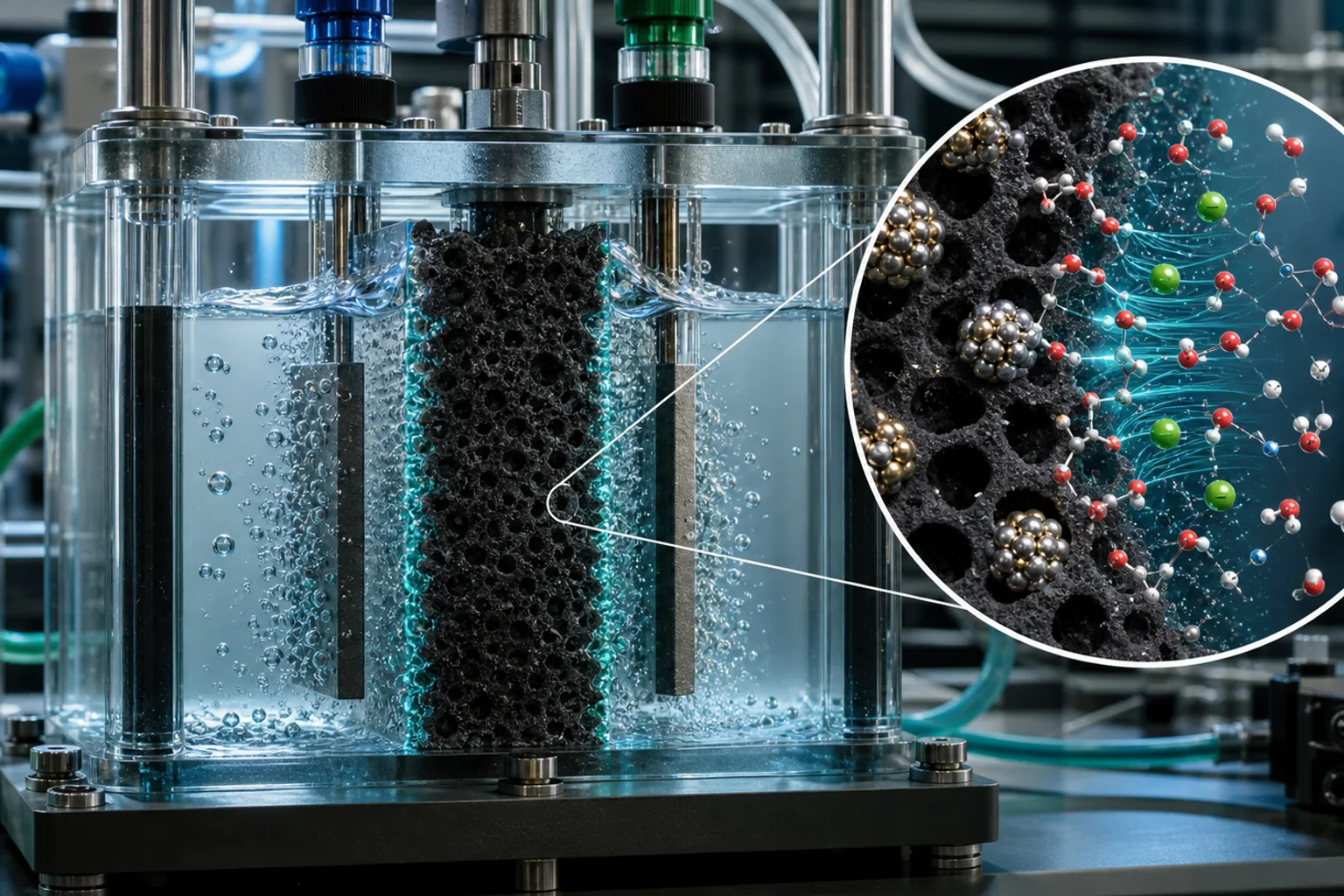
Aldehyde oxidation-coupled hydrogen production can markedly reduce the energy demand of electrolysis while enabling hydrogen generation and collection from two compartments. However, high-current-density operation relies on catalysts that sustain fast kinetics and high selectivity under strong interfacial gradients. Electro-oxidized lignin is employed to construct a lignin-metal supramolecular framework composite, which upon carbonization yields RuNi@NOLC, a Ni-enriched RuNi alloy confined within an oxygen-enriched, nitrogen-doped lignin-derived carbon (NOLC) microenvironment. In a membrane-free flow electrolyzer using RuNi@NOLC as both cathode and anode catalysts, the coupled process achieves a specific energy consumption of 0.76 kWh Nm -3 H 2 , a formate Faradaic efficiency of 99.5%, and an apparent hydrogen Faradaic efficiency of 199.6% arising from dual-compartment hydrogen generation and collection. The NOLC microenvironment provides Donnan hydration with a hydration-funnel effect, enabling directional enrichment of H 2 O together with OH - at N-containing sites and stabilization of the transition configuration for water splitting, thereby markedly accelerating the Ni-centered Volmer step as the rate-determining process and establishing a 3-fold synergy of Ni-centered water activation, Ru-mediated hydrogen release, and NOLC-directed transport of water and hydroxide. Under formaldehyde oxidation bias, Ru-OH and RuOxH species dominate low-potential initiation. Assisted by neighboring Ni-OH ads , these Ru-centered oxygenated species drive intermediates toward OCHO formation and formate production, while alloy electronic effects mitigate poisoning by strongly adsorbed intermediates before transport limitations prevail at higher potentials. This work converts the coordination-chemistry programmability of lignin into quantifiable interfacial-solvation advantages, providing a clear paradigm for understanding and designing microenvironment-dominated mechanisms in paired electrolysis.