Health & Medicine

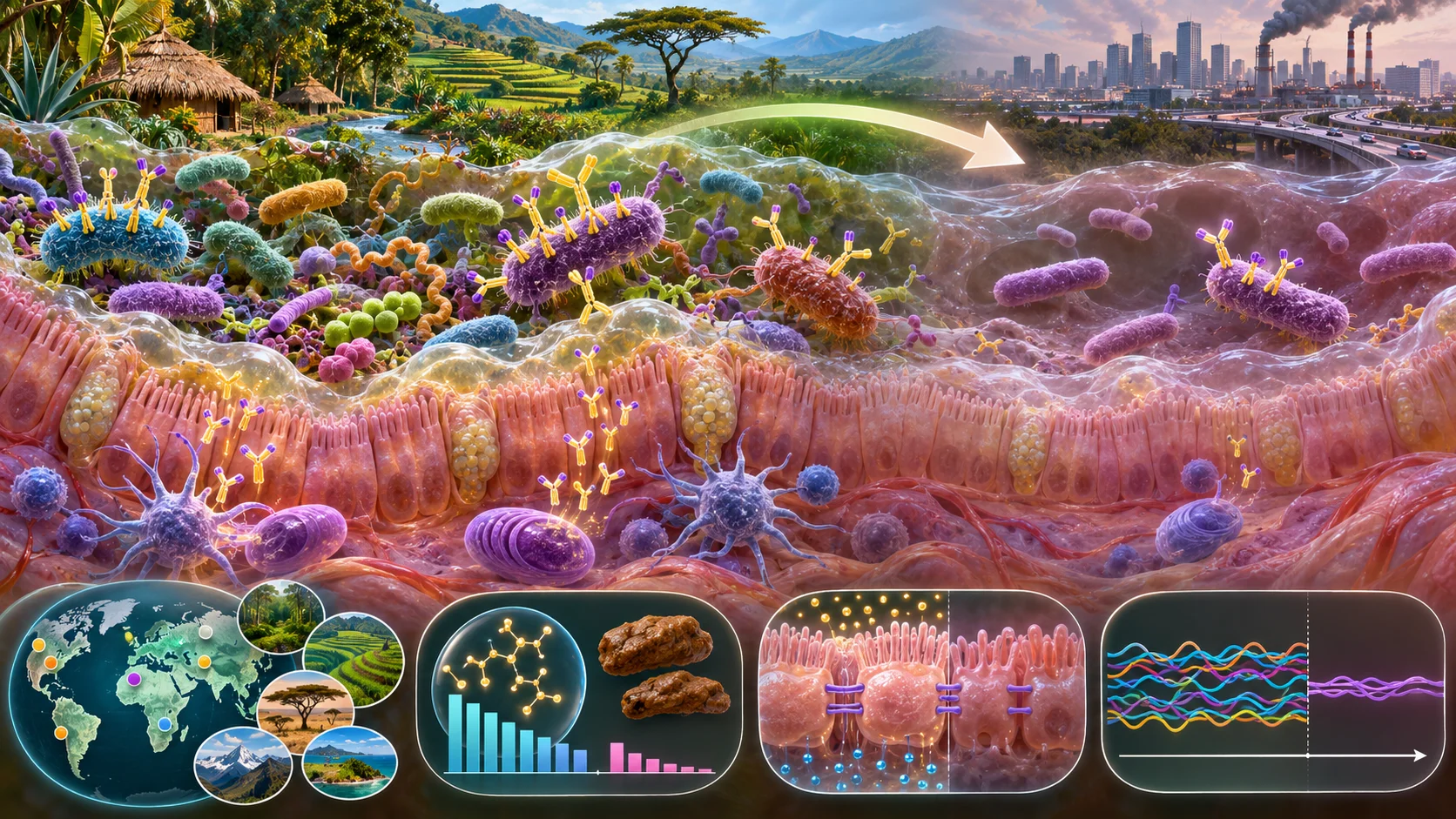
Industrialization drives convergent microbiome and host physiological shifts in the human metaorganism.
| Source: Cell

Understanding how industrialization reshapes the human metaorganism requires integrating microbiome ecology with host physiology across globally diverse populations. Here, we generate multivariate data from the Global Microbiome Conservancy cohort, including gut microbiome, immunoglobulin A (IgA) sequencing, host genotyping, diet, lifestyle, and fecal biomarker profiles, to investigate host-microbiome interactions across gradients of industrialization and geography. We show that industrializatio

Understanding how industrialization reshapes the human metaorganism requires integrating microbiome ecology with host physiology across globally diverse populations. Here, we generate multivariate data from the Global Microbiome Conservancy cohort, including gut microbiome, immunoglobulin A (IgA) sequencing, host genotyping, diet, lifestyle, and fecal biomarker profiles, to investigate host-microbiome interactions across gradients of industrialization and geography. We show that industrialization is associated with homogenized microbial compositions, reduced microbial diversity, and lower community stability, independent of host confounders. We further show that industrialization is linked to elevated markers of gut stress, increased IgA secretion, and altered patterns of IgA-bacteria interactions. Finally, we show that microbiome-based disease predictors trained on industrialized populations are uninformative in less industrialized cohorts, highlighting limited cross-population transferability. Together, our results reveal coordinated restructuring of the microbial ecosystem and host physiology and emphasize the need for inclusive, globally representative data to improve translational microbiome applications across diverse human populations.

Read the original source →

Related Stories

Health & Medicine

An innervated and vascularized HNSCC-on-a-chip model built on defined and tunable engineered extracellular matrices.

Understanding the tumor microenvironment requires experimental platforms that faithfully recapitulate its key components. Here, we present an innervated and vascularized head and neck squamous cell carcinoma (HNSCC)-on-a-chip platform built with fully defined and tunable engineered extracellular matrices (eECMs). In a stepwise increase of complexity, we first cocultured patient-derived HNSCC cells, cancer-associated fibroblasts, and endothelial cells within tailored eECMs, revealing extracellula

Continue reading
Health & Medicine

Septin binding restricts Shigella growth and triggers intracellular tolerance.

Pathogen survival relies on their ability to adapt to changing environments, yet how intracellular bacteria tolerate cell-autonomous immunity remains unclear. Septins assemble into cage-like structures around cytoplasmic Shigella targeted by autophagy, but their antibacterial activity was unknown. Using advanced microscopy and cell-free reconstitution, we show that septins polymerize into circumferentially oriented filaments that inhibit bacterial growth. RNA-sequencing reveals that septin bindi

Continue reading
Health & Medicine

DCAF6 reprograms TGF-β responses through TRIM33 destruction.

TGF-β signaling plays a pivotal role in regulating numerous cellular processes, primarily through the Smad-dependent pathway. Disruptions of the pathway are associated with developmental disorders and life-threatening diseases, such as cancer. It has been reported that TRIM33 inactivates Smad4 signaling and also drives its own signaling responses. However, the mechanism controlling TRIM33 activity has remained unclear. In this study, we identify DCAF6 as a previously unrecognized ubiquitin

Continue reading
Health & Medicine

Origami state machine with time-varying magnetic fields.

Achieving reliable, remote control over multiple stable states in modular systems remains a challenge due to the coupling between modules and history-dependent transitions. Here, we present magnetic origami state machines that enable deterministic navigation from any unknown initial state to any target state under magnetic actuation. By assuming mutually distinct energy barriers in modular Kresling origami assemblies, we realize fully accessible transition graphs with scalable state spaces. Guid

Continue reading
Health & Medicine

Deep mutational scanning of the GPCR rhodopsin reveals pleiotropic mutational effects and their roles in modulating receptor signaling.

Biophysical pleiotropy, the phenomenon in which a mutation affects multiple protein properties, underlies many genetic diseases and shapes protein evolution, yet remains poorly understood, limiting synthetic biology and therapeutic development. Although extensively studied in soluble proteins, little is known about how pleiotropic effects shaped the evolution of receptor protein functions. Here, we developed a cell-based assay designed to assess pleiotropic effects in G protein-coupled receptors

Continue reading