Physical/Tech

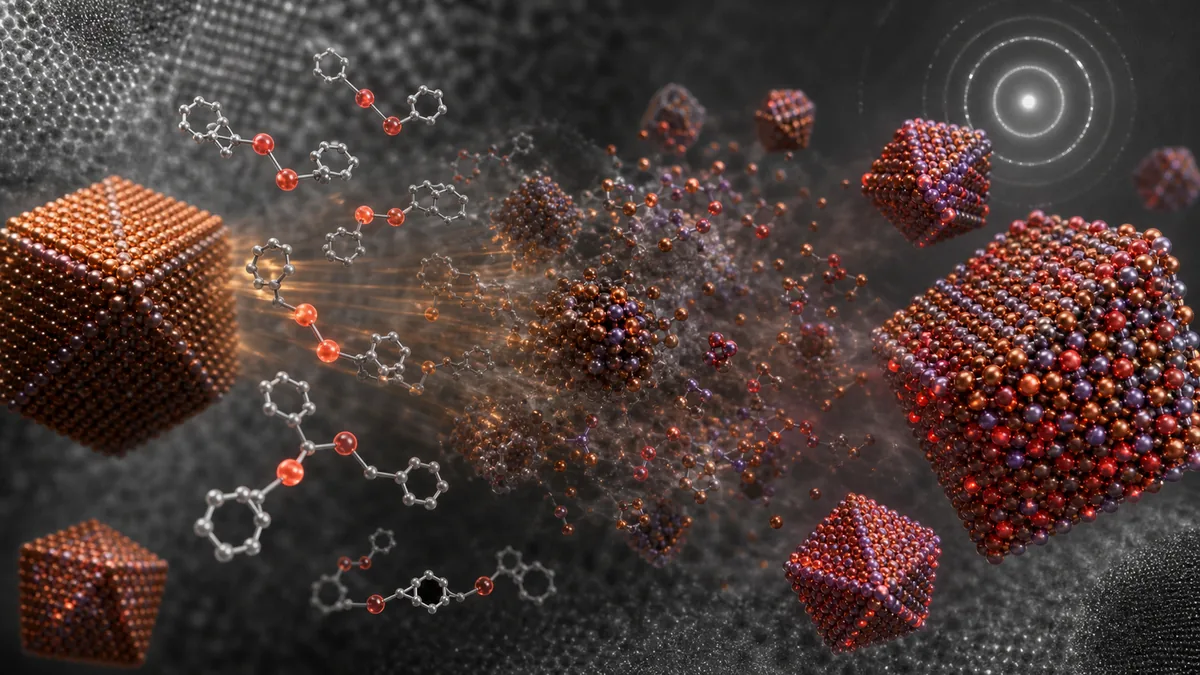
Identifying Disordered Intermediates in the Reaction of Cu 3- x P and Dibenzyl Diselenide to form Cu 3 PSe 4 Nanoparticles.
| Source: Journal of the American Chemical Society

Developing a detailed understanding of ternary nanoparticle (TNP) formation is essential for their optimized rational synthesis and development of synthetic routes for new TNPs. Herein, we explore the reaction of Cu 3- x P and dibenzyl diselenide (Bn 2 Se 2 ) to form colloidal Cu 3 PSe 4 TNPs. Temperature-resolved X-ray scattering (XRD and PDF), electron microscopy (TEM and STEM), and spectroscopy (EDS, EELS, XPS, and MAS NMR) reveal that Cu 3- x P reacts by surface coordination of Se leading to

Developing a detailed understanding of ternary nanoparticle (TNP) formation is essential for their optimized rational synthesis and development of synthetic routes for new TNPs. Herein, we explore the reaction of Cu 3- x P and dibenzyl diselenide (Bn 2 Se 2 ) to form colloidal Cu 3 PSe 4 TNPs. Temperature-resolved X-ray scattering (XRD and PDF), electron microscopy (TEM and STEM), and spectroscopy (EDS, EELS, XPS, and MAS NMR) reveal that Cu 3- x P reacts by surface coordination of Se leading to fragmentation followed by rearrangement to Cu-Se binary phases, during which all obvious crystalline P-containing phases disappear via XRD. However, partially oxidized P in solid phases was observed using STEM-EDS and XPS, in which P is found to preform P-Se bonds prior to Cu 3 PSe 4 formation. Using a combination of 31 P MAS NMR and PDF analysis obtained from synchrotron total scattering data, P-Se bonds in [PSe 4 ] 3- tetrahedral building blocks were identified within intermediate Cu-Se phases containing P cation substitution (P Cu ), denoted (Cu,P)-Se, that assemble into Cu 3 PSe 4 . We hypothesize that these intermediate compounds with their substoichiometric, vacancy-rich structures and significant Cu disorder are important for accessing Cu 3 PSe 4 ─offering a new insight into complex TNP syntheses. We summarize our findings by writing plausible pseudoelementary steps (PESteps) in which the Cu 3- x P precursor converts to smaller fragments of Cu-Se phases containing P en route to the final Cu 3 PSe 4 product. Additional interesting aspects of this system include the use of Bn 2 Se 2 as a readily monitorable probe for the reaction and the Se-P bond formation that facilitates Cu-P bond cleavage in an overall 8-electron redox reaction involving P 3- and 4 Se 0 . The results obtained lay the groundwork for future mechanistic investigations, notably kinetics studies working from the PESteps aimed ultimately at the rational design and synthesis of complex ternary pnictogen chalcogenide nanoparticles.

Read the original source →

Related Stories

Physical/Tech

Multiband condensate of magnons in two dimensions.

Wavelike bosonic particles can accumulate in a single mode characterized by a particular wavelength, and such condensates are at the heart of phenomena such as superconductivity and superfluidity where usually a single complex number describes their state. If there are several flavors of excitations or particles, a vector containing several complex numbers can characterize multicomponent condensation, thus opening new possibilities for textures, dynamics, and devices. Thus far, multicomponent co

Continue reading
Physical/Tech

Indirect reciprocity with dual private assessment.

People often cooperate out of concern for their reputation. The corresponding theory of indirect reciprocity predicts that such cooperation can only evolve if people's opinions of each other are sufficiently correlated. This correlation, however, can be difficult to achieve when individuals form their opinions independently from one another, as in private assessment models. In that case, errors can generate disagreements that propagate throughout a population. Here, we identify a simple mechanis

Continue reading
Physical/Tech

A genetic program for rapid initiation of axillary meristems at the onset of flowering.

Shoot branching patterns and their diversity arise from variable activities of axillary meristems (AMs). A common feature of flowering plants is delayed AM initiation and growth during the vegetative phase, followed by a sudden and rapid acceleration of apical AM initiation during the reproductive phase. The mechanisms underlying this pronounced developmental shift are poorly understood. During tomato floral transition, the primary shoot meristem (PSM) terminates in a flower after producing two

Continue reading
Physical/Tech

David Botstein: A pioneering geneticist and educator 1942-2026.

David Botstein, who died on February 27, 2026, was a towering figure in the field of modern molecular genetics. His research career was largely focused on the development of methods to better understand biological systems, beginning with his early work on Salmonella phage P22 and yeast, where he exploited the use of conditional lethal mutations as suppressors to identify genes with common functions and to order them in a pathway. He is best remembered for developing restriction fragment length p

Continue reading
Physical/Tech

Ultra-narrowband organic room-temperature phosphorescence achieved by boosting low-frequency vibronic coupling.

We pioneered a strategy based on low-frequency vibronic coupling to design narrowband room-temperature phosphorescent (RTP) materials. Here we select coronene derivative (CoDe) system and report that attaching aroyl group to the coronene core disrupts its intrinsic symmetry and introduces abundant low-frequency vibrational modes, thereby affording efficient room-temperature phosphorescence with a full width at half maximum (FWHM) of approximately 25 nm or narrower. In CoDe systems functionalized

Continue reading