High-efficiency, long-lived lead-free perovskite light-emitting diodes.
Tin halide perovskite light-emitting diodes (PeLEDs) offer promise due to their solution processability and low toxicity, yet low efficiency and poor stability hinder practical use. We found that electroluminescence failure in CsSnI 3 is primarily driven by excessive hole injection-triggered electrochemical Sn 2+ oxidation and an irreversible phase transition to Cs 2 SnI 6 . Through a dual-side optimization strategy combining formamidine doping with triphenylphosphine oxide modification to stabi
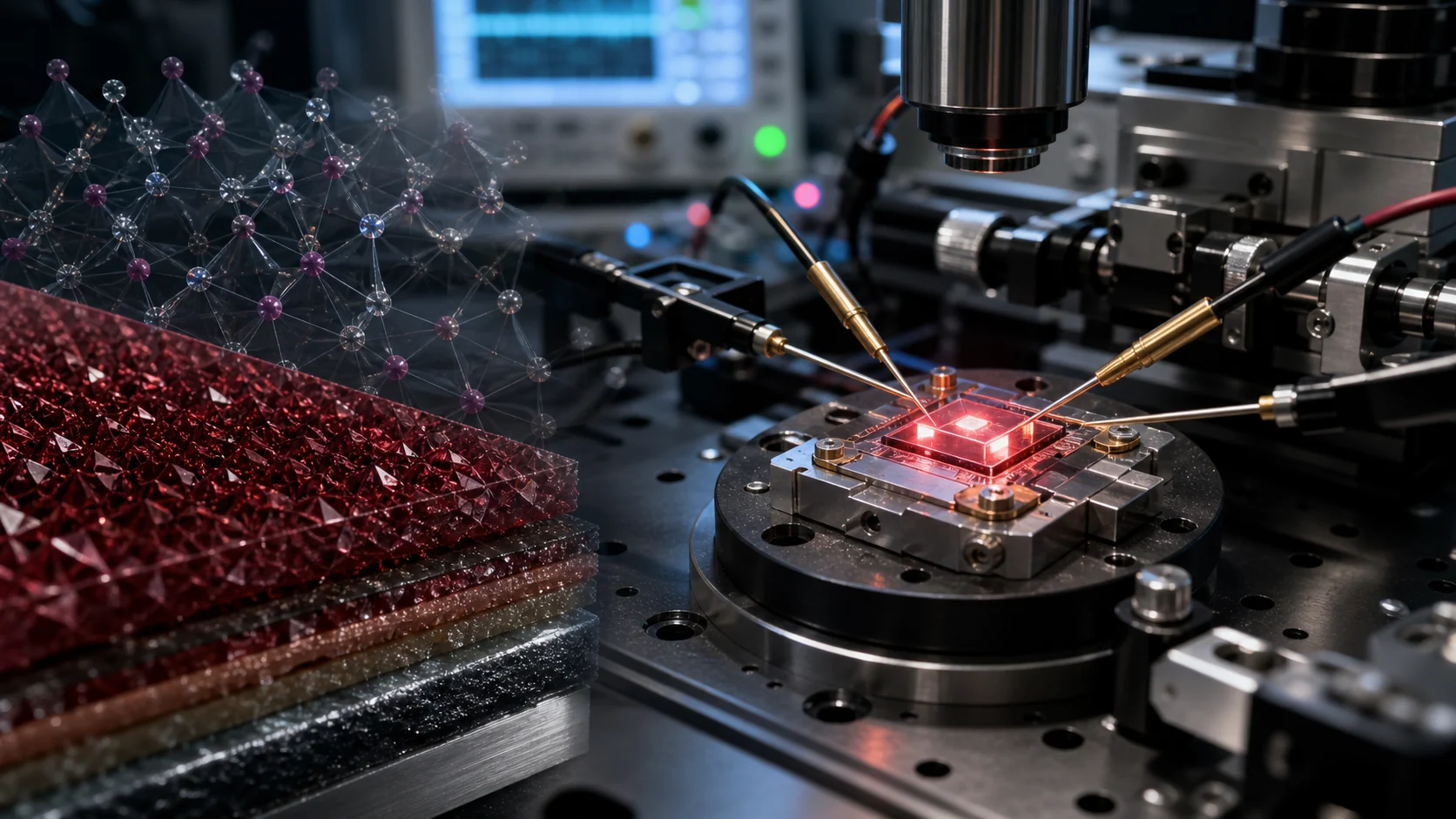
Tin halide perovskite light-emitting diodes (PeLEDs) offer promise due to their solution processability and low toxicity, yet low efficiency and poor stability hinder practical use. We found that electroluminescence failure in CsSnI 3 is primarily driven by excessive hole injection-triggered electrochemical Sn 2+ oxidation and an irreversible phase transition to Cs 2 SnI 6 . Through a dual-side optimization strategy combining formamidine doping with triphenylphosphine oxide modification to stabilize the perovskite lattice, suppress nonradiative recombination, and balance carrier transport, we demonstrate highly efficient near-infrared PeLEDs. These lead-free devices achieve a peak external quantum efficiency of 21.2% at 963 nanometers and a maximum radiance of 195.8 watts per steradian per square meter (W sr -1 m -2 ). Notably, the operating half-lifetime reaches 920.5 hours at 7.1 W sr -1 m -2 , providing pathways for high-performance lead-free PeLEDs.