Experience-dependent modulation of extracellular matrix integrity supports perceptual skill learning and memory.
Perceptual learning refines sensory abilities but requires extensive training, limiting its real-world impact. Understanding its neural mechanisms could accelerate skill acquisition. The extracellular matrix (ECM) has been proposed to regulate learning by degrading to enable synaptic plasticity, and reaccumulating over several days to stabilize the changes. However, this time course does not align with the temporal dynamics of many forms of learning, including perceptual learning, which involves
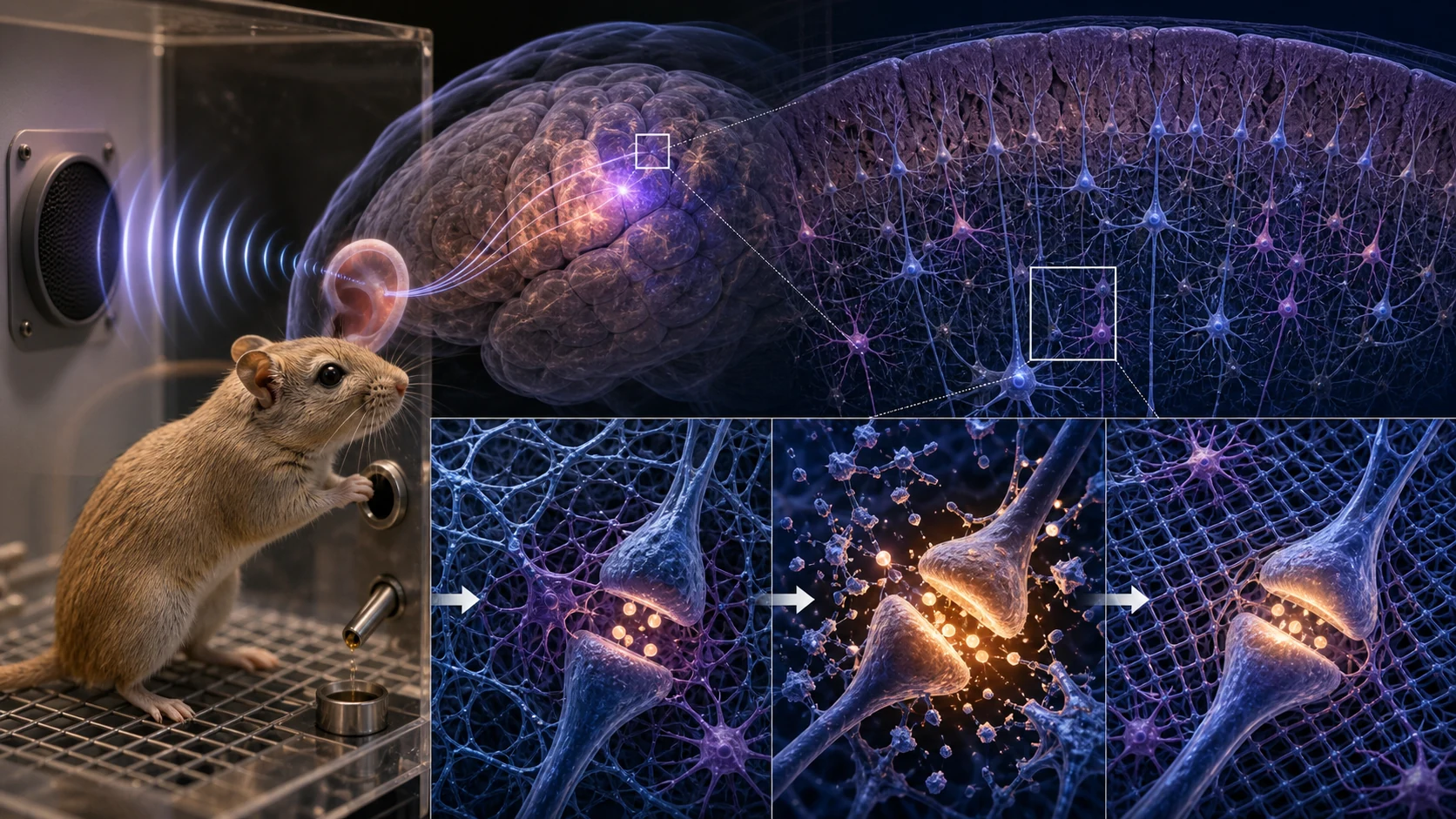
Perceptual learning refines sensory abilities but requires extensive training, limiting its real-world impact. Understanding its neural mechanisms could accelerate skill acquisition. The extracellular matrix (ECM) has been proposed to regulate learning by degrading to enable synaptic plasticity, and reaccumulating over several days to stabilize the changes. However, this time course does not align with the temporal dynamics of many forms of learning, including perceptual learning, which involves daily performance gains that consolidate between training sessions. To resolve this discrepancy, we tracked and manipulated auditory cortical ECM integrity in Mongolian gerbils during perceptual learning. We found that the ECM undergoes rapid training-induced changes, degrading and returning to baseline within 24 h of each session. The magnitude of this cycle diminished with continued training, and the cycle ultimately disappeared as performance plateaued. Enzymatic digestion of the ECM with chondroitinase ABC (chABC) impaired perceptual learning, and postlearning chABC treatment destabilized the acquired skill memory. These findings identify the ECM as a key regulator of perceptual learning and support a framework in which an experience-dependent decrease in ECM degradation constrains further plasticity, preserving learned representations against interference from new input.