Health & Medicine

Engineered T cell-agonist chimera for logic-gated STING activation and augmented cancer immunotherapy.
| Source: Proceedings of the National Academy of Sciences of the United States of America

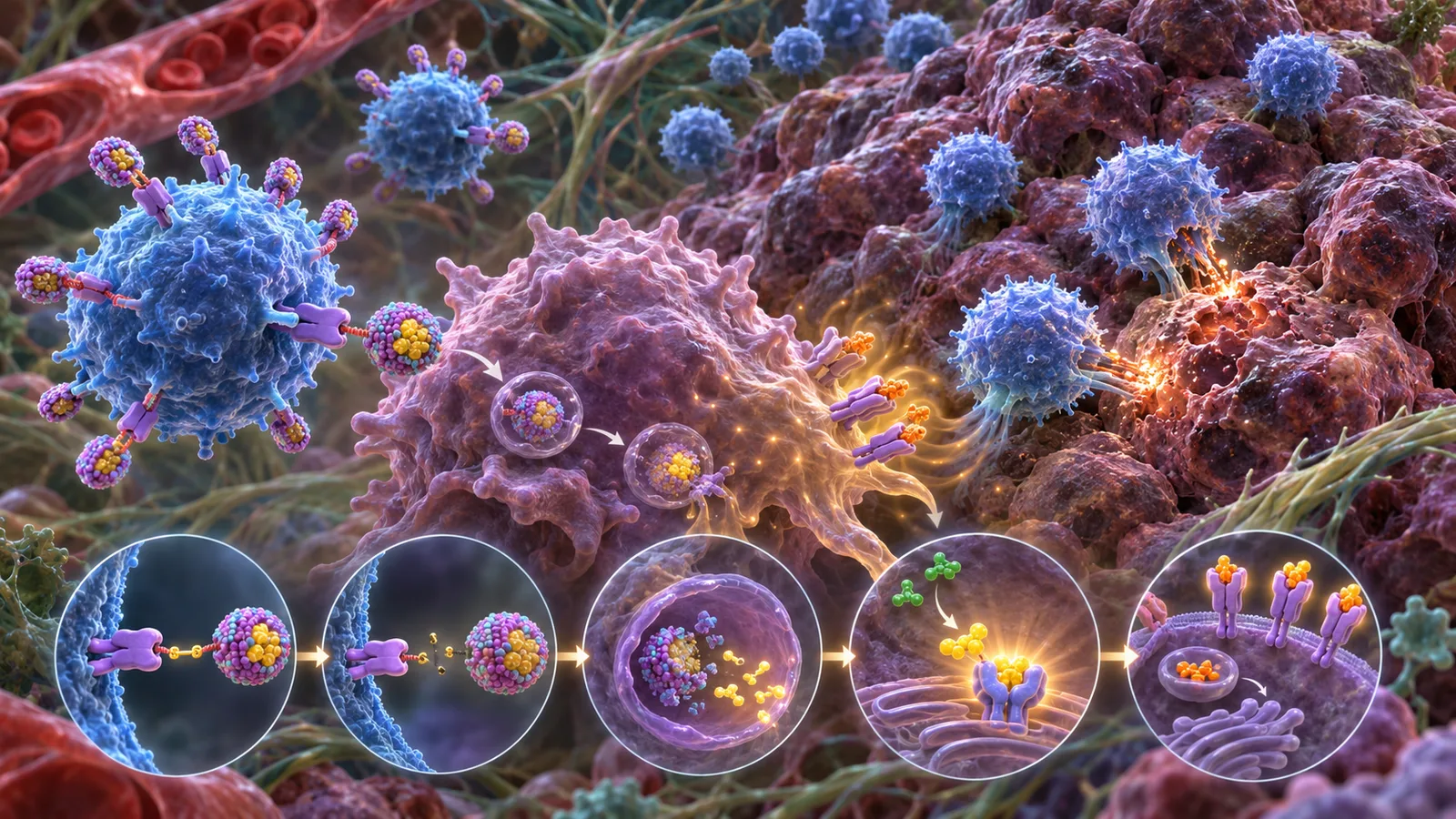
The efficacy of adoptive T cell therapy against solid tumors is markedly hindered by the immunosuppressive microenvironment. Here, we demonstrate that stimulator of interferon genes (STING) activation in tumor-associated macrophages (TAM) enhances the intratumoral infiltration and cytotoxicity of adoptive T cells. We next design a TAM-targeted nanoagonist and engineer a T cell - agonist chimera (SNTC) via covalent surface anchoring, to achieve synchronized biodistribution of STING agonist with a

The efficacy of adoptive T cell therapy against solid tumors is markedly hindered by the immunosuppressive microenvironment. Here, we demonstrate that stimulator of interferon genes (STING) activation in tumor-associated macrophages (TAM) enhances the intratumoral infiltration and cytotoxicity of adoptive T cells. We next design a TAM-targeted nanoagonist and engineer a T cell - agonist chimera (SNTC) via covalent surface anchoring, to achieve synchronized biodistribution of STING agonist with adoptive T cells. The nanoagonist is locally released in tumor tissue in response to the elevated reduction potential on T cell surface, followed by intracellular glutathione-mediated restoration of STING agonist in TAM, thereby enabling AND logic-gated STING activation. SNTC not only reshapes tumor stroma and immunosuppressive tumor microenvironment to augment adoptive T cell function but also enhances the antigen presentation ability of TAM to activate endogenous T cells. SNTC elicits robust antitumor efficacy in melanoma tumor-bearing mice, resulting in over 40% survival beyond 60 d. Moreover, combining tumor-infiltrating T lymphocyte (TIL)-based SNTC with immune checkpoint blockade therapy leads to sustained tumor regression in mouse model of orthotopic pancreatic tumor. Collectively, SNTC holds translational potential to optimize STING activation for adoptive T cell therapy of cancer.

Read the original source →

Related Topics

Related Stories

Health & Medicine

Spontaneous gas film expansion at an oil-water interface.

Spontaneous interfacial separation of oil and water, by inserting a gas film between the two liquids, is thermodynamically unfavorable because the oil-water interface is replaced by oil-gas and water-gas interfaces with a higher combined interfacial energy. Here, we demonstrate that microstructural confinement enables this transition after bubble introduction through the coupling of wetting, capillarity, and gas transport. Spontaneous oil imbibition into a water-submerged micropillar array, toge

Continue reading
Health & Medicine

Senescent CD8 T effector memory cells are functionally impaired, enriched in aging and disease, and a barrier to immunotherapy.

Senescent cells play important roles in various biological processes that promote fitness and health; however, their timely elimination by immune cells is critical to maintain tissue homeostasis and prevent disease. Despite this, senescent cells accumulate systemically with age, suggesting that certain immune cells also become senescent and dysfunctional during aging. In support of this, we previously demonstrated that CD8 T cells, immune cells capable of targeting senescent cells, increasingly

Continue reading
Health & Medicine

An innervated and vascularized HNSCC-on-a-chip model built on defined and tunable engineered extracellular matrices.

Understanding the tumor microenvironment requires experimental platforms that faithfully recapitulate its key components. Here, we present an innervated and vascularized head and neck squamous cell carcinoma (HNSCC)-on-a-chip platform built with fully defined and tunable engineered extracellular matrices (eECMs). In a stepwise increase of complexity, we first cocultured patient-derived HNSCC cells, cancer-associated fibroblasts, and endothelial cells within tailored eECMs, revealing extracellula

Continue reading
Health & Medicine

Septin binding restricts Shigella growth and triggers intracellular tolerance.

Pathogen survival relies on their ability to adapt to changing environments, yet how intracellular bacteria tolerate cell-autonomous immunity remains unclear. Septins assemble into cage-like structures around cytoplasmic Shigella targeted by autophagy, but their antibacterial activity was unknown. Using advanced microscopy and cell-free reconstitution, we show that septins polymerize into circumferentially oriented filaments that inhibit bacterial growth. RNA-sequencing reveals that septin bindi

Continue reading
Health & Medicine

DCAF6 reprograms TGF-β responses through TRIM33 destruction.

TGF-β signaling plays a pivotal role in regulating numerous cellular processes, primarily through the Smad-dependent pathway. Disruptions of the pathway are associated with developmental disorders and life-threatening diseases, such as cancer. It has been reported that TRIM33 inactivates Smad4 signaling and also drives its own signaling responses. However, the mechanism controlling TRIM33 activity has remained unclear. In this study, we identify DCAF6 as a previously unrecognized ubiquitin

Continue reading