Artificial Intelligence

Deep learning of fossil pollen morphology reveals 25,000 y of ecological change in eastern African grasslands.

| Source: Proceedings of the National Academy of Sciences of the United States of America

Grass (Poaceae) pollen is largely overlooked in investigations of grassland evolution because the pollen of most species cannot be differentiated using traditional optical microscopy. However, the combination of superresolution microscopy and deep learning enables the capture and quantification of distinct morphological variation across the pollen of grass species. Using a semisupervised deep-learning strategy, we trained convolutional neural networks (CNNs) on superresolution images of known mo

Grass (Poaceae) pollen is largely overlooked in investigations of grassland evolution because the pollen of most species cannot be differentiated using traditional optical microscopy. However, the combination of superresolution microscopy and deep learning enables the capture and quantification of distinct morphological variation across the pollen of grass species. Using a semisupervised deep-learning strategy, we trained convolutional neural networks (CNNs) on superresolution images of known modern and unlabeled fossil grass pollen. We used learned CNN features to estimate taxonomic diversity and discriminate between C 3 and C 4 grass species-applying Shannon entropy as a measure of morphological variability and a gradient-boosted decision tree as a classifier of photosynthetic type. We validated the method on modern grass pollen assemblages and then applied our trained models to fossil assemblages from a 25,000-y lake-sediment record from Mt. Kenya, correlating shifts in grass diversity through time with changes in atmospheric CO 2 concentration and proxy records of local temperature, precipitation, and fire occurrence. Our data show that the species diversity of these montane grasslands declined substantially between 21,500 and 16,000 years ago, coincident with the most severe regional cooling of the last ice age, and that the fraction of C 4 grasses gradually decreased after the late-glacial-Holocene transition, associated with higher temperatures and decreasing fire activity. Our results demonstrate that CNN features of pollen morphology can advance palynological analysis and enable robust estimation of changes in grass diversity and C 4 grass abundance in ancient grassland ecosystems.

Read the original source →

Related Stories

Artificial Intelligence

Large-scale semidefinite programming with graphics processing units.

Semidefinite programming (SDP) provides a powerful framework in applied mathematics with applications spanning optimization, machine learning, quantum computing, and beyond. However, the computational cost of solving large-scale SDP problems remains a significant practical limitation. We break this long-standing computational bottleneck through a synergistic codesign of low-rank algorithms and graphics processing unit (GPU) architectures, developing accelerated first-order methods that leverage

Continue reading
Artificial Intelligence

Genome stability disrupted by the circRBM39(4,5,6)-RPA2 axis represses breast tumorigenesis.

Genome instability (GI) is a hallmark of cancer. GI is associated with accumulative DNA damage and tumor-specific defects in DNA repair. Multiple antitumor drugs have been developed to promote persistent GI and to drive DNA damage beyond a threshold that tumor cells can survive. However, regulatory roles of circular RNAs (circRNAs) in GI and DNA damage remain elusive. Through circRNA profiling and a small interfering RNA (siRNA)-mediated screen, we have identified a circRNA termed circRBM39(4,5,

Continue reading
Artificial Intelligence

α-aminobutyric acid promotes tumor progression by polarizing macrophages through the ASNS-mTORC2 axis.

Tumor-associated macrophages (TAMs), the most abundant immune cell subset in the tumor microenvironment (TME), exhibit phenotypic plasticity and exert critical roles in tumor progression and antitumor immunity. Targeting TAM polarization has emerged as a promising strategy for cancer immunotherapy, yet the key regulators governing this process remain incompletely defined. Here, we identified α-aminobutyric acid (AABA) as a pro-tumor metabolite that drives M2-like polarization of TAMs to pr

Continue reading
Artificial Intelligence

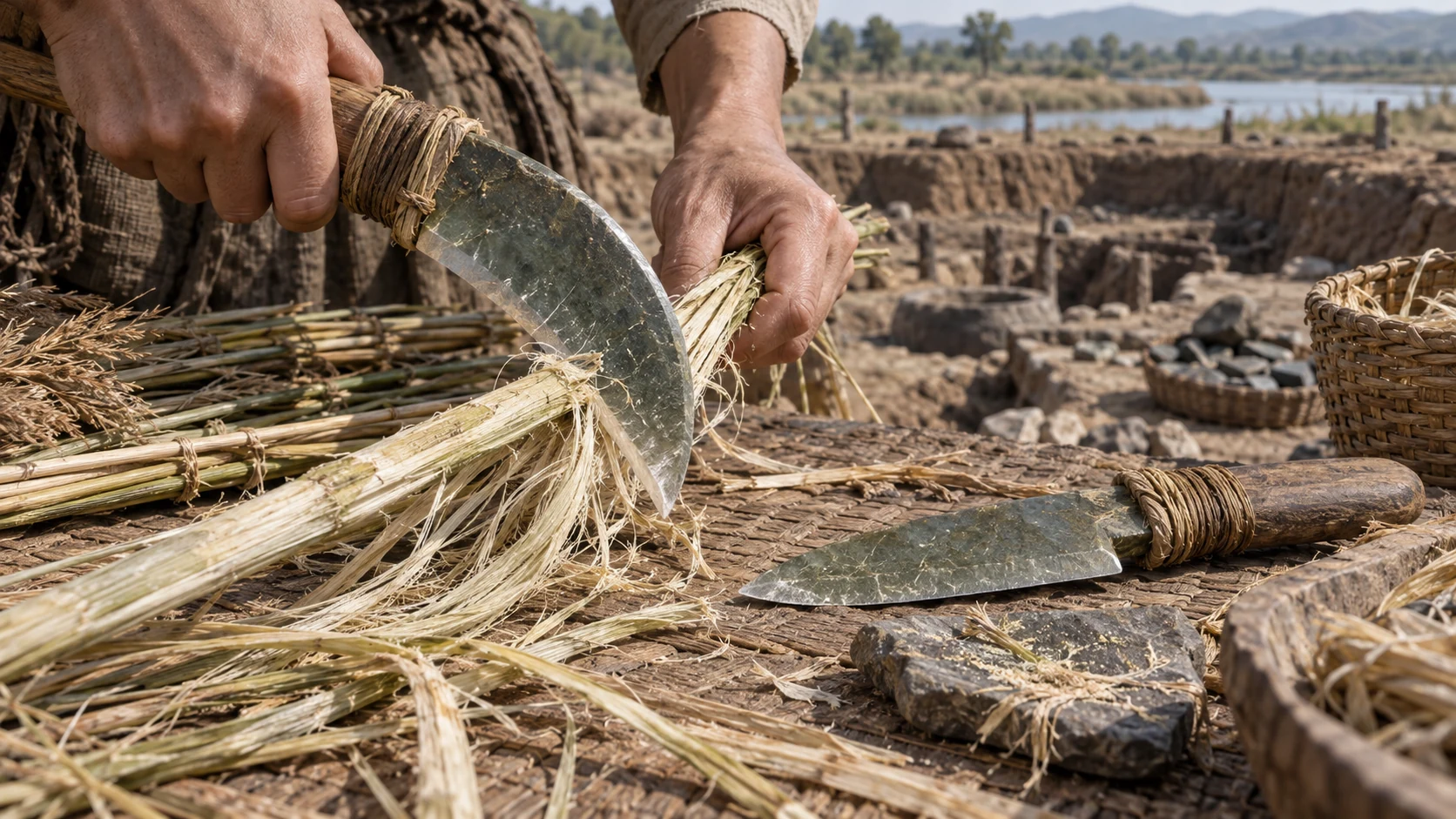
Plant fiber exploitation contributed to the emergence of ground-edged cutting tools in North China.

Ground-edged cutting tools are widely regarded as technological hallmarks of early agriculture in North China, commonly hypothesized to have been developed primarily for cereal harvesting. Yet the functional foundations of this innovation remain insufficiently tested. This study integrates use-wear and microfossil analyses of 140 stone tools from the Peiligang site, with experimental data, to reassess their roles within long-term trajectories of technological change from the Late Paleolithic to

Continue reading
Artificial Intelligence

Transient chaos in the self-organization of dissipative optical solitons.

Transient chaos is a hallmark of complex dynamics in nonlinear systems. Governed by chaotic saddles, it manifests as short-lived yet rich chaotic behavior preceding an abrupt transition to a stable attractor. However, real-time capture and quantitative characterization of such inherently unpredictable and nonrepetitive dynamics remain challenging, obscuring their physical origins. Here, we experimentally demonstrate transient chaos during the self-organization of dissipative optical solitons in

Continue reading