Health & Medicine

De novo pan-rhodamine binders for fluorescence microscopy from mammalian cells to extremophiles.
| Source: Cell

Fluorescent imaging in live cells is a cornerstone of life sciences. While natural fluorescent proteins have been engineered to enhance individual features, no existing tag combines ideal properties into a single system: high brightness, reversible binding, compact size, and stability across diverse conditions. Here, we achieve this through de novo design of rhodamine binders (Rhobin). To harness the broad repertoire of rhodamine fluorophores, we developed a generalizable design strategy for a p

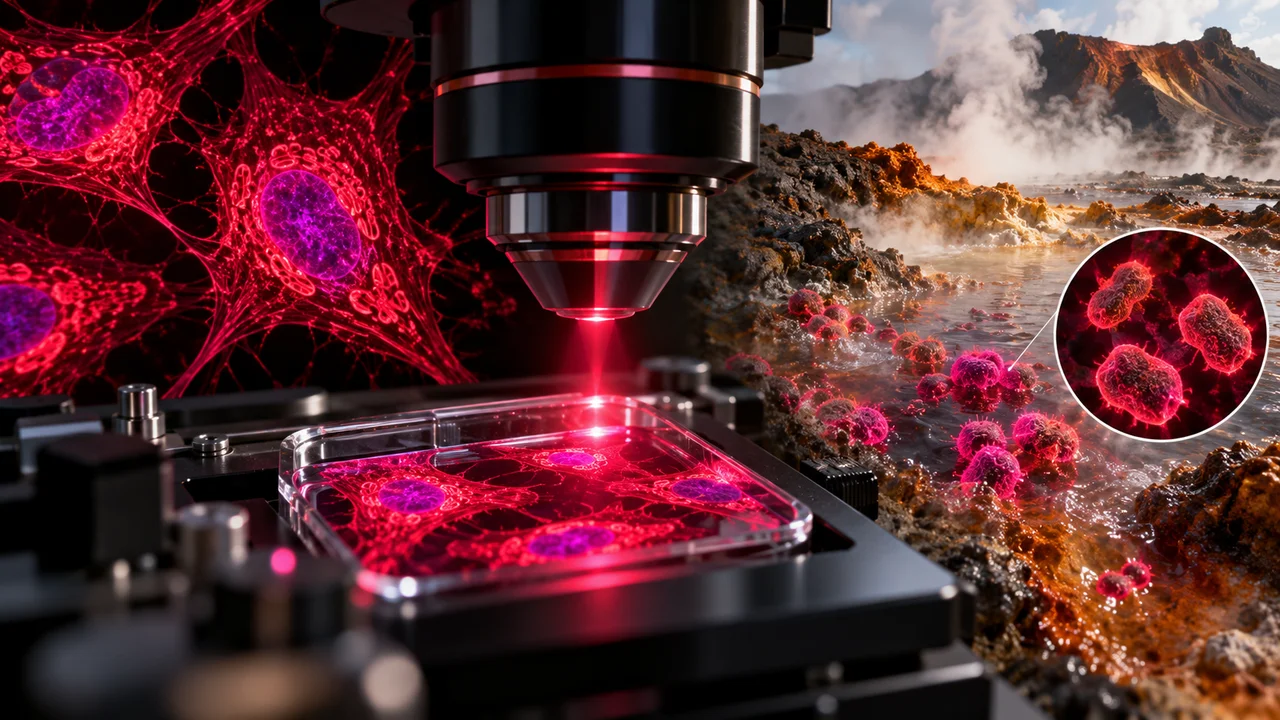
Fluorescent imaging in live cells is a cornerstone of life sciences. While natural fluorescent proteins have been engineered to enhance individual features, no existing tag combines ideal properties into a single system: high brightness, reversible binding, compact size, and stability across diverse conditions. Here, we achieve this through de novo design of rhodamine binders (Rhobin). To harness the broad repertoire of rhodamine fluorophores, we developed a generalizable design strategy for a pan-rhodamine binder compatible with diverse wavelengths and applications. Rhobin enables live- and fixed-cell imaging of various subcellular targets in mammalian cells, showing brightness surpassing existing tags. Its reversible fluorophore binding supports super-resolution stimulated emission depletion (STED) and live-cell single-molecule imaging for extended durations compared with HaloTag. Beyond conventional systems, Rhobin enables live imaging of the extremophile Sulfolobus acidocaldarius at 75°C, previously inaccessible with current tags. Together, these results establish Rhobin as a versatile platform for next-generation imaging and biosensor design.
Read the original source →

Related Topics

Related Stories

Health & Medicine

PLASTID ENVELOPE ION CHANNELS (PEC1/2) link Ca 2+ and jasmonic acid signaling in plant cells.

Plants constantly encounter adverse environmental interactions. One organelle is particularly specialized in stress signaling and phytohormone synthesis: the plastid. Calcium (Ca 2+ ), a key second messenger, is known to intersect with cellular phytohormone signaling networks. While cytosolic Ca 2+ dynamics have been studied extensively, the physiological relevance of stromal Ca 2+ transients and the identity of channels mediating rapid Ca 2+ flux into plastids remain largely unexplored. In this

Continue reading
Health & Medicine

Structural insights into fosfomycin efflux by a streptococcal ABC transporter.

Gram-positive bacteria encode a broad array of ABC transporters that mediate substrate translocation across the cell membrane, with some contributing to their survival under environmental stresses such as antimicrobial exposure. While several of these transporters have been shown to exhibit multidrug efflux activity, the functional roles of many others remain unknown. Here, using an efflux pump screen in the opportunistic human pathogen Streptococcus pneumoniae , we identified a previously uncha

Continue reading
Health & Medicine

Detection of "hidden" mitotic crossovers by long-read DNA sequencing.

Mitotic crossovers in diploid organisms are usually detected by looking for loss of heterozygosity (LOH) for a marker. Assuming the crossover occurs between two duplicated chromatids, a single reciprocal crossover will result in two recombinant chromatids and two nonrecombinant chromatids. LOH will only be observed when a recombinant chromatid cosegregates with a nonrecombinant chromatid. Cells containing both recombinant chromosomes will not result in LOH. Below, we use long-range DNA sequencin

Continue reading
Health & Medicine

Amino acid homeostasis by CORVET/HOPS: A metabolic and stress resilience checkpoint for T cells.

Amino acid sufficiency is critical for T cell metabolic reprogramming, yet how T cells maintain amino acid homeostasis remains poorly defined. Here, we identify the CORVET and HOPS (CORVET/HOPS) tethering complexes as essential upstream regulators. In activated T cells, they sustain intracellular amino acid levels by promoting macropinocytosis to acquire extracellular nutrients. This function enables dual signaling outcomes: suppression of the integrated stress response (ISR) and activation of m

Continue reading
Health & Medicine

Bright monomeric fluorescent protein elite-niRFP704 for two-channel near-infrared STED nanoscopy.

The near-infrared (NIR) spectral region is attractive for live-cell imaging, due to low autofluorescence and reduced phototoxicity. Some phytochrome-derived fluorescent proteins absorb and emit fluorescence in the NIR, but have short fluorescence lifetimes and relatively low quantum yields, requiring higher laser powers thus limiting their usefulness for live-cell superresolution microscopy. Using the bacterial phytochrome miRFP703 as a template, we screened for variants with longer fluorescence

Continue reading