Climate-driven host ecology as a framework for zoonotic disease risk: Understanding transferability across arenavirus systems.
Mechanistic frameworks linking climate to zoonotic disease risk through host ecology remain rare, limiting transferable insights across systems. We develop a Bayesian framework combining an integral projection model of rodent demography with a compartmental disease model. Applied to capture-mark-recapture data from the Natal multimammate mouse ( Mastomys natalensis ; N = 20,249 captures, 1994-2023) and serological data on the Lassa virus-related Morogoro arenavirus ( N = 7,850 tests, 2010-2017),
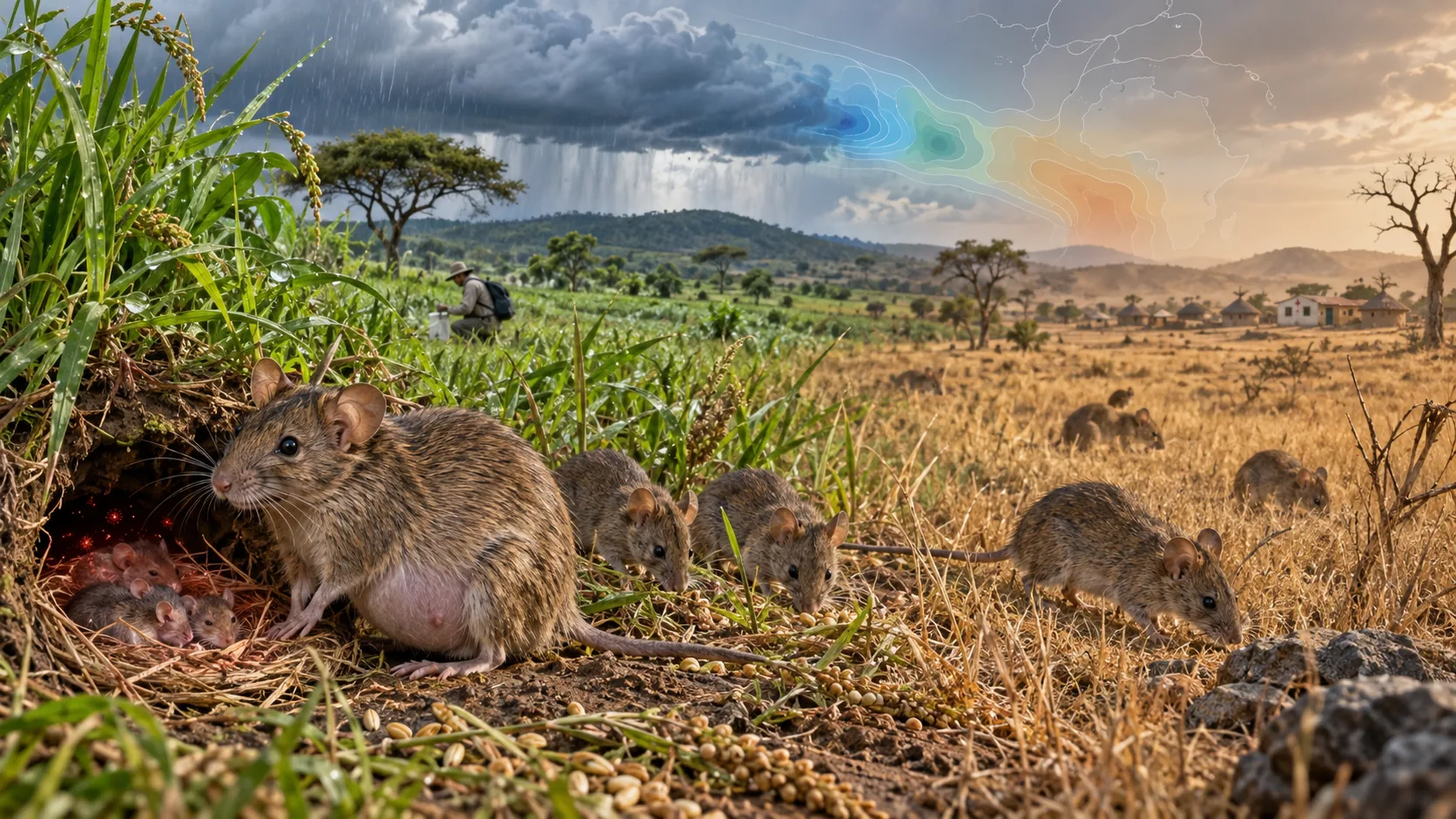
Mechanistic frameworks linking climate to zoonotic disease risk through host ecology remain rare, limiting transferable insights across systems. We develop a Bayesian framework combining an integral projection model of rodent demography with a compartmental disease model. Applied to capture-mark-recapture data from the Natal multimammate mouse ( Mastomys natalensis ; N = 20,249 captures, 1994-2023) and serological data on the Lassa virus-related Morogoro arenavirus ( N = 7,850 tests, 2010-2017), the framework jointly estimates climatic, demographic, and transmission parameters. Rainfall was a dominant driver of rodent recruitment, with seasonal rainfall explaining 52.1% (95% CrI 2.1 to 79.0%) of modeled recruitment variation. In a field-first, we estimate that 79.1% (95% CrI 69.3 to 88.9%) of infected pregnancies result in vertical transmission, identifying this as the primary mechanism maintaining viral persistence between breeding seasons. We assess framework transferability to capture the seasonal dynamics of Lassa fever outbreaks in Nigeria ( N = 6,469 laboratory-confirmed cases, 2018-2025), substituting model climate inputs without refitting any parameters. Predicted peaks in rodent subadult infections preceded observed outbreaks by 0.92 mo (95% CrI -2.76 to 0.92), with 83% of predicted and observed peaks falling within ±28 d [Pr(Δ ≤ 28d) = 0.83], substantially outperforming seasonal rainfall or rodent demography [Pr(Δ ≤ 28d) ≤ 0.11]. Infected adult peaks lagged observed outbreaks by 0.92 mo [Pr(Δ ≤ 28d) = 0.56], suggesting subadults might primarily be responsible for zoonotic hazard. Outbreak magnitude was not reproduced, likely reflecting human behavioral and surveillance factors beyond the model's scope. These results illustrate how mechanistic frameworks grounded in reservoir host ecology can yield transferable insights into zoonotic risk, with potential application across other climate-sensitive host-pathogen systems.