Circumventing thermodynamic limitations in converting carbon dioxide into carbon nanotubes via tandem catalysis
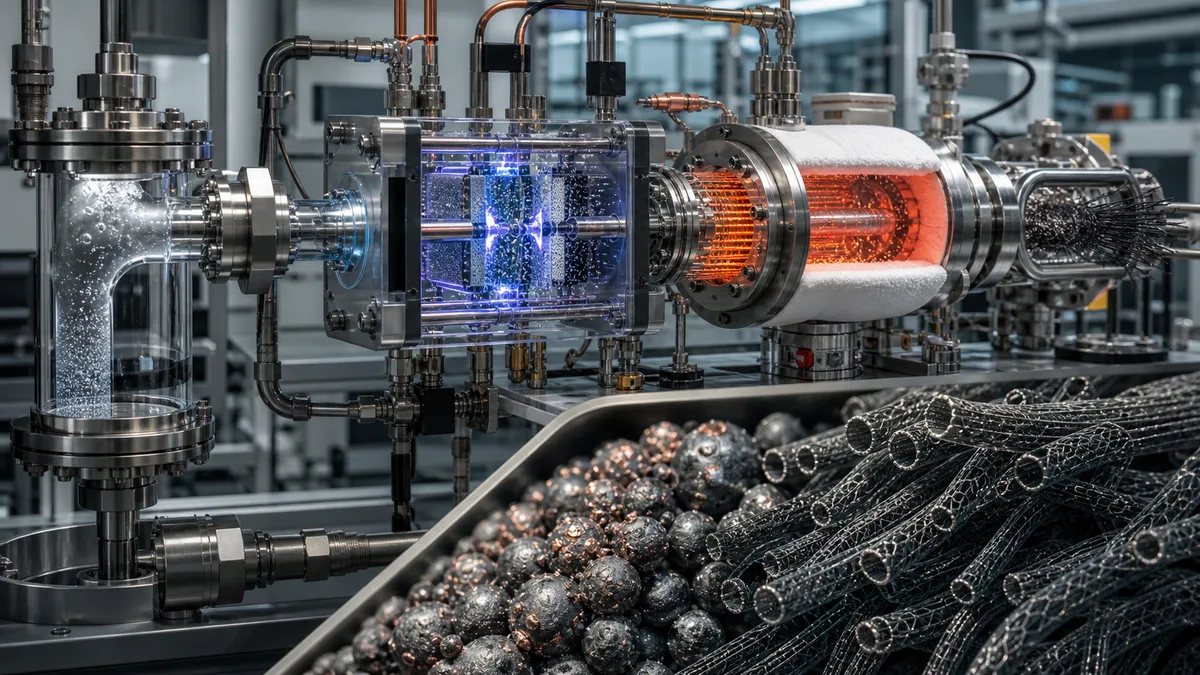
Carbon nanotubes (CNTs) are important materials for electronics and structural composites, but their production still relies on hydrocarbon-based chemical vapor deposition, an energy-intensive and fossil-dependent process, limited by rapid catalyst deactivation. Using CO 2 as a carbon feedstock offers a sustainable route for CNT synthesis, yet direct CO 2 conversion to CNTs is thermodynamically unfavorable and existing CO 2 -to-carbon pathways mainly yield amorphous or weakly graphitized solids.
Carbon nanotubes (CNTs) are important materials for electronics and structural composites, but their production still relies on hydrocarbon-based chemical vapor deposition, an energy-intensive and fossil-dependent process, limited by rapid catalyst deactivation. Using CO 2 as a carbon feedstock offers a sustainable route for CNT synthesis, yet direct CO 2 conversion to CNTs is thermodynamically unfavorable and existing CO 2 -to-carbon pathways mainly yield amorphous or weakly graphitized solids. Here, we demonstrate a tandem electrochemical–thermochemical (EC-TC) strategy that overcomes these limitations. CO 2 is first electrochemically reduced to a tunable mixture of C 2 H 4 and CO, which is directly fed into a thermochemical reactor and converted into CNTs with controllable morphology and high CNT-to-metal mass ratios (~200) over NiFe catalysts at 750 °C. In situ synchrotron-based characterization and density functional theory calculations reveal that CO dissociation and C 2 H 4 decomposition on NiFe alloys cooperatively promote CNT nucleation and sustained growth. This EC-TC strategy establishes a modular route for converting CO 2 into value-added carbon nanomaterials.