Chiral Phosphoric Acid-Catalyzed Asymmetric Hydrogenolysis of C-O Bonds.
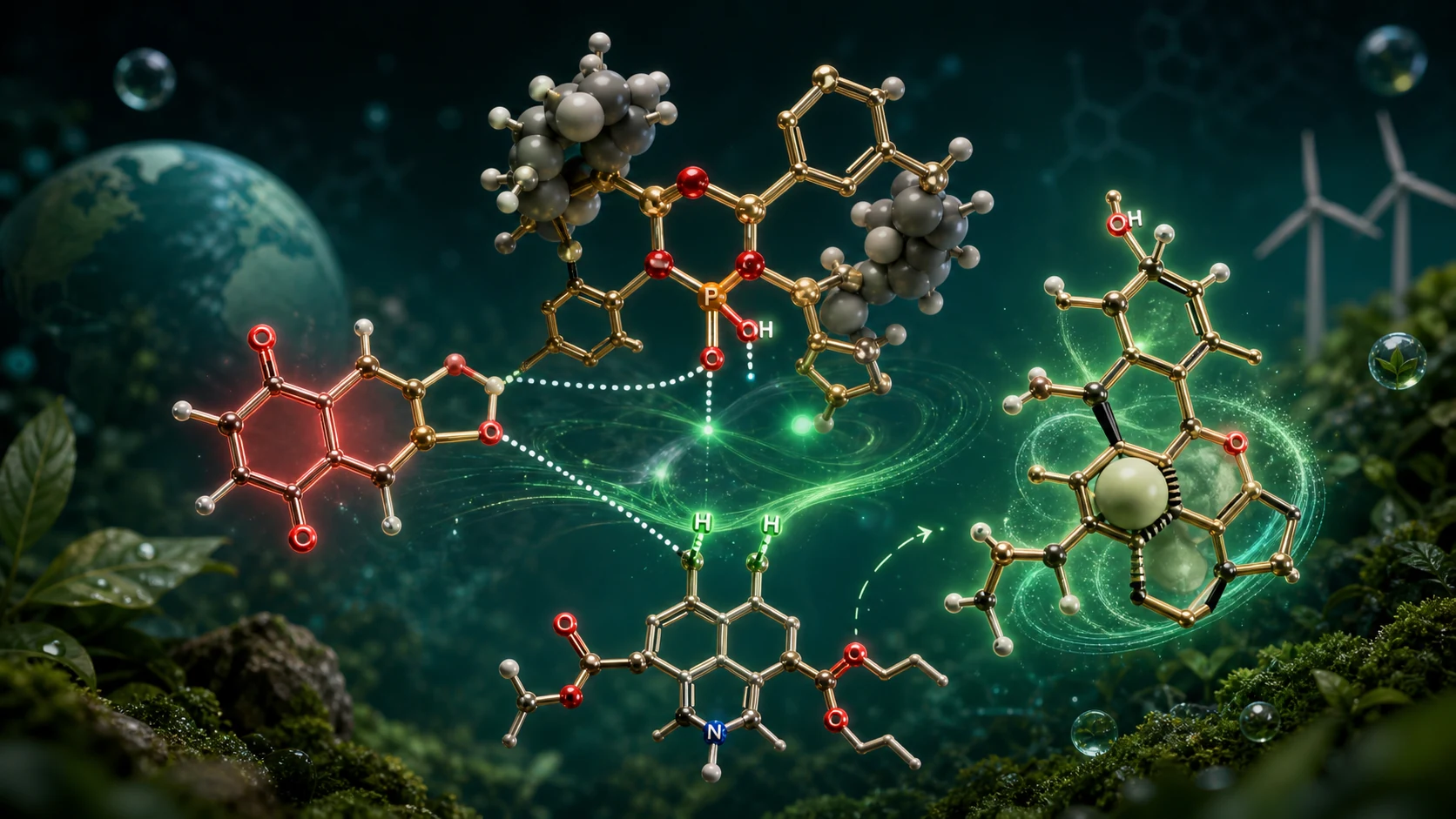
The combination of chiral phosphoric acid with a biomimetic hydrogen source (Hantzsch esters) constitutes a powerful system for asymmetric reduction of unsaturated compounds. In contrast, asymmetric hydrogenolysis of C-O single bonds remains an elusive challenge owing to the high C-O bond energy and the weak intermolecular affinity between the substrate and the catalyst. In this study, we report a hydrogen-bond-activation strategy, driven by aromatization, for asymmetric hydrogenolysis of C-O bo
The combination of chiral phosphoric acid with a biomimetic hydrogen source (Hantzsch esters) constitutes a powerful system for asymmetric reduction of unsaturated compounds. In contrast, asymmetric hydrogenolysis of C-O single bonds remains an elusive challenge owing to the high C-O bond energy and the weak intermolecular affinity between the substrate and the catalyst. In this study, we report a hydrogen-bond-activation strategy, driven by aromatization, for asymmetric hydrogenolysis of C-O bonds using the chiral phosphoric acid/Hantzsch ester system. This protocol enables kinetic resolution of o -quinone monoketals, affording axially chiral compounds and chiral spirocycles with selectivity factors up to 1773. Moreover, this methodology provides an efficient route to axially chiral cannabidiol ( ax CBD) analogs. Preliminary mechanistic experiments and DFT calculations suggested that asymmetric hydrogenolysis proceeded via an enantioselective 1,4-transfer hydrogenation initiation step, followed by an aromatization-driven remote proton transfer and skeletal rearrangement.