Chiral Counteranion-Directed Asymmetric Intramolecular Rhodium-Catalyzed [(3+2+2)] Carbocyclization Reactions with Alkylidenecyclopropanes.
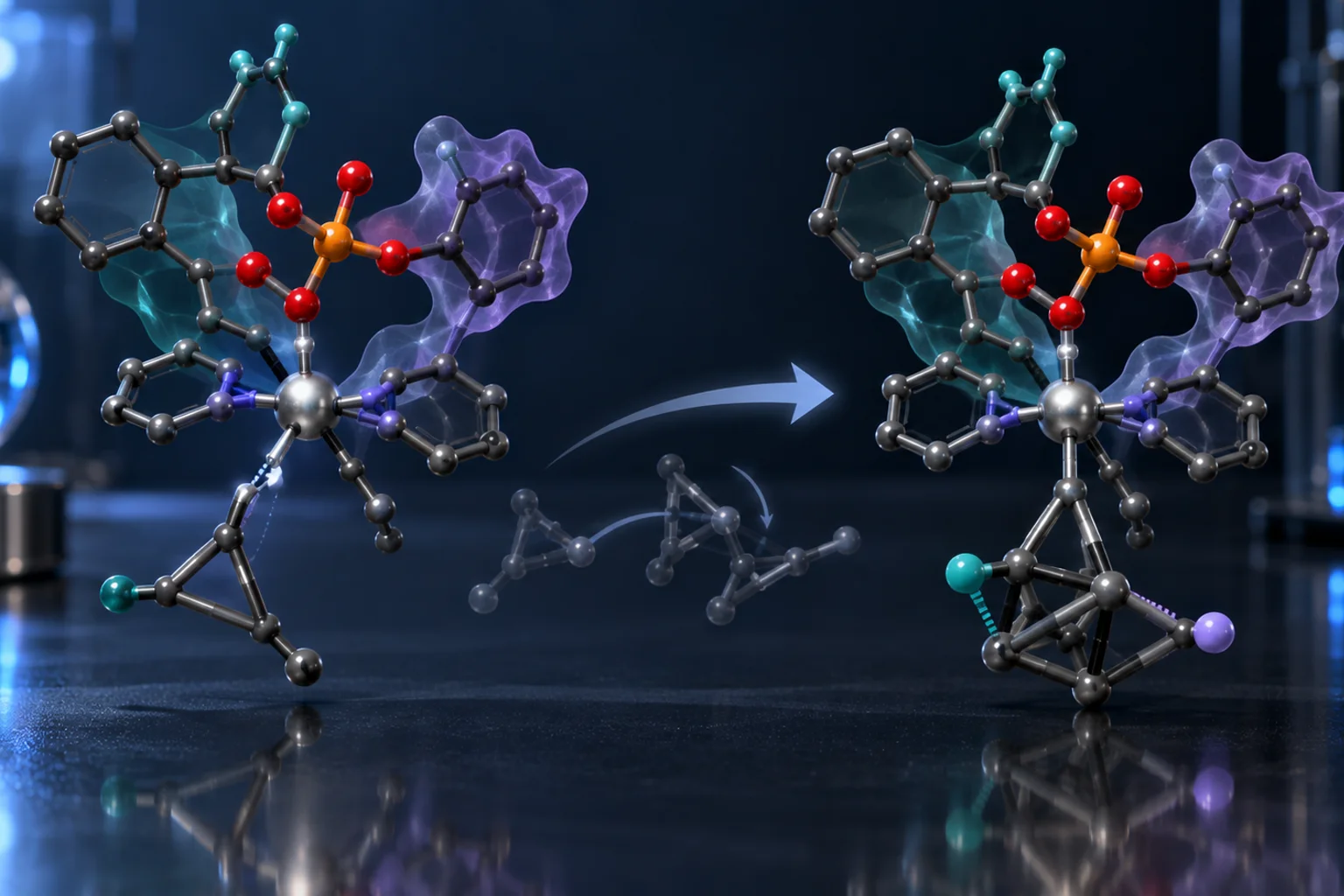
Transition metal-catalyzed higher-order [m+n+o] carbocyclizations of alkylidenecyclopropanes (ACPs) provide atom-economical routes to complex polycyclic frameworks; however, achieving high enantioselectivity in these transformations remains extremely challenging. Herein, we report the first asymmetric intramolecular rhodium-catalyzed [(3+2+2)] carbocyclization of ACPs, enabled by asymmetric counteranion-directed catalysis (ACDC), to afford bridged tricyclic products with high diastereo- and enan
Transition metal-catalyzed higher-order [m+n+o] carbocyclizations of alkylidenecyclopropanes (ACPs) provide atom-economical routes to complex polycyclic frameworks; however, achieving high enantioselectivity in these transformations remains extremely challenging. Herein, we report the first asymmetric intramolecular rhodium-catalyzed [(3+2+2)] carbocyclization of ACPs, enabled by asymmetric counteranion-directed catalysis (ACDC), to afford bridged tricyclic products with high diastereo- and enantioselectivity. Conventional ligand-controlled approaches failed to provide satisfactory reactivity or enantioinduction, whereas generating a chiral phosphate counteranion in situ from a silver phosphate (e.g., Ag-(S)-TRIP) via salt metathesis with a rhodium complex markedly enhanced enantioselectivity. Enantiomeric excesses of up to 93% were achieved using a matched combination of chiral phosphate and phosphoramidite ligands. The ACDC strategy also enables kinetic resolution of 1,5-diene-tethered ACPs in a new rhodium-catalyzed [(3+2+2)] carbocyclization, providing access to previously inaccessible tricyclic scaffolds with excellent stereocontrol. These results constitute rare examples of highly stereoselective rhodium-catalyzed higher-order carbocyclizations of ACPs and demonstrate that chiral counteranion-directed catalysis can enable asymmetric transition metal-catalyzed [m+n+o] cyclizations that remain inaccessible to conventional chiral-ligand control.