Arraying Shape-Persistent Molecular Alkynyl Trap into Highly Porous and Robust Zirconium Metal-Organic Framework for Propyne Capture and Propyne/Propylene Separation.
Adsorptive separation of propyne/propylene (C3H4/C3H6) using porous adsorbents offers a promising route toward energy-efficient production of polymer-grade C3H6. Currently, the prevailing adsorbents are ultramicroporous metal-organic frameworks (MOFs) that feature narrow channels and/or consist of inorganic anion pillars, which often lead to limited C3H4 uptake capacity and high isosteric enthalpy of adsorption. We report herein a highly porous and robust zirconium metal-organic framework, terme
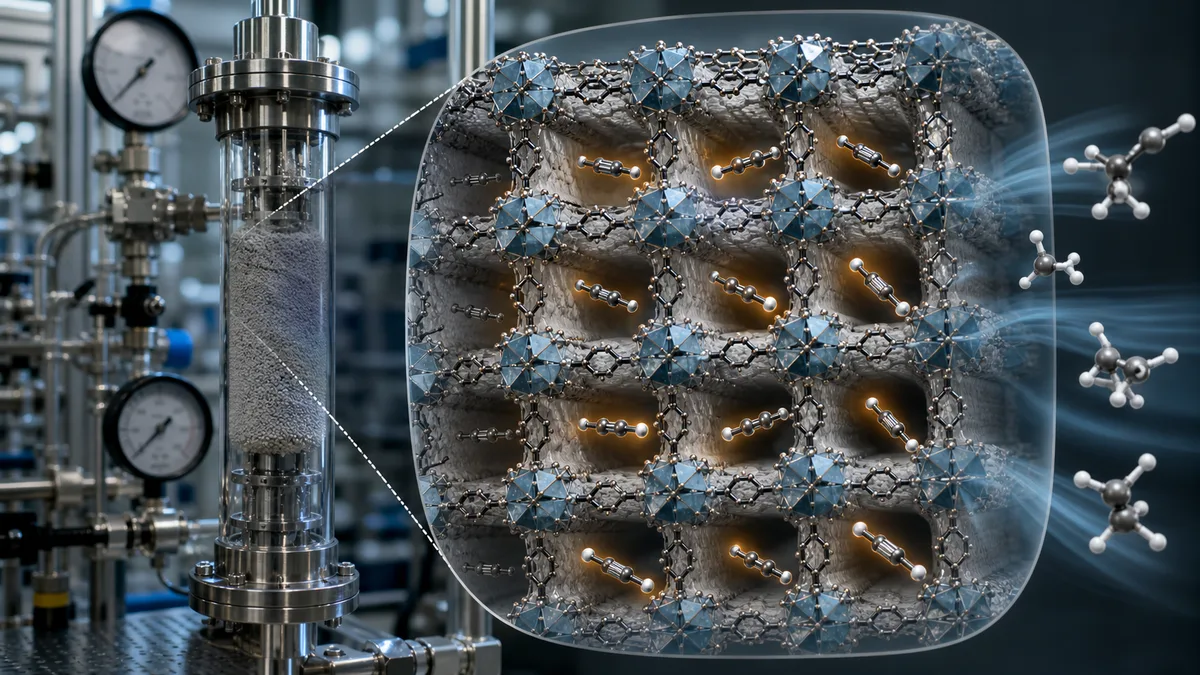
Adsorptive separation of propyne/propylene (C3H4/C3H6) using porous adsorbents offers a promising route toward energy-efficient production of polymer-grade C3H6. Currently, the prevailing adsorbents are ultramicroporous metal-organic frameworks (MOFs) that feature narrow channels and/or consist of inorganic anion pillars, which often lead to limited C3H4 uptake capacity and high isosteric enthalpy of adsorption. We report herein a highly porous and robust zirconium metal-organic framework, termed SJTU-520. This MOF incorporates shape-persistent molecular arrays in three-dimensional space derived from cyclotetrabenzoin, which function as selective sites for the preferential entrapment of C3H4 over C3H6, thus enabling high C3H4 capture capacity, record high C3H4/C3H6 uptake ratio at 1 bar and 298 K, and efficient C3H4/C3H6 separation at ambient conditions. Compared with the cyclotetrabenzoin and tetraacetate cyclotetrabenzoin-based supramolecular organic crystals, SJTU-520 exhibits significantly higher surface area (3650 m2/g versus 42 and 570 m2/g), leading to a C3H4 uptake boost by 6.1-fold and 3.7-fold at 298 K and 1 bar, without any compromise of the C3H4/C3H6 selectivity. The efficient C3H4/C3H6 separation was validated by extensive breakthrough experiments under various conditions with great recyclability and high productivity of polymer-grade C3H6 from a 10/90 C3H4/C3H6 mixture. Computational simulations revealed that the four benzene walls of the cyclotetrabenzoin macrocycle in SJTU-520 formed equidistant π-π interactions with the C≡C triple bond of encapsulated C3H4 molecule. This work illustrates a general and powerful strategy─the reticulation of intrinsically functional organic scaffolds into highly porous frameworks─toward creating bespoke materials with precisely tailored functionalities and enhanced properties.