An Inhalable Hybrid Nitric Oxide Nanogenerator for Lung Adenocarcinoma Treatment via Bioorthogonal-Activated Gas-Immunotherapy.
Nitric oxide (NO) holds promise for circumventing resistance to platinum-based chemotherapy by reprogramming the tumor microenvironment (TME) in lung adenocarcinoma (LUAD). However, their further application is greatly hindered by uncontrolled release kinetics and off-target toxicity. Herein, an inhalable NO nanogenerator (10m@FOMs-Cu) that reprograms the TME via specific NO release is developed by encapsulating a biorthogonal-activated NO-cisplatin prodrug into TME-responsive hybrid micelles, a
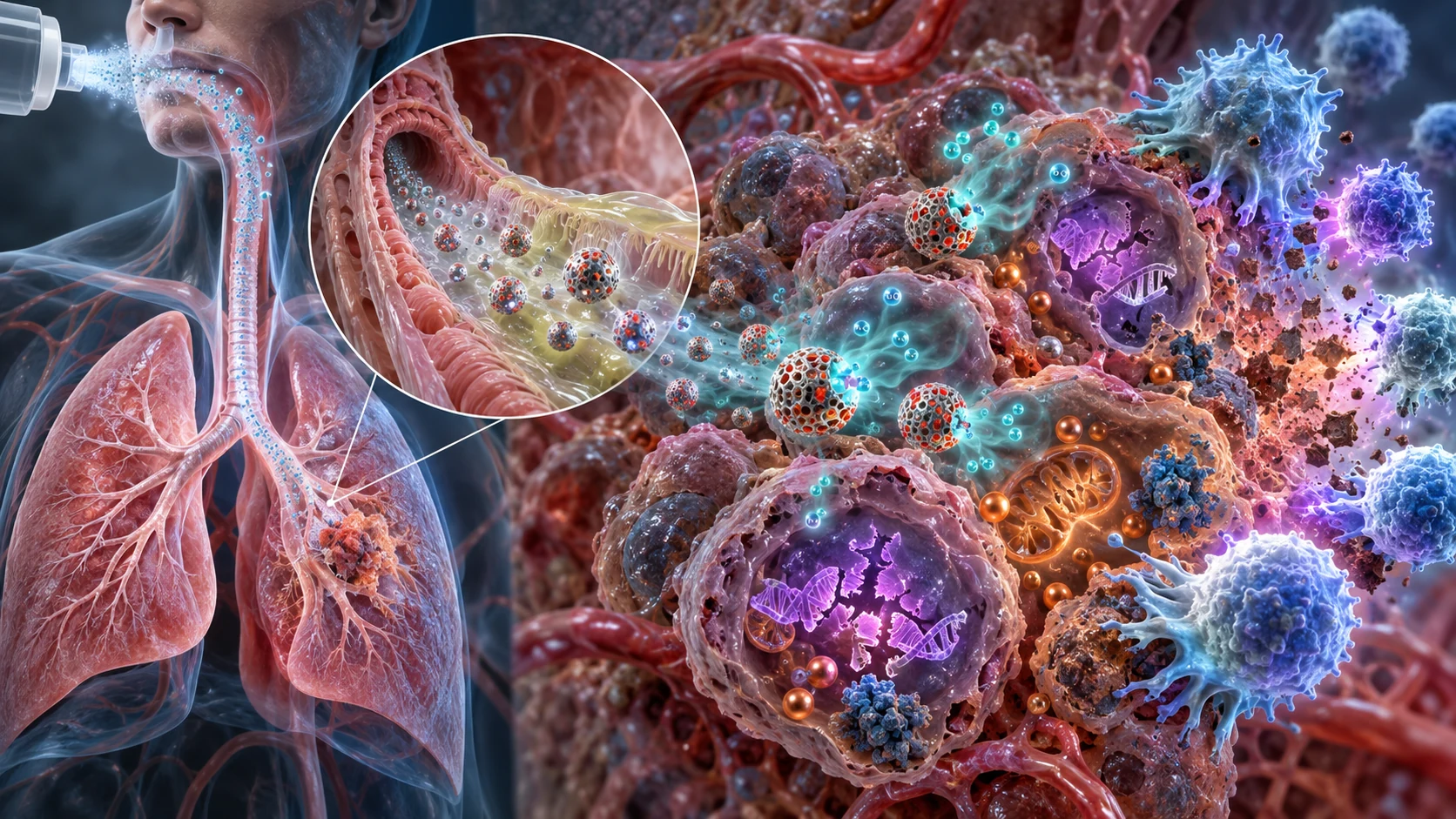
Nitric oxide (NO) holds promise for circumventing resistance to platinum-based chemotherapy by reprogramming the tumor microenvironment (TME) in lung adenocarcinoma (LUAD). However, their further application is greatly hindered by uncontrolled release kinetics and off-target toxicity. Herein, an inhalable NO nanogenerator (10m@FOMs-Cu) that reprograms the TME via specific NO release is developed by encapsulating a biorthogonal-activated NO-cisplatin prodrug into TME-responsive hybrid micelles, allowing for sustained and effective LUAD treatment. The prodrug integrates a Pt-based catalyst with a caged active NO donor within one molecule and is further encapsulated in a disulfide-cross-linked organosilica shell, enabling redox-triggered self-catalytic NO release while minimizing off-target injury to normal tissues. It is verified that nebulized 10m@FOMs-Cu could achieve efficient mucus-extracellular matrix dual barrier penetration to reach the TME, thereby ensuring sustained NO release to potentiate Pt(II)-mediated nuclear damage and Cu(II)/Cu(I)-mediated cuproptosis. This sensitization process reprograms the TME by inducing metabolism-DNA stress feedback, triggering a systemic and durable immune response that confers efficient tumor suppression in orthotopic and rechallenged LUAD. It demonstrates that 10m@FOMs-Cu could serve as a potent and safe nebulized nanomedicine for LUAD therapy and provides insights into designing gas-based nanotherapeutics.